Here are a pair of herons. On the left, an immature Green Heron; on the right a Great Blue Heron, striking an interesting pose (more on that below).

We can tell that the Green Heron is immature, because of the streaked breast. As they grow older, the breast becomes a solid rufous color.
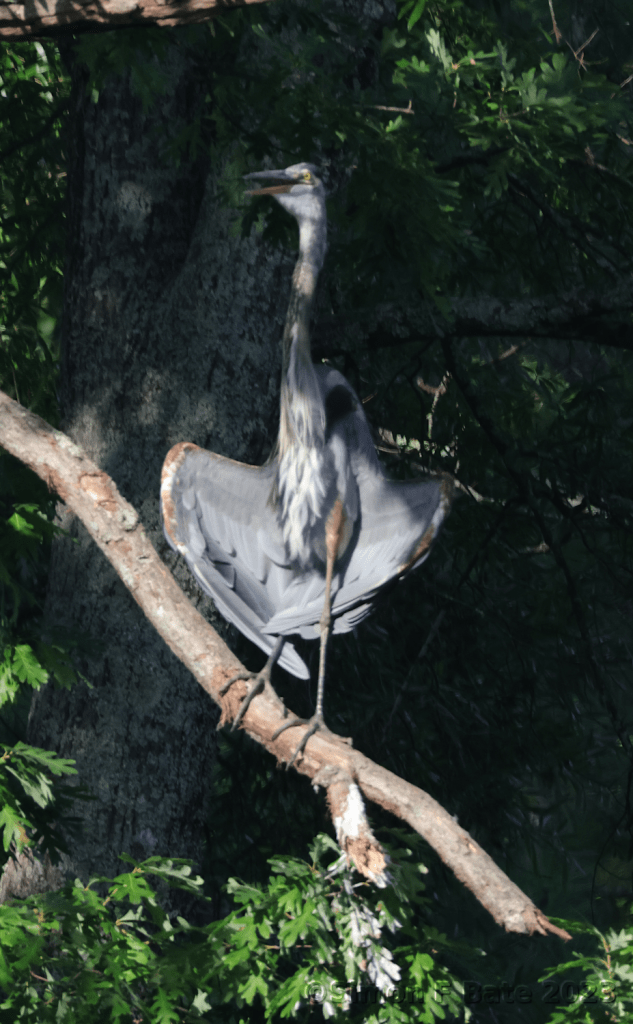
Don’t ever worry if you see a Great Blue Heron standing in the pond on a freezing winter morning; they can keep quite warm all on their own. However, keeping cool in the summer is another matter. In very hot weather, the heron will set its wings out away from its body in a bowl-like configuration, so they can catch cooling breezes. I’m not sure what advantage this arrangement has over simply holding its wings out. Could be that it takes less energy. Also, it seems that there’s less chance of a strong gust blowing the bird around than if it had its wings fully out.
If you notice, the heron’s bill is open. If I had taken a video, you would see that it is vibrating or fluttering its throat (gular) tissues. This “gular fluttering” circulates air around the moist tissues in their upper throat, which cools the bird by evaporation. It’s a bird’s equivalent of dogs panting. Not all birds do it, but it is known in herons, cormorants, crows, and nightjars (whip-poor-wills and their allies).
 Seagroves Walks
Awesome!!
LikeLiked by 1 person
Love this pair. Especially the young green one.
LikeLiked by 1 person