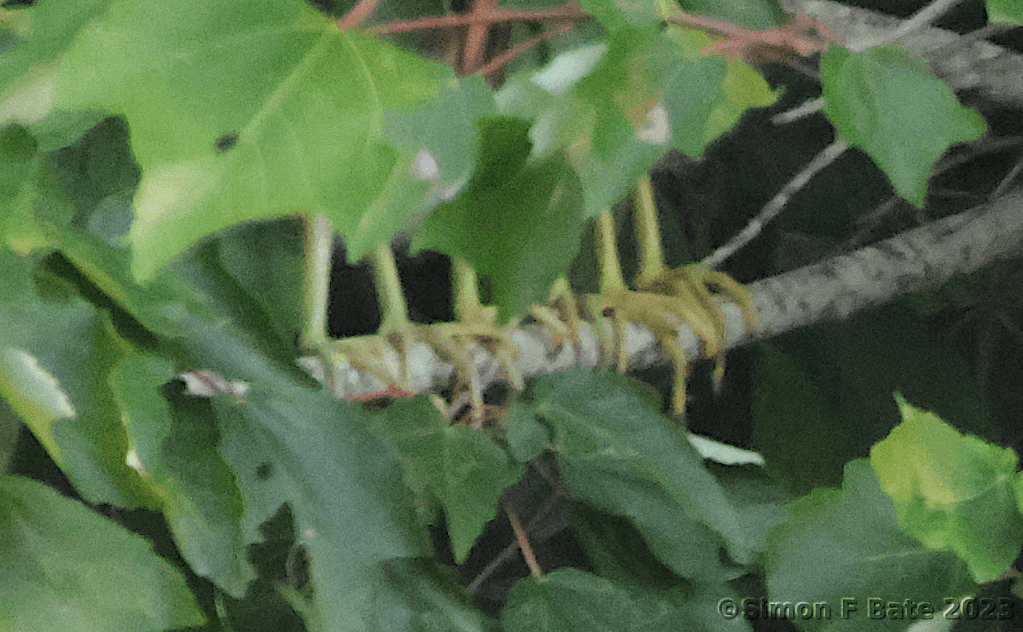
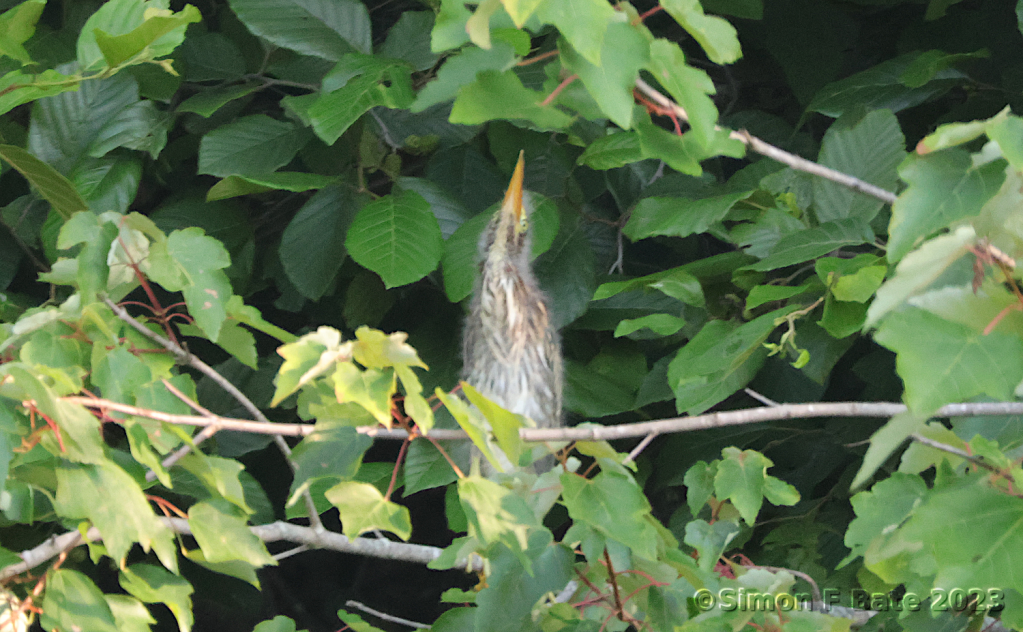
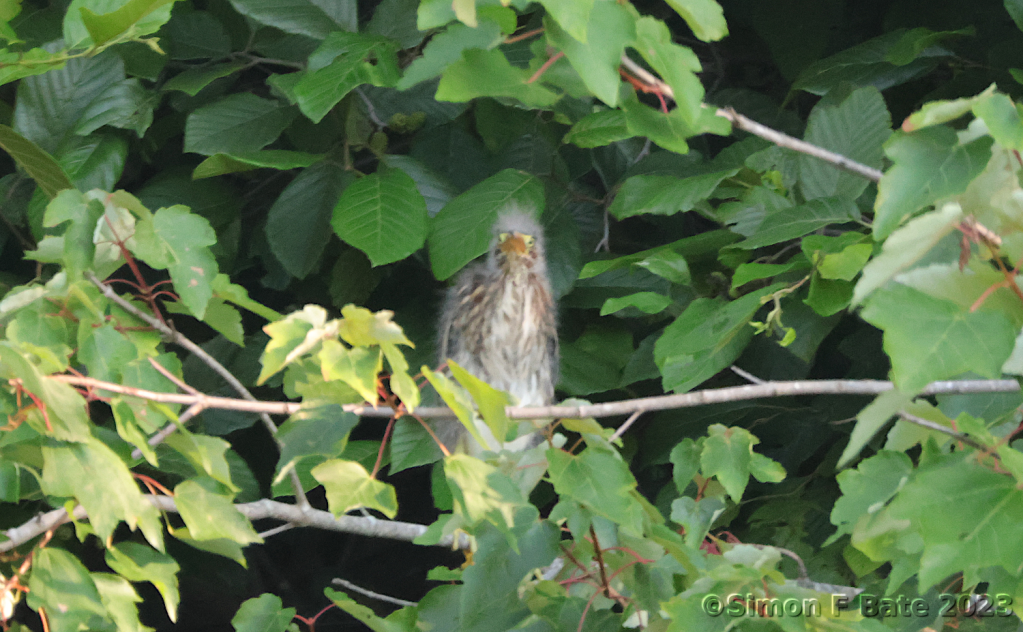
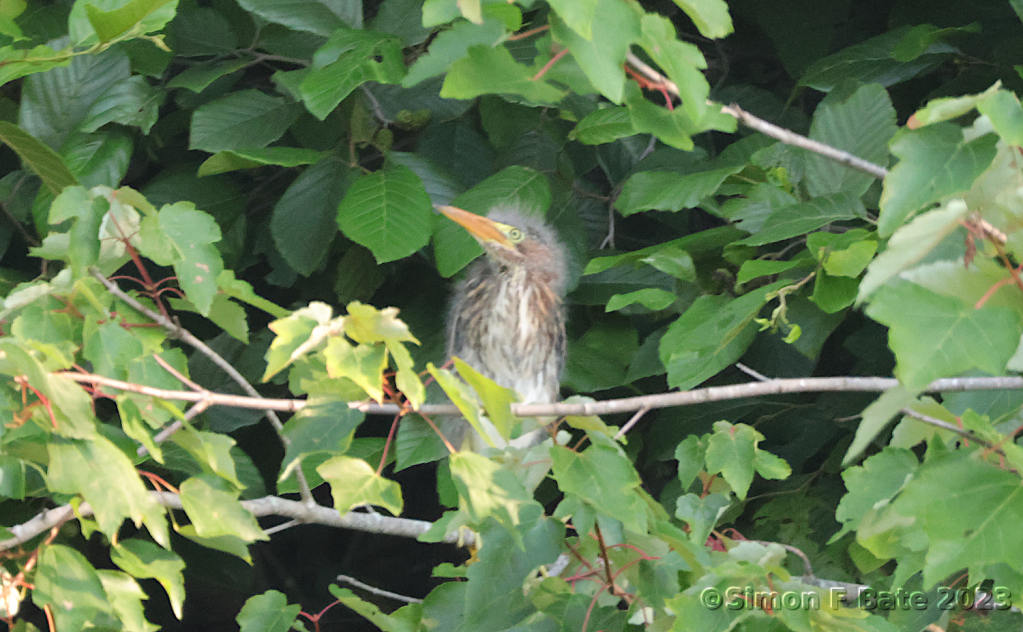
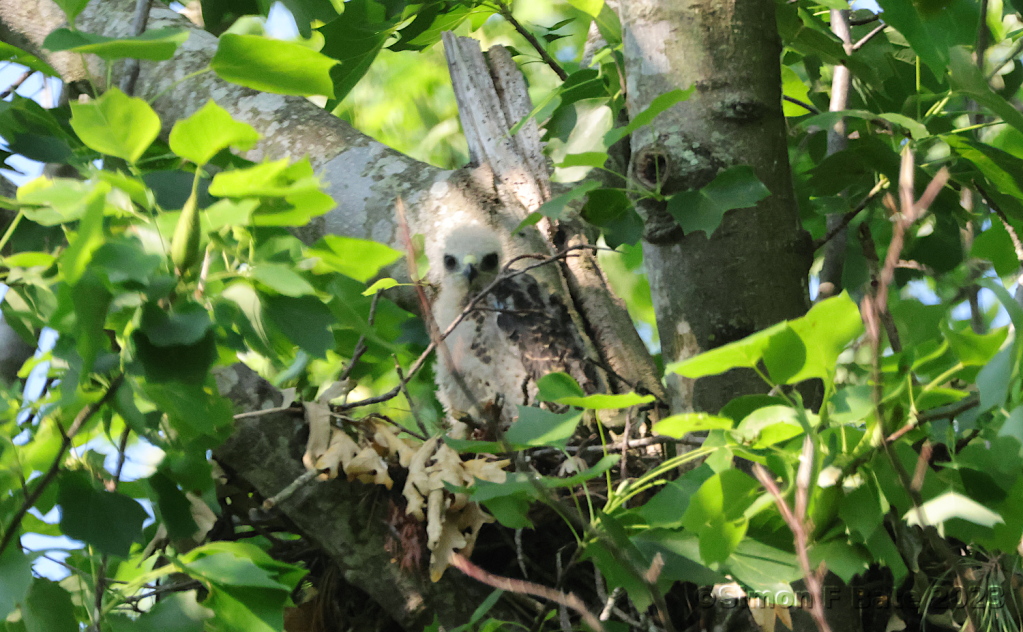
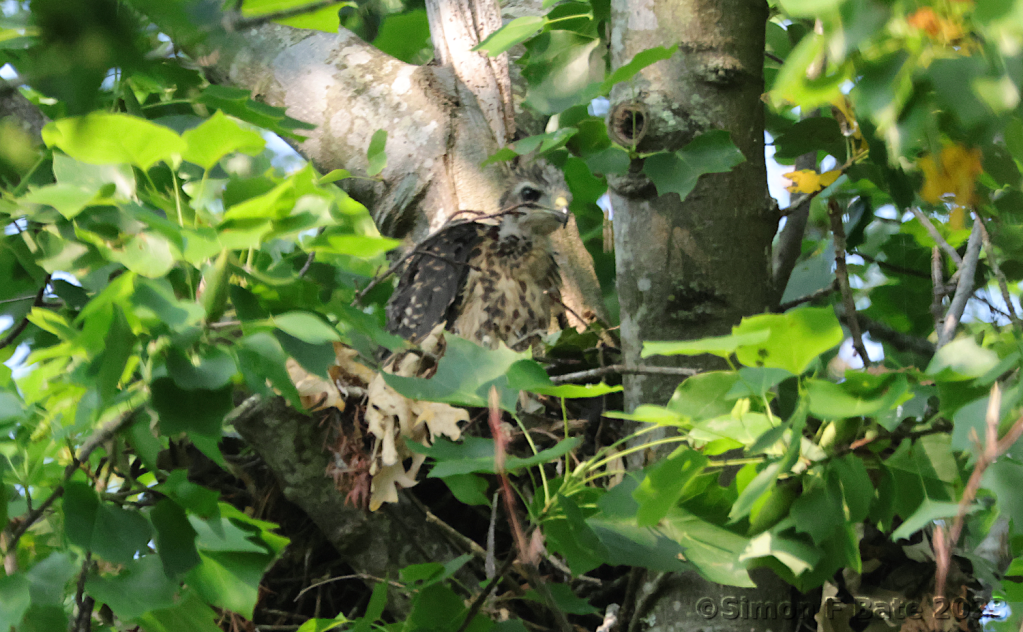
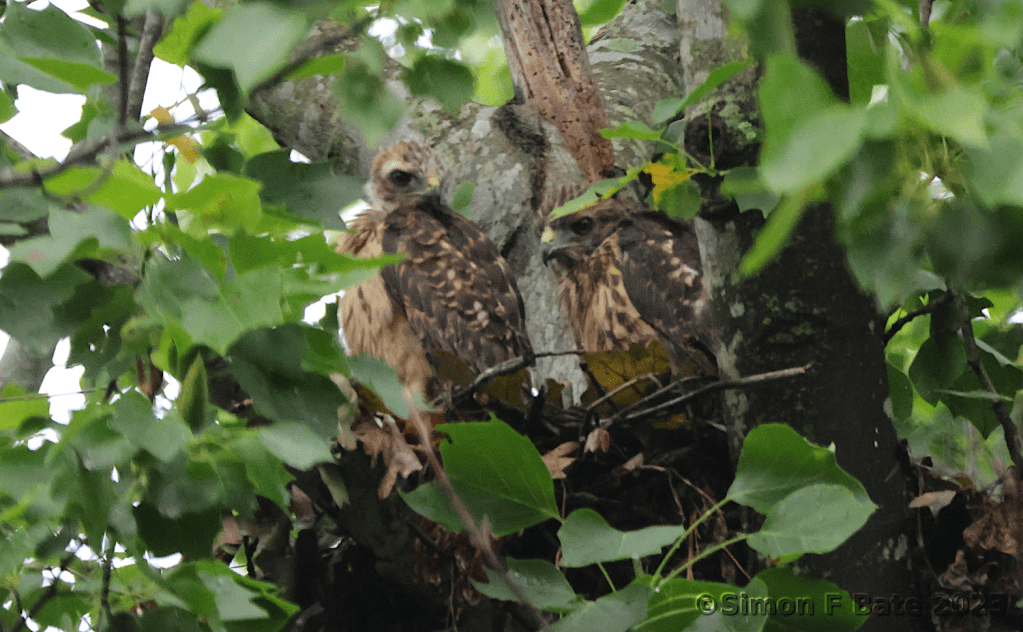
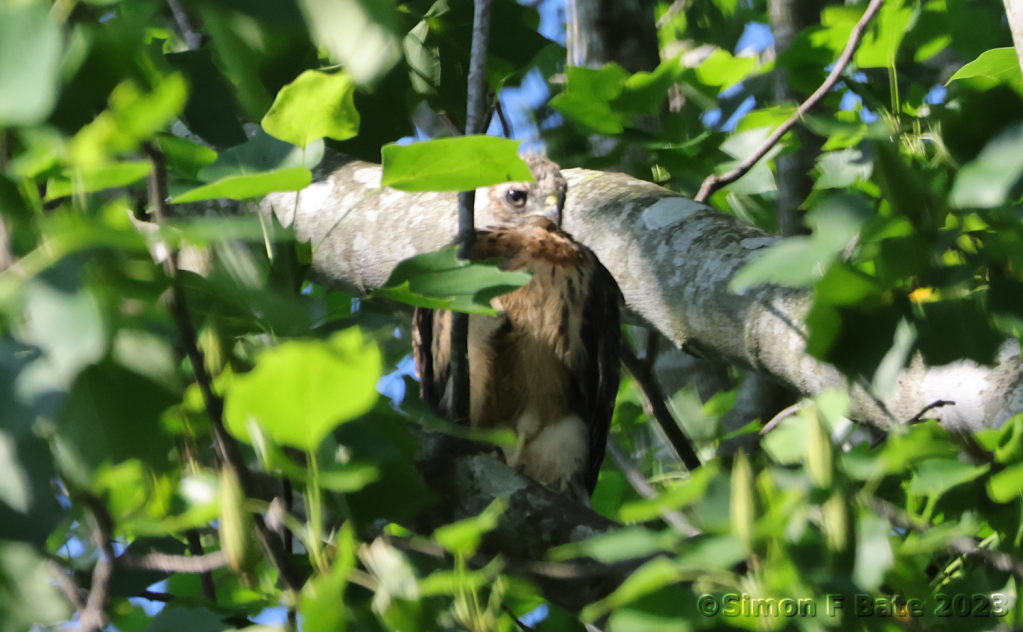
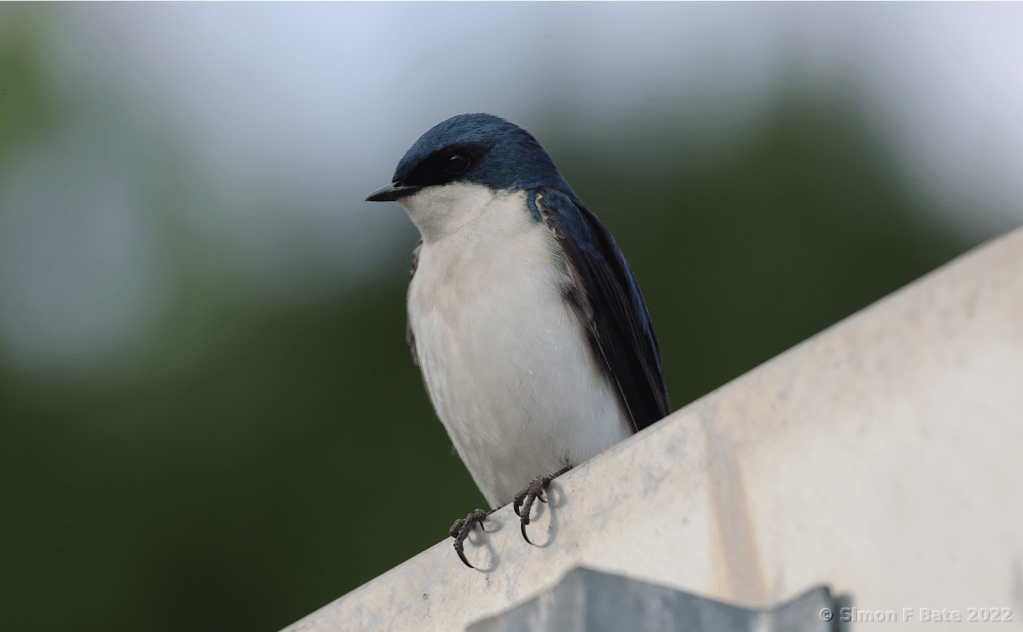
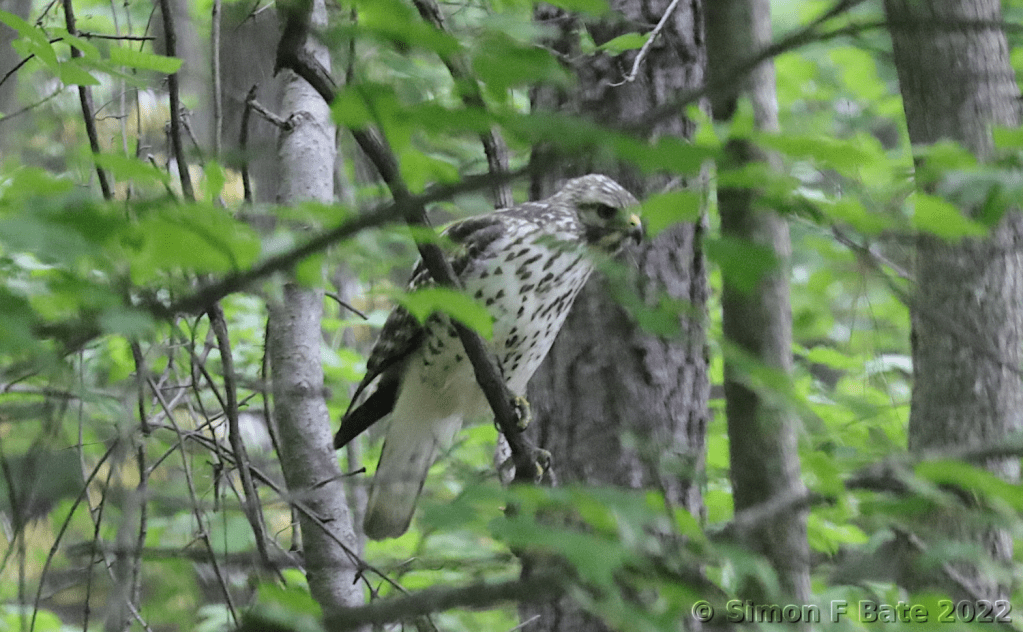
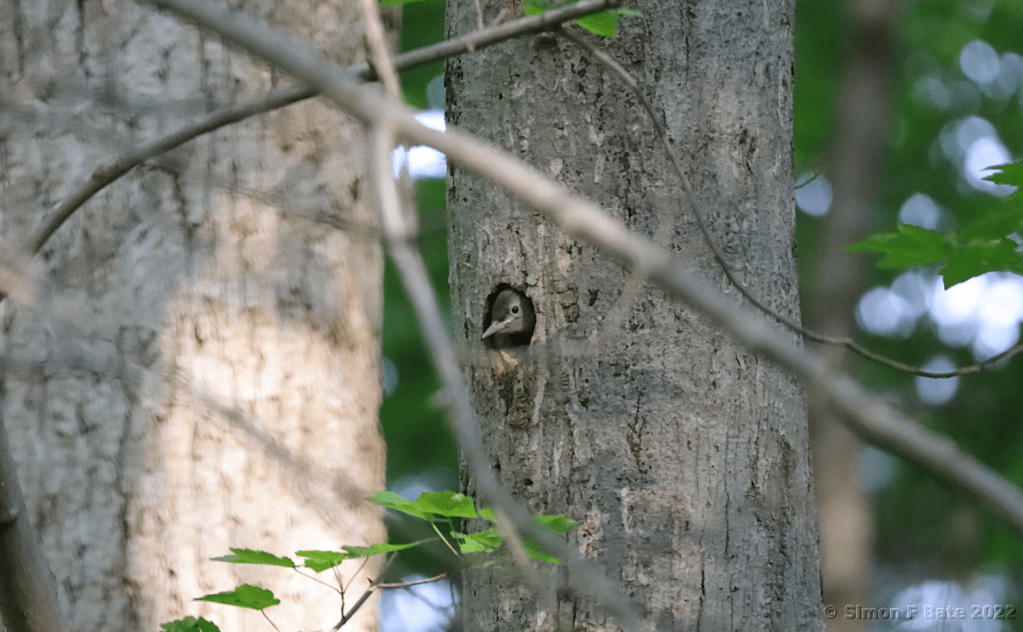
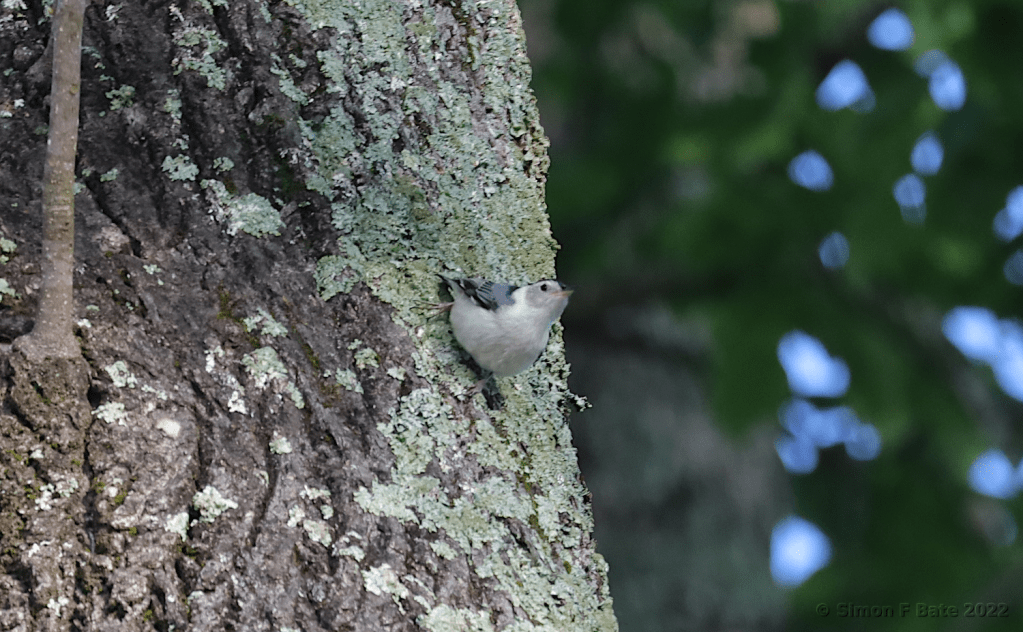
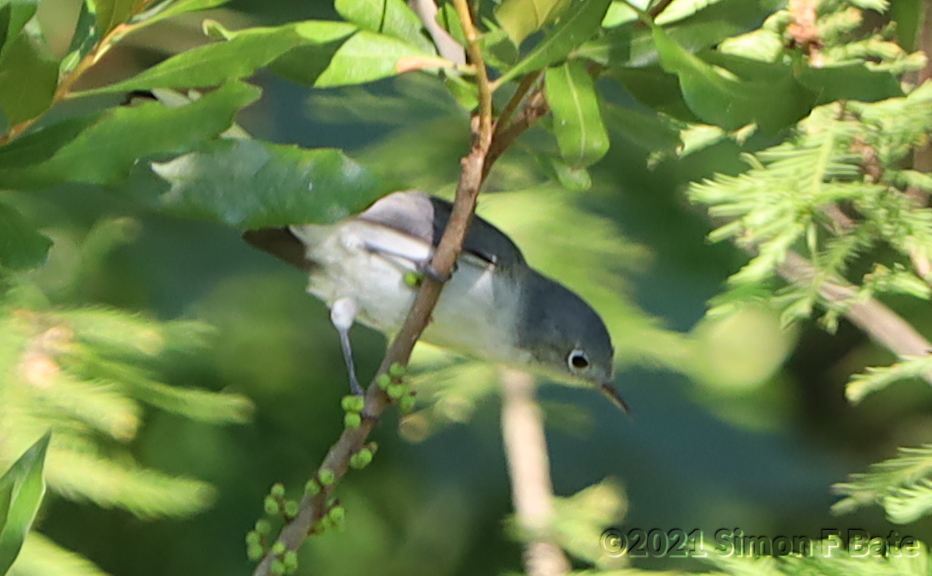
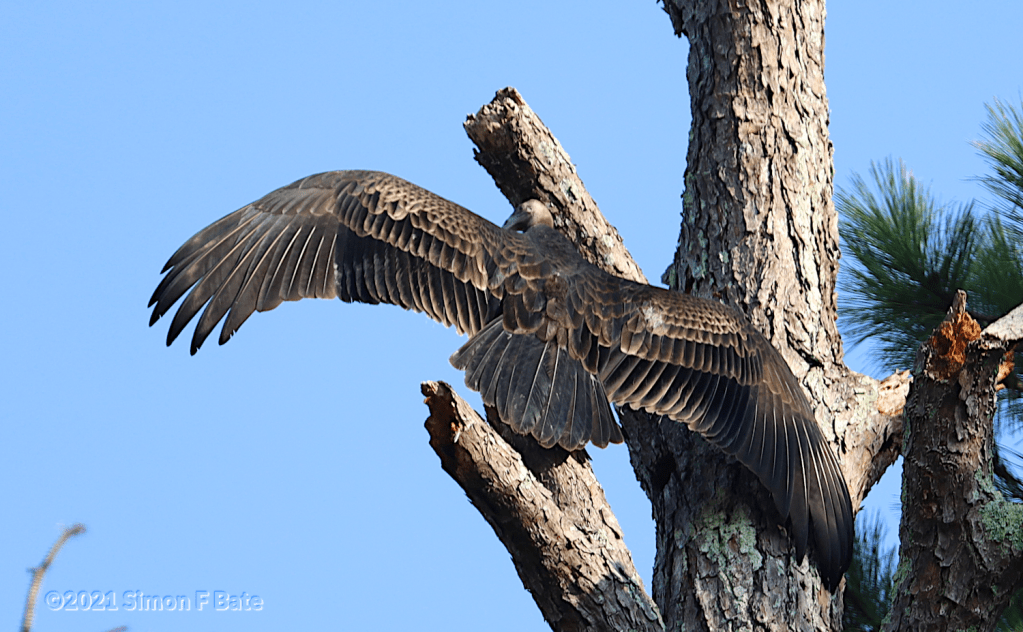
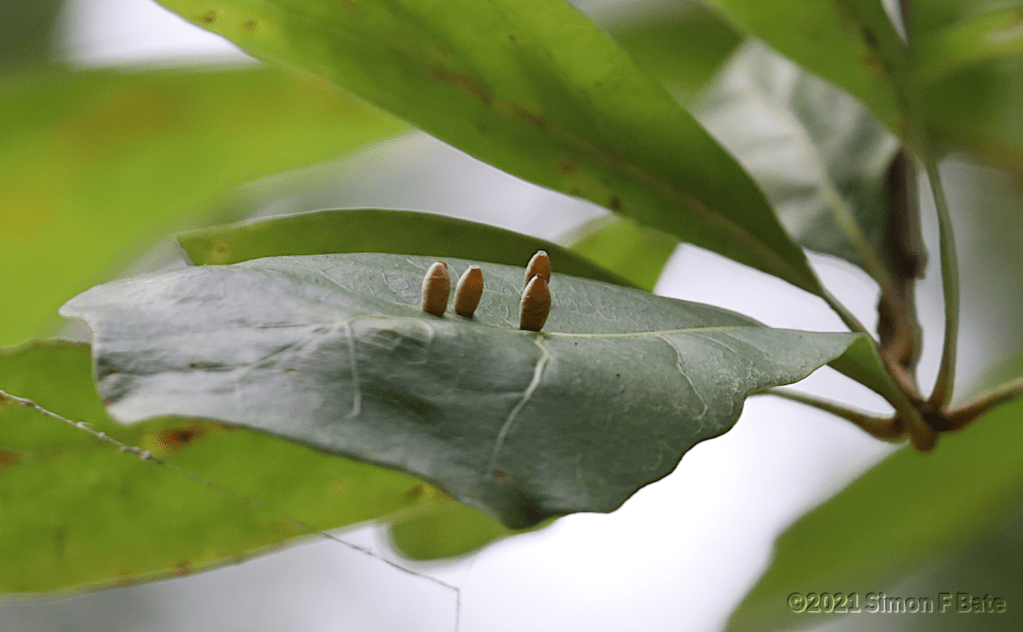
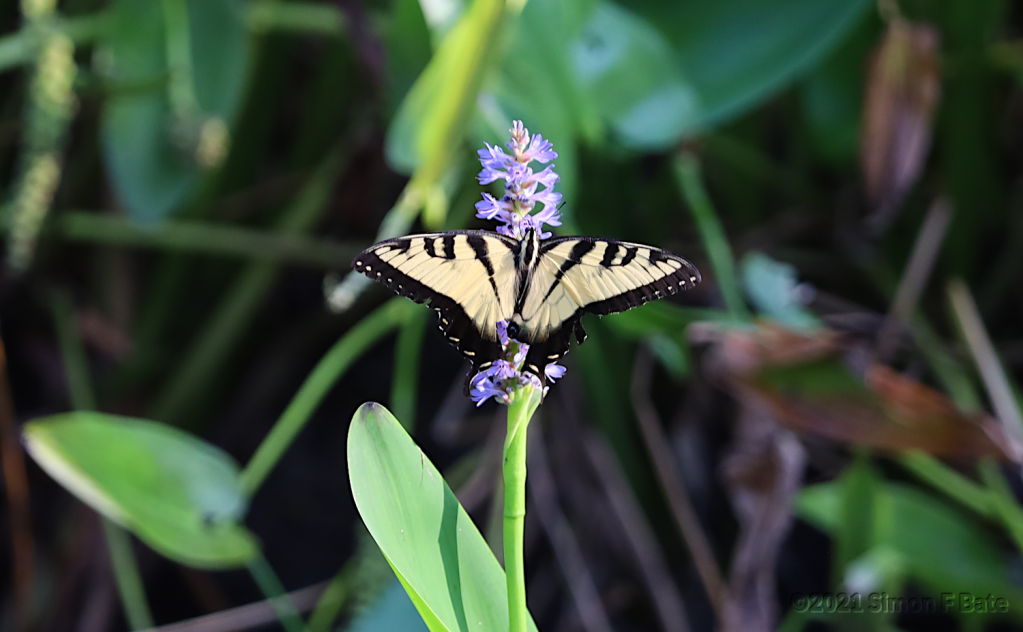
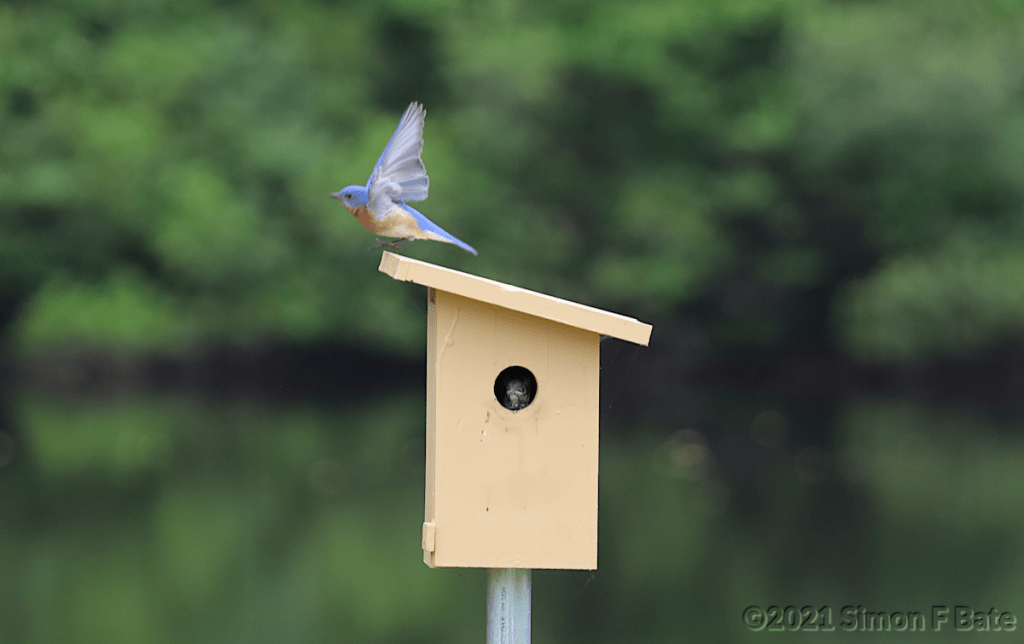
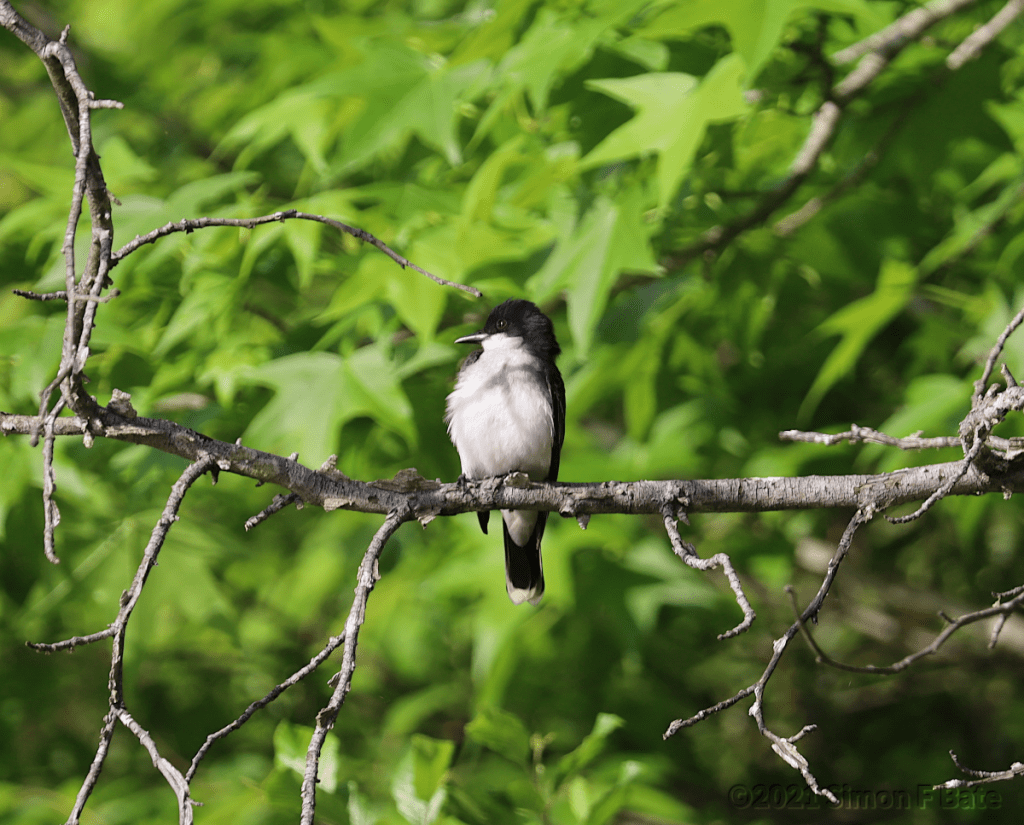
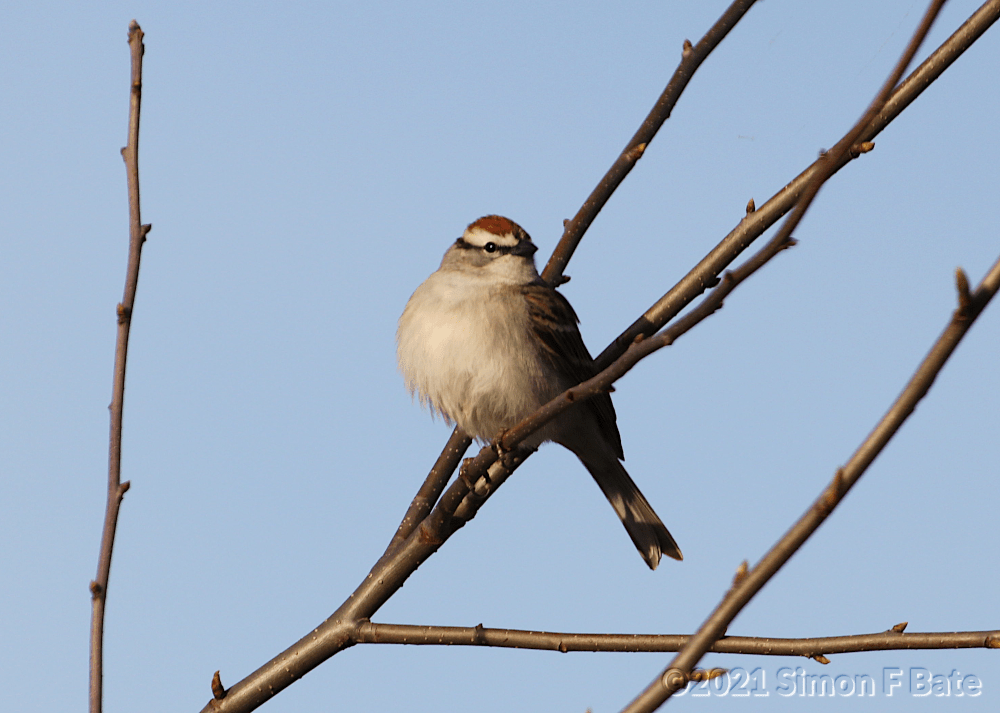
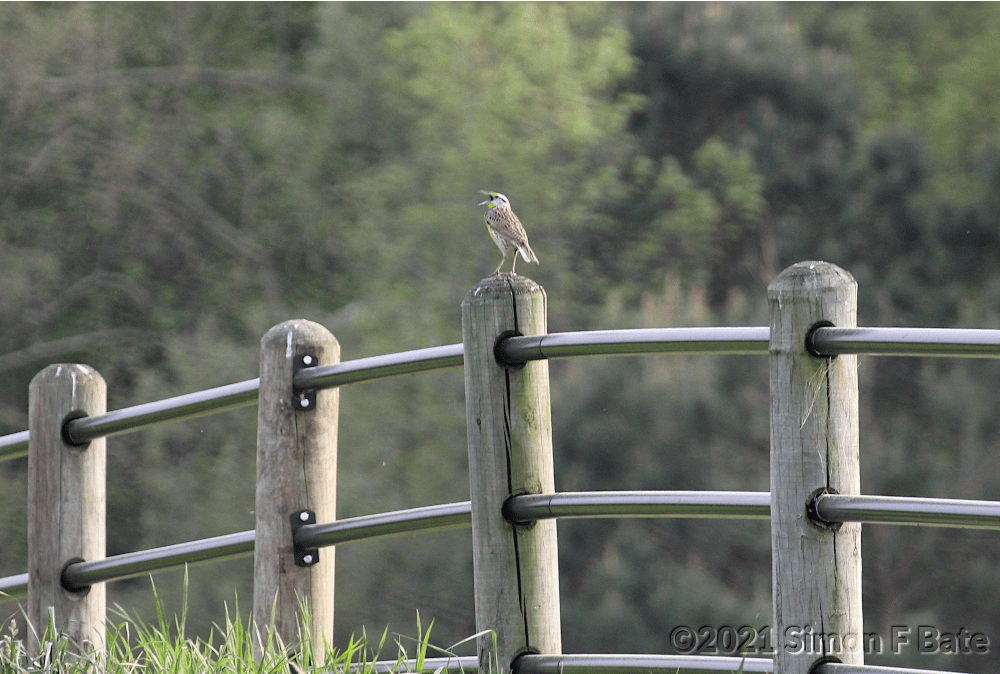
Annual Baby Bird Edition

I’m always surprised by the number of young birds we see around the pond in the spring.

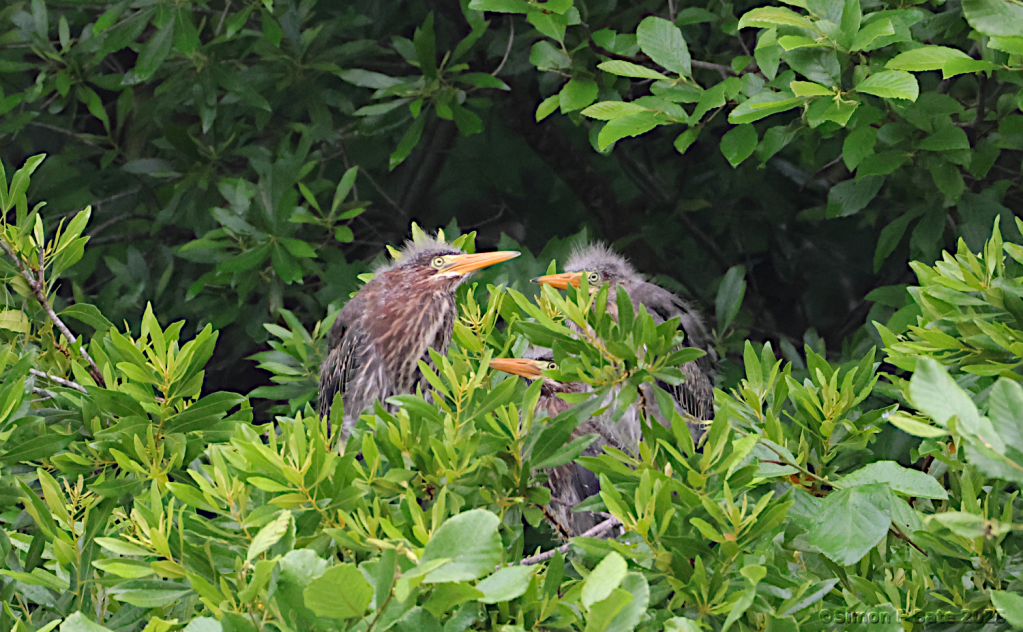
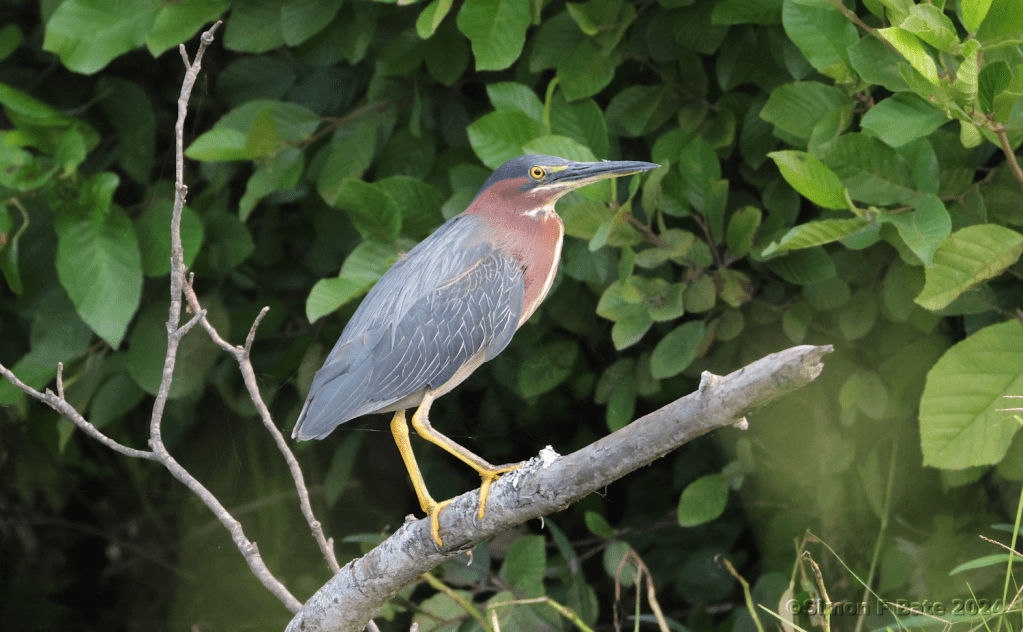
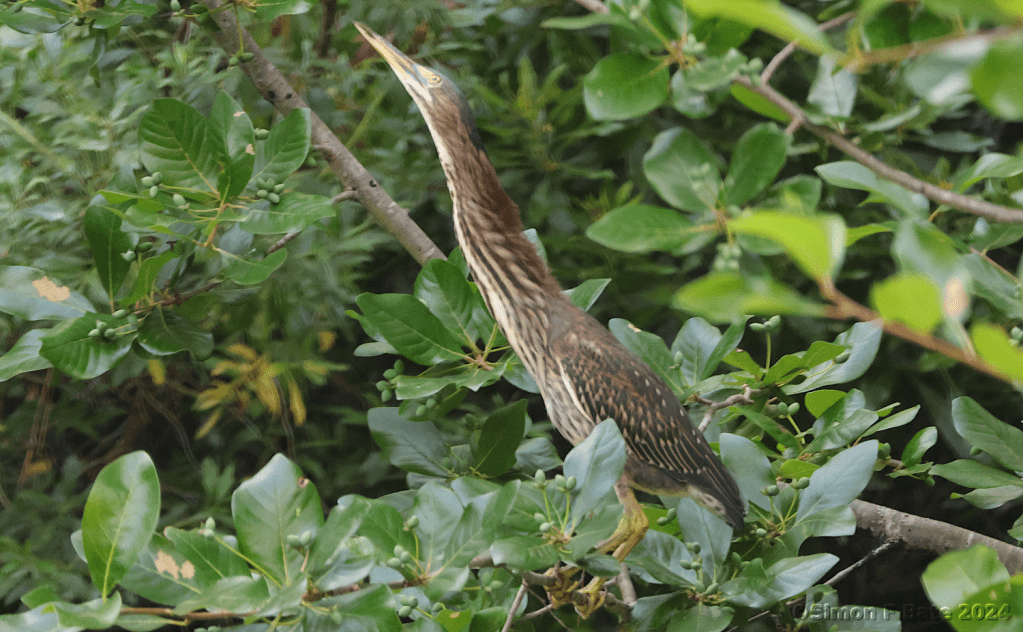
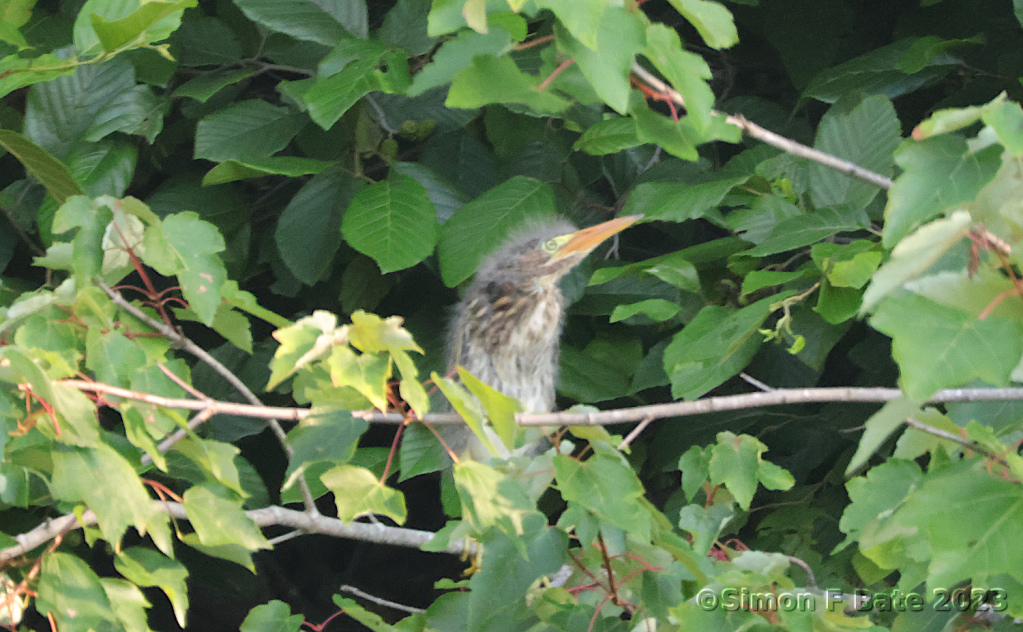
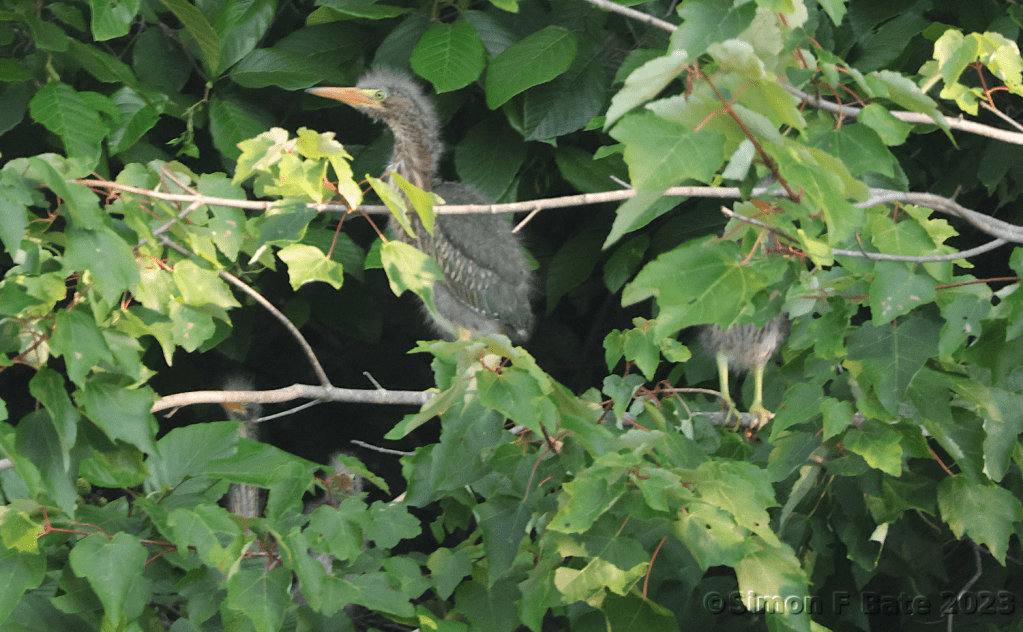
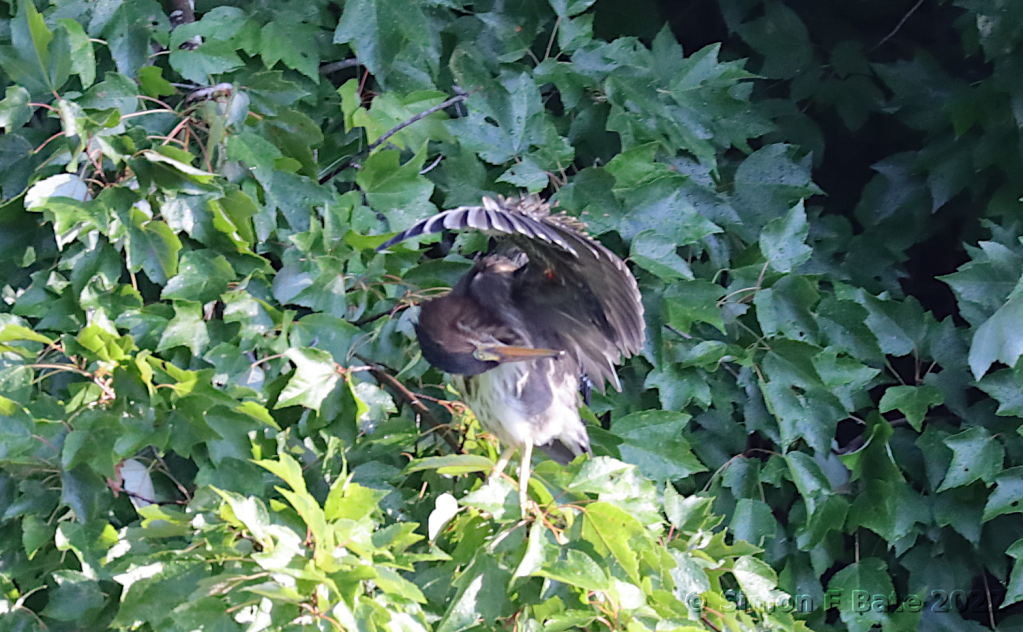
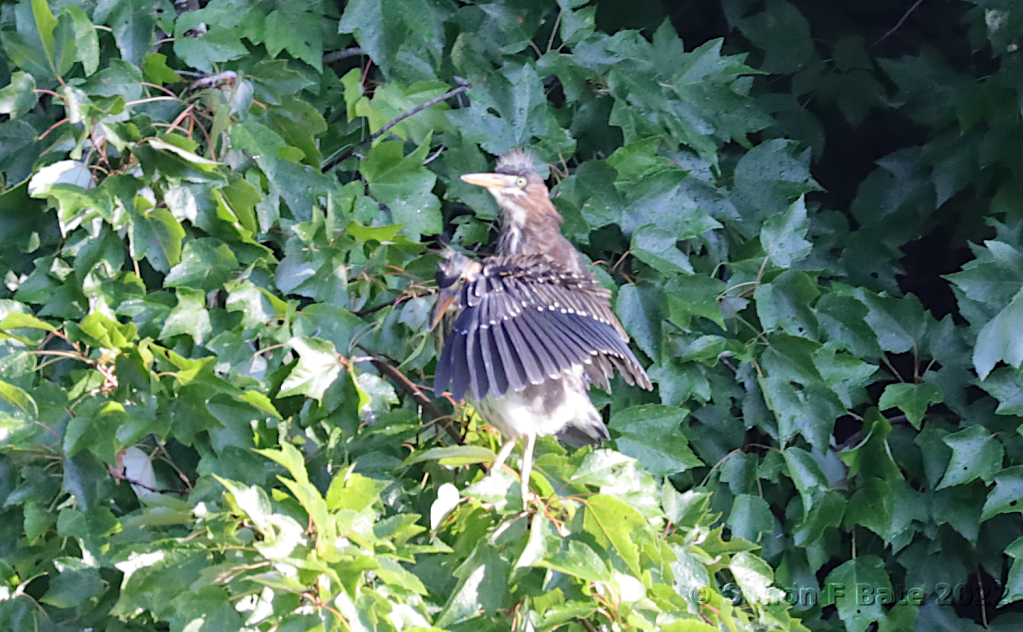
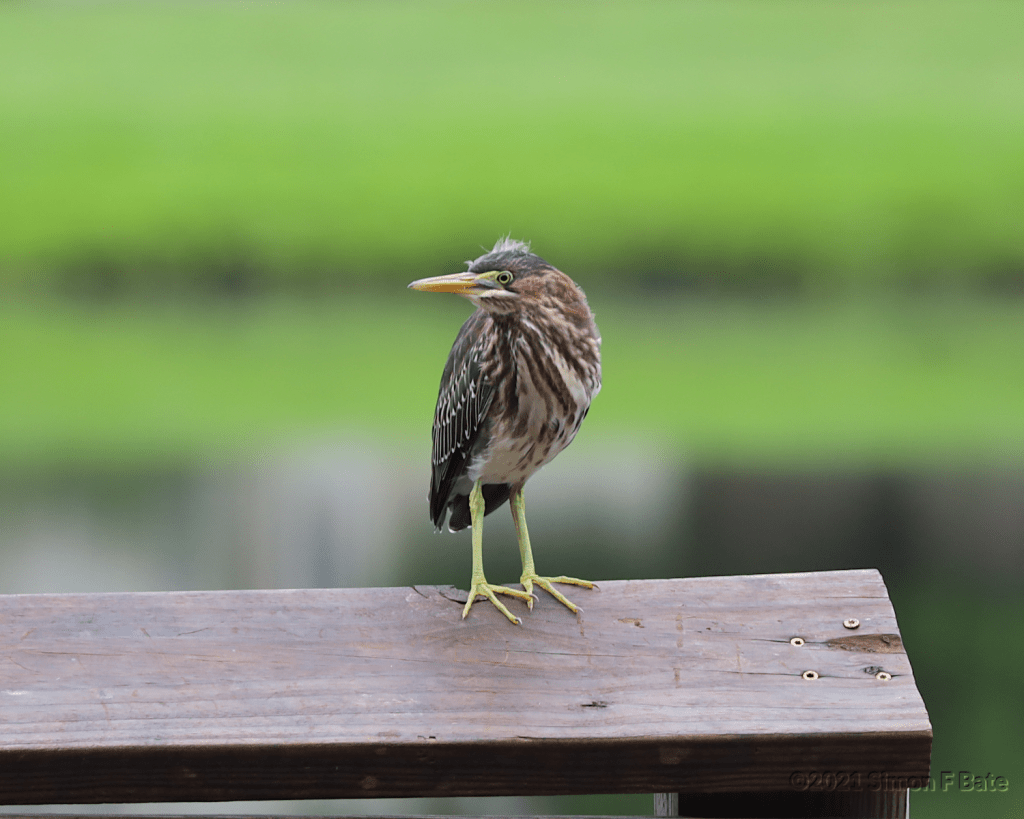
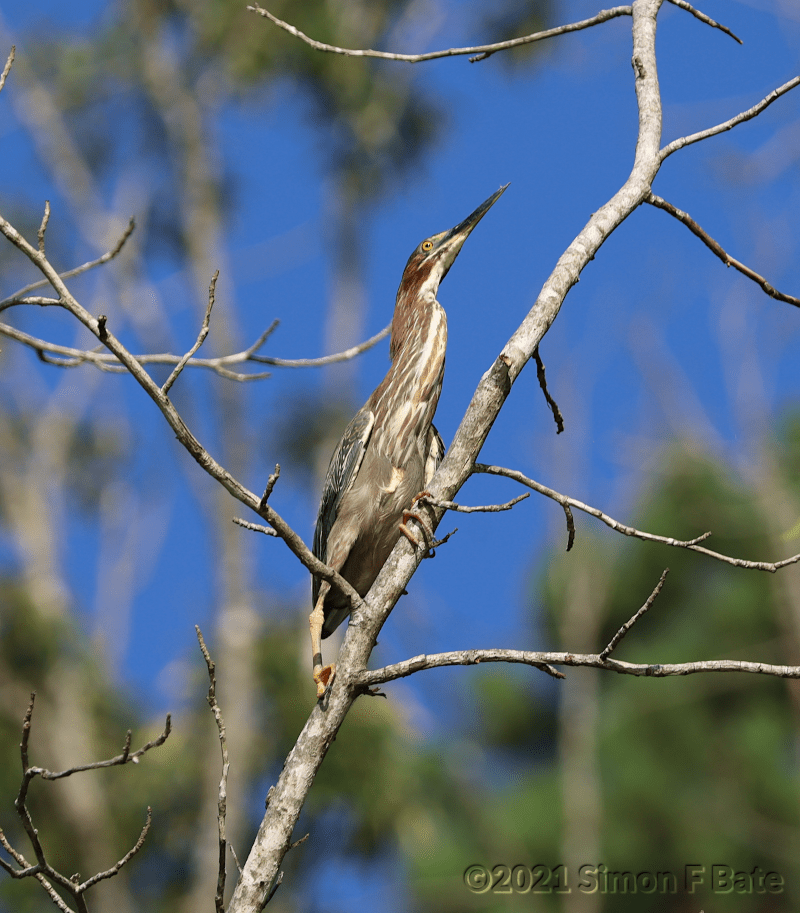
I spied a Green Heron nest a few weeks back. I’ll put together a separate series of pictures to watch them growing up. In watching the little ones, we became aware of two more nests on the pond. Both of these new nests were much further along than the one we had been watching. This trio was fairly close to the spillway. They’ve fledged since I took the picture.

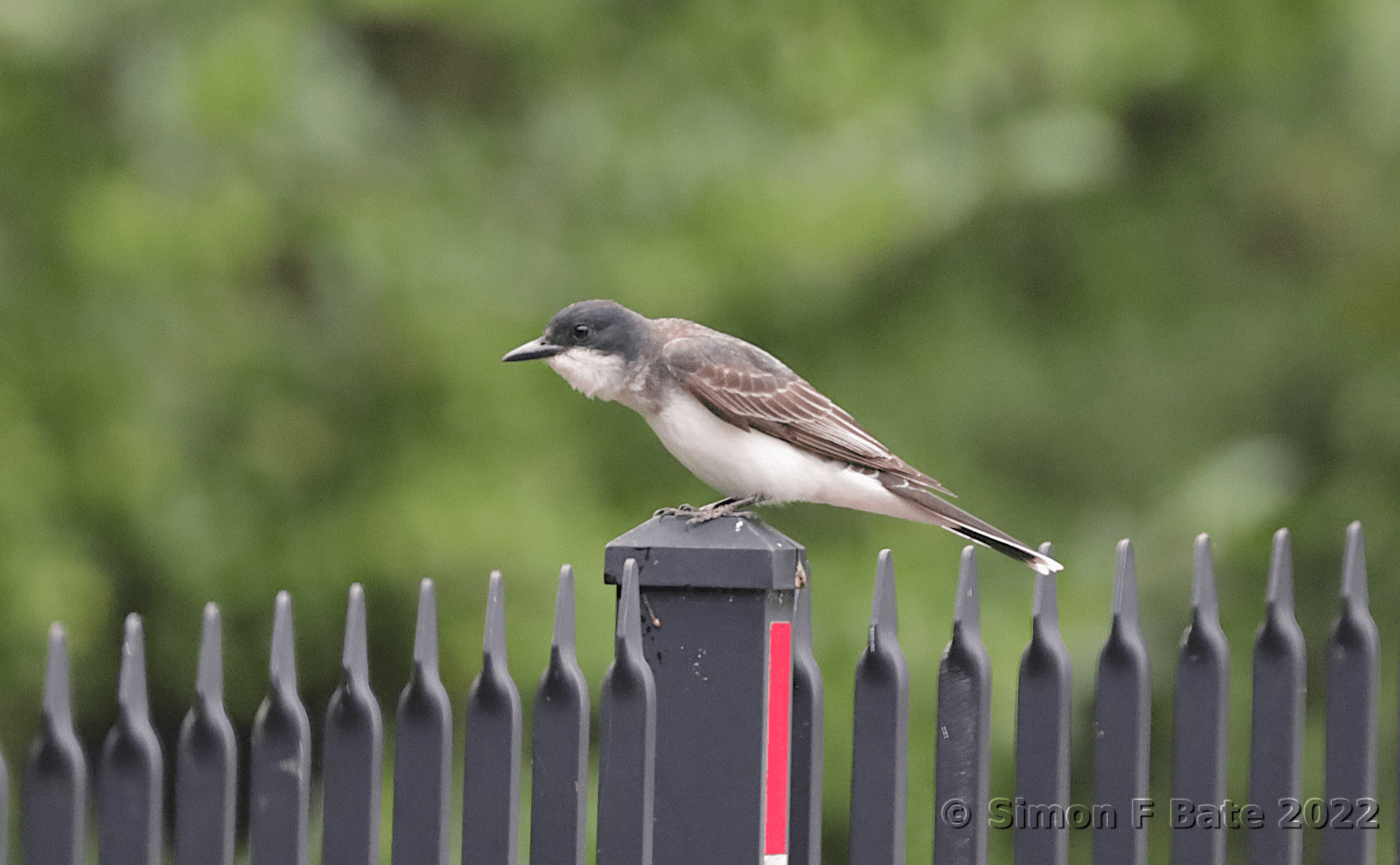
Here’s an adult Eastern Kingbird along with a fledgling, which looks like it’s still growing into its feathers.

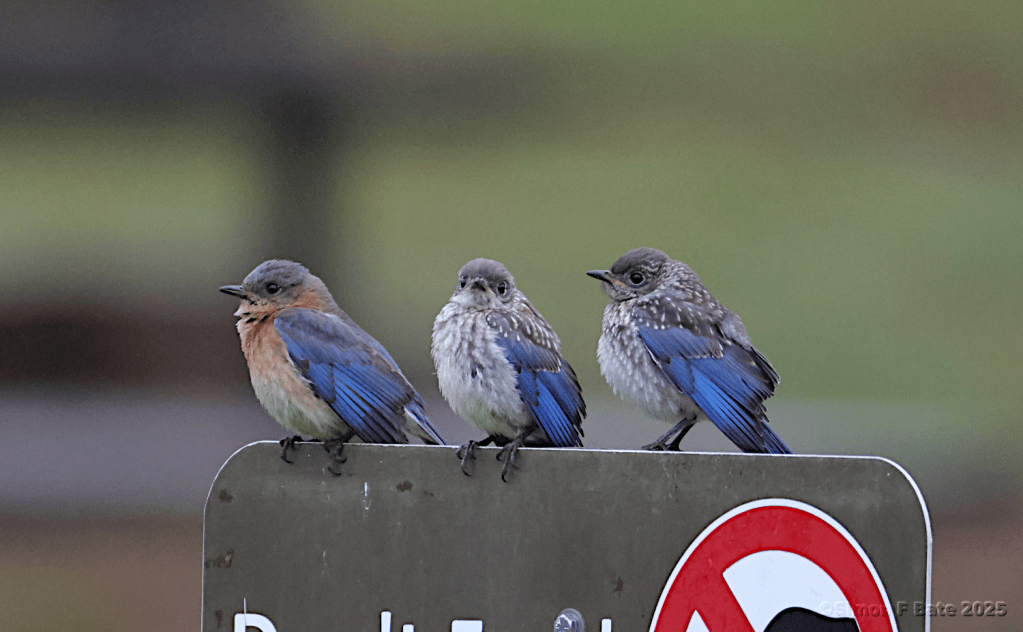
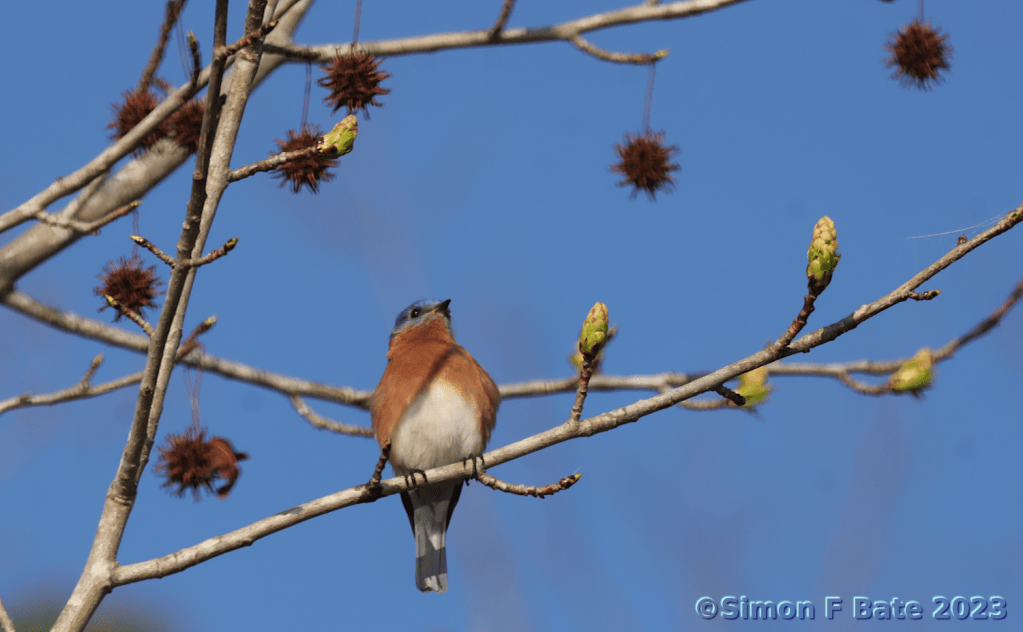
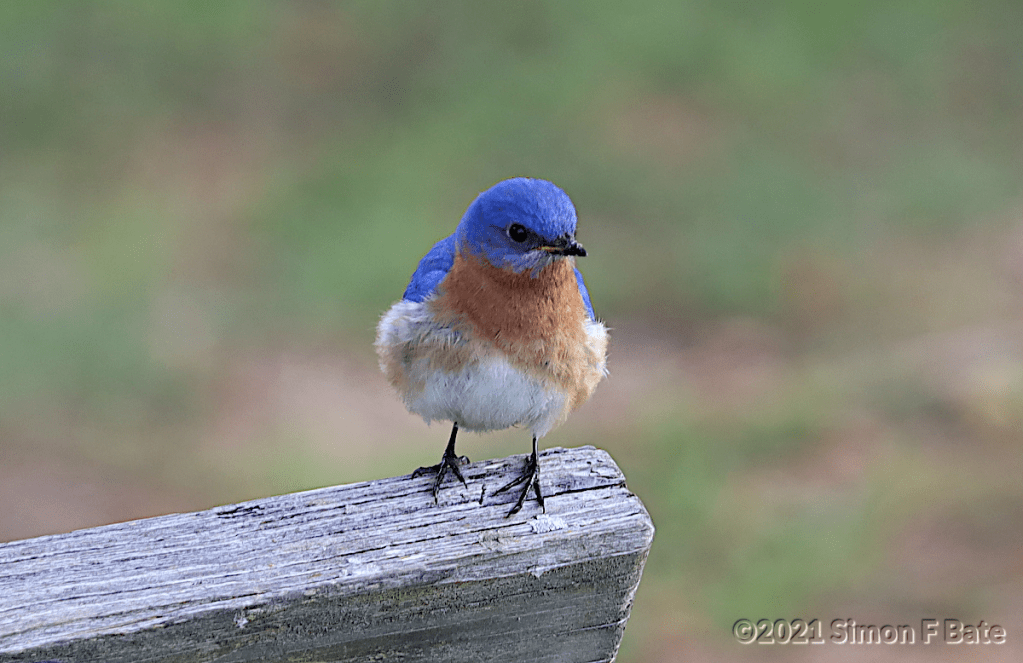
We often get lots of young Eastern Bluebirds, but they don’t always line up (with Mom) quite like this.

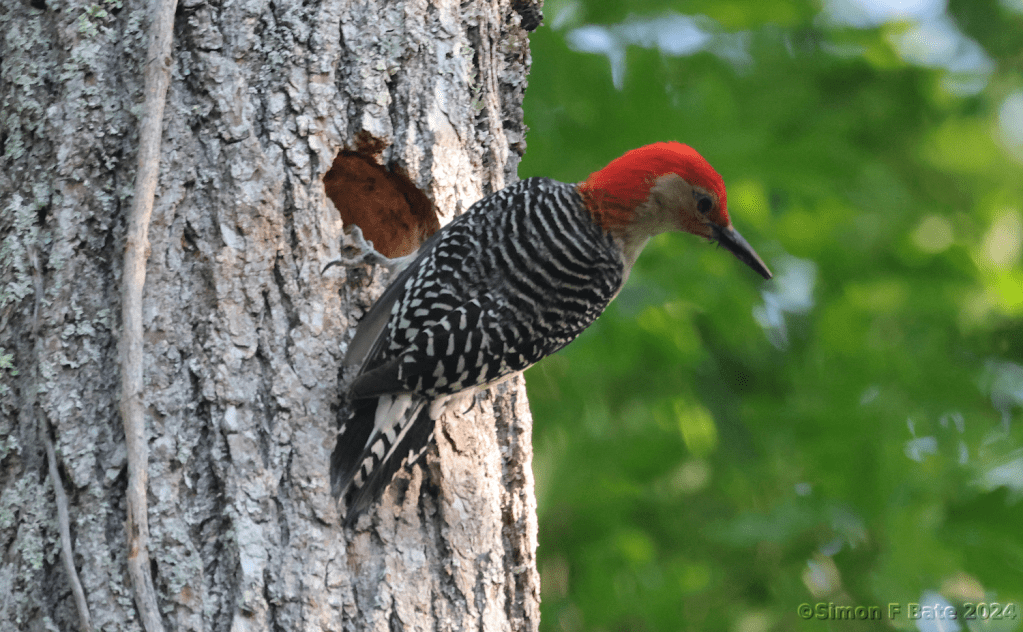
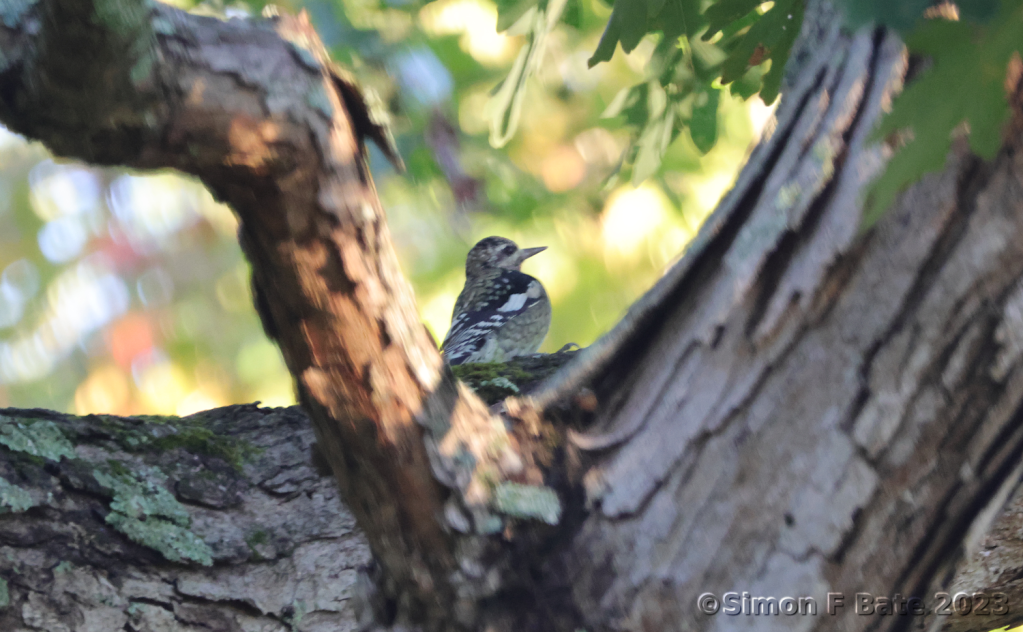
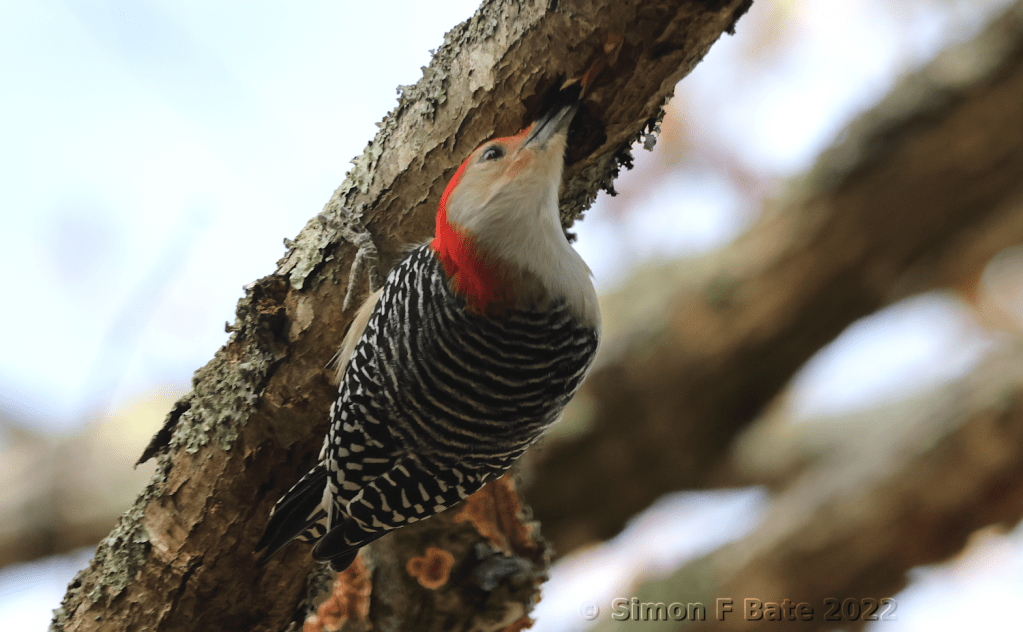
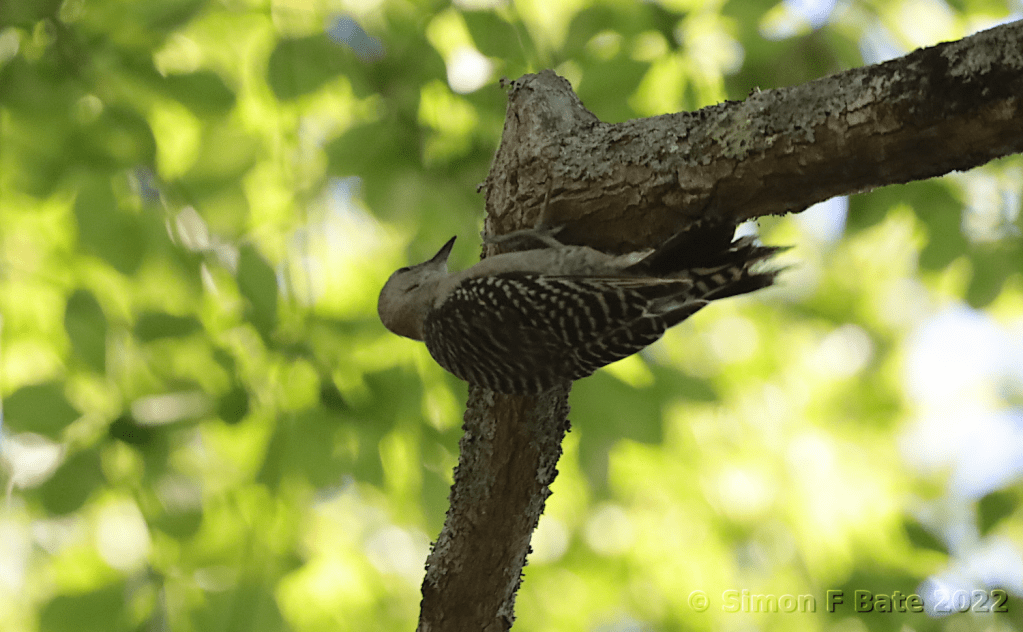
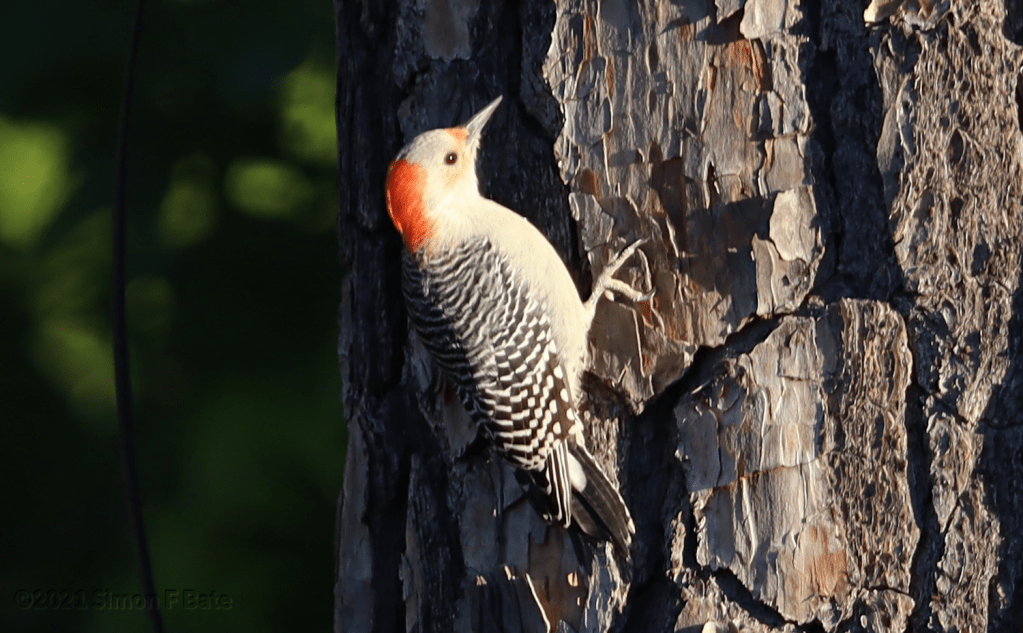
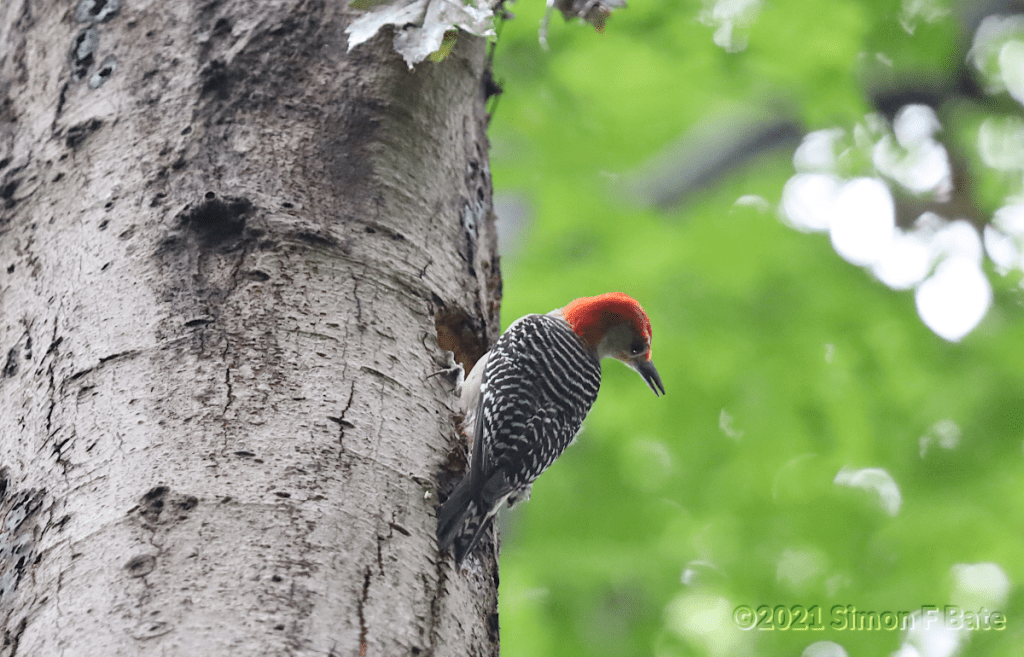
Finally, this morning I saw a young Red-bellied Woodpecker high in a tree. It was fairly advanced in age, because it was already looking for food (but not old enough to get red feathers on its head). I was trying to get a good picture when Dad showed up with some additional food.

Another great thing about this picture is that you can see the adult’s red belly. A common question is “why can’t I see the red on the belly?” The reason is that the red is on the belly, not the chest. Usually their legs (and the rest of their body) are close to the tree, so it’s obscured.

Like what you see here? Let me know what you liked!

Follow the blog to get updates.

Four Beauties

It has been ages since my last post. You would think now that I’m one quarter retired, I’d find more time for things like posting, but somehow the time gets away.

This is another “Quick Post” with four pictures and just a bit of text.

Spring (proper) has finally arrived at the pond. Going back through the last month’s pictures, it’s amazing to see the change from leafless branches to green.

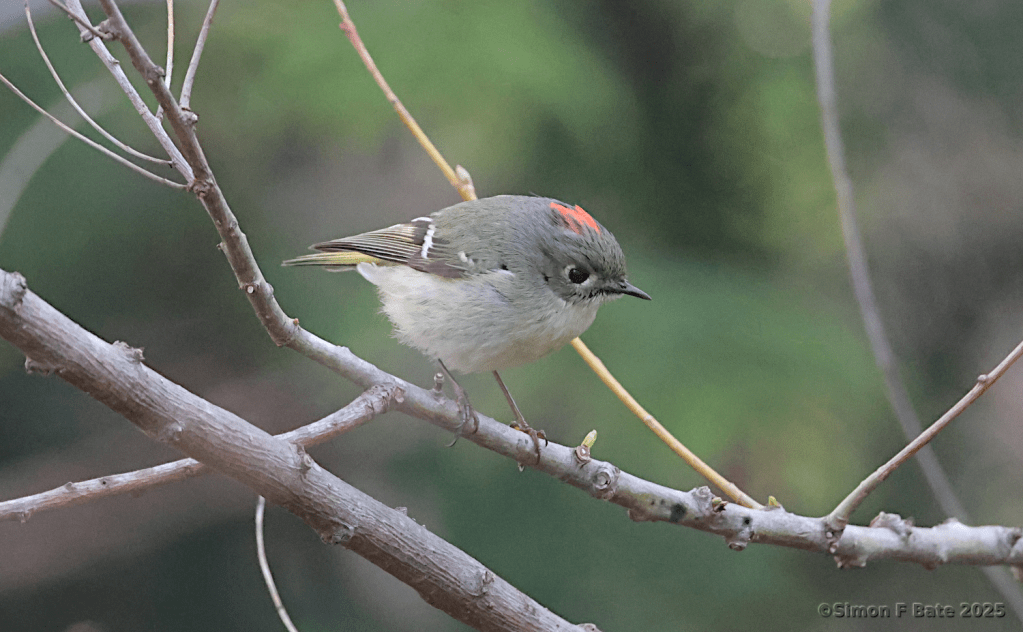
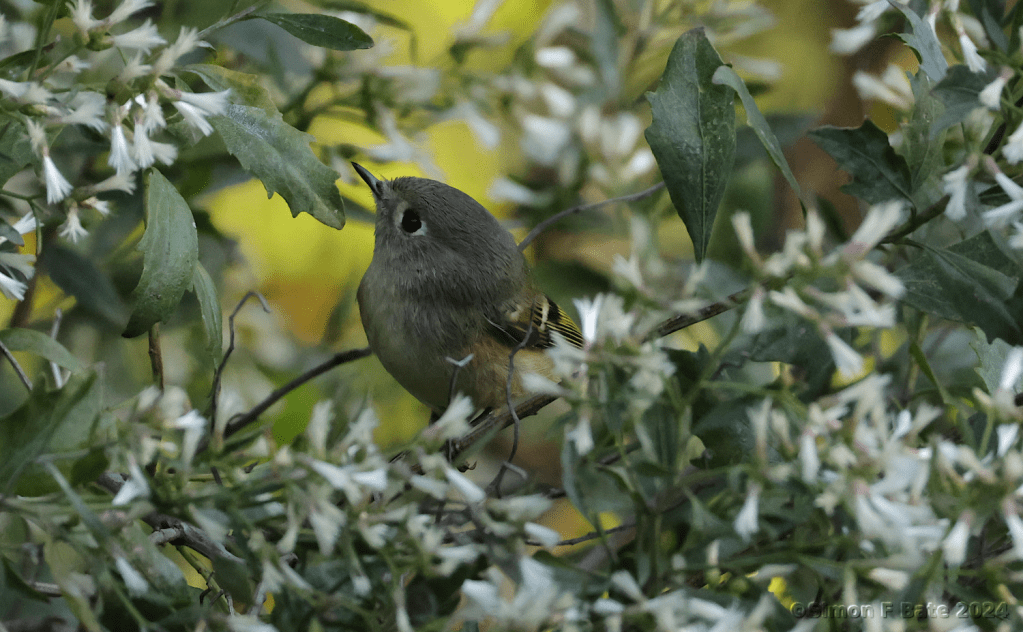
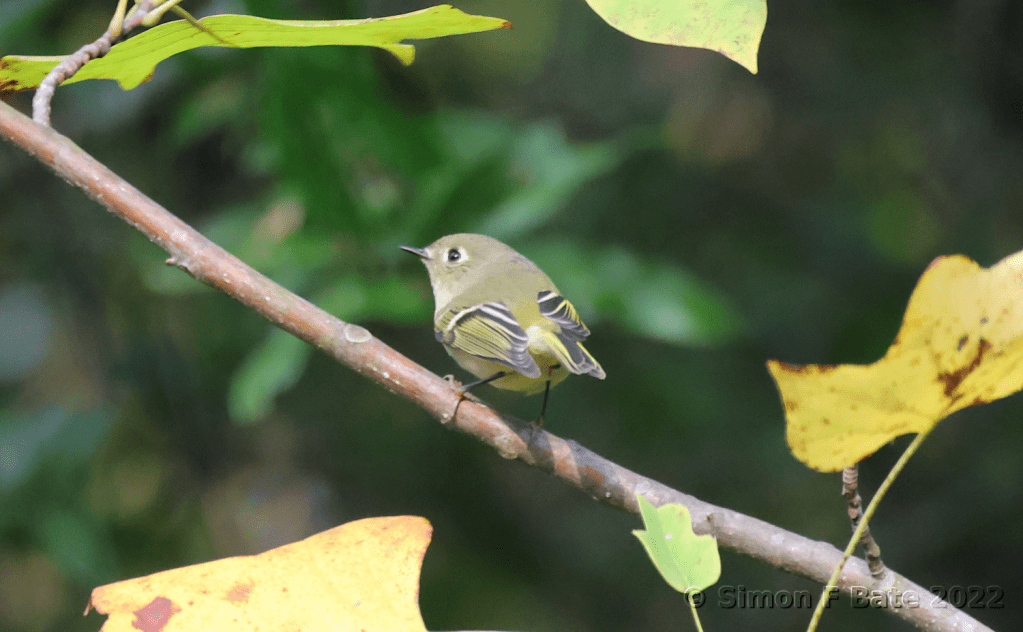
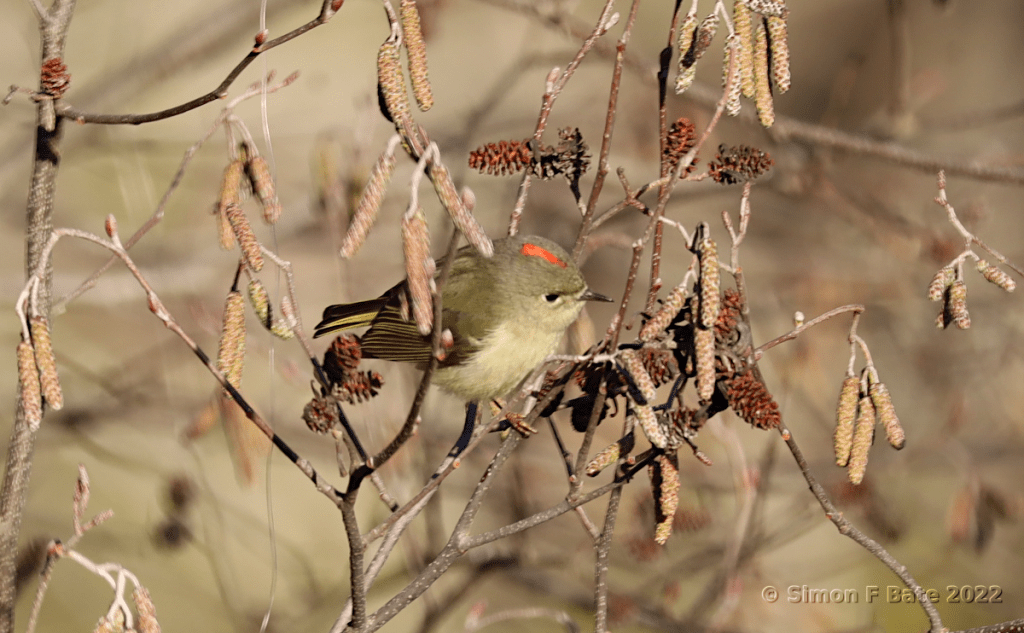
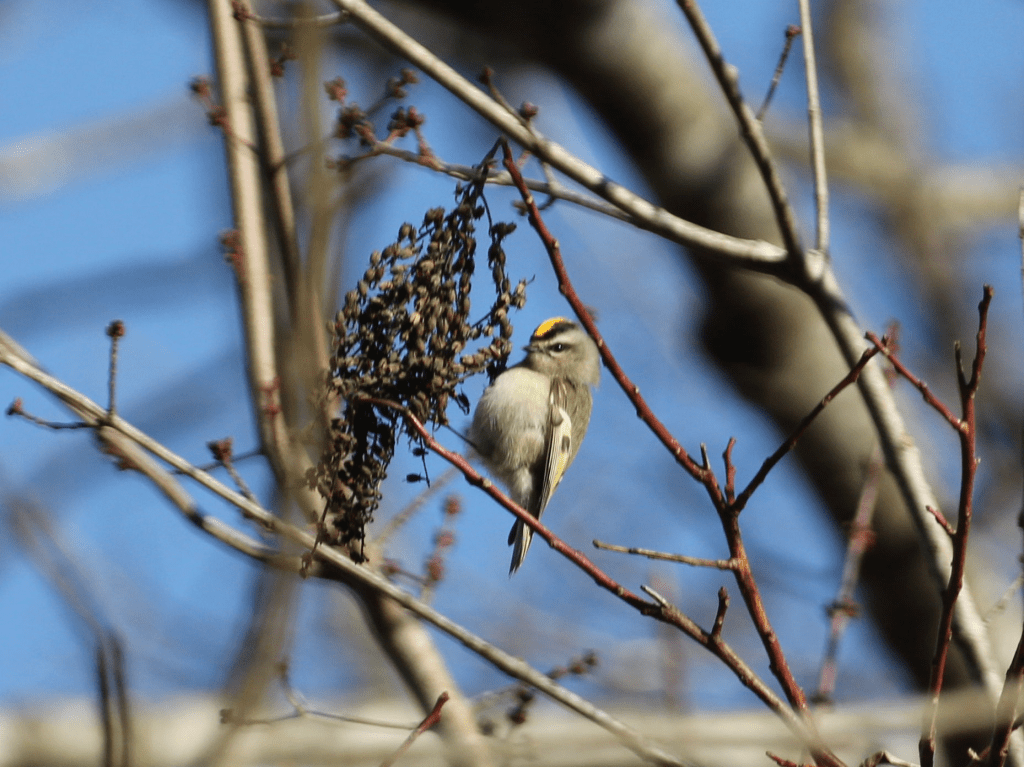
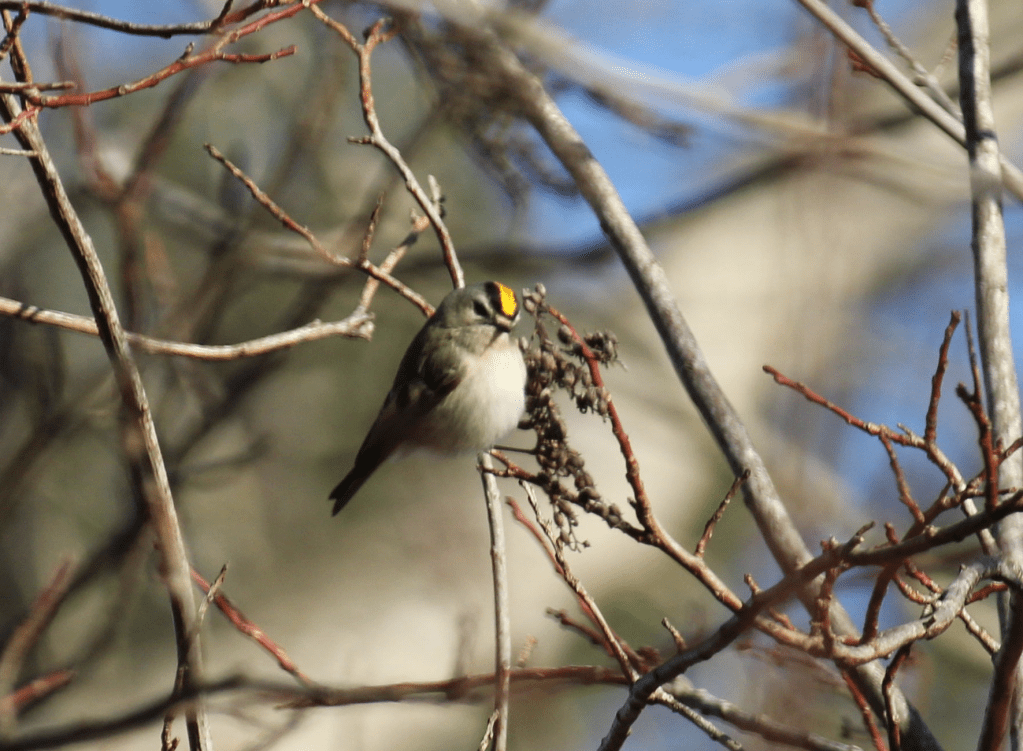
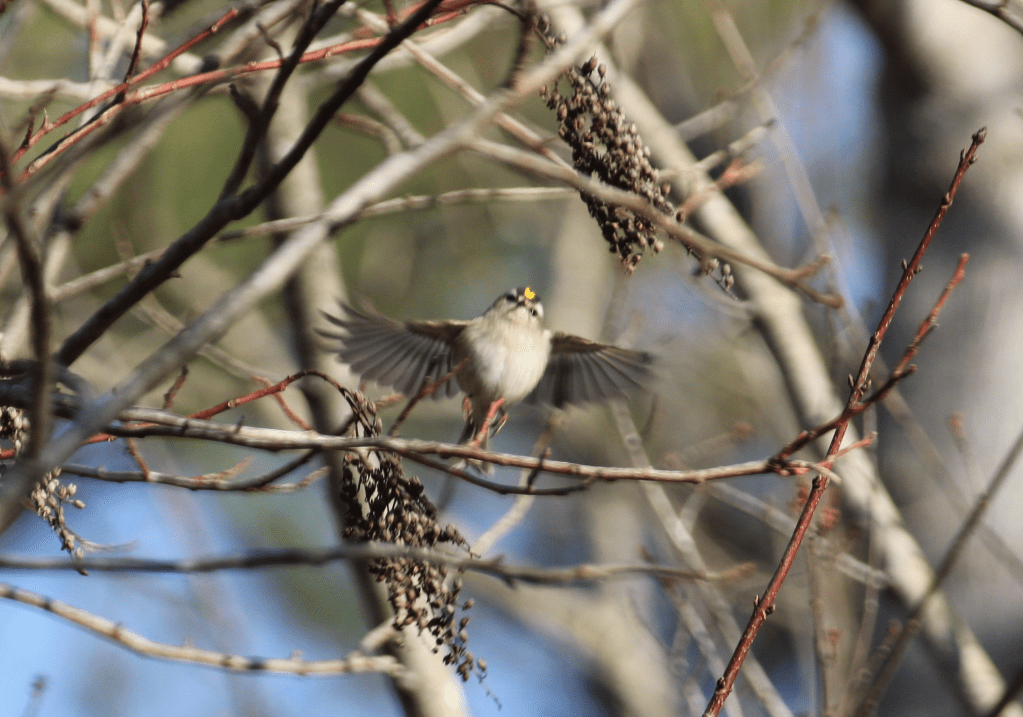
From back in March, here’s a male Ruby-crowned Kinglet. It has been more than a week since I last saw or heard one, so I think they’re on their way north now.

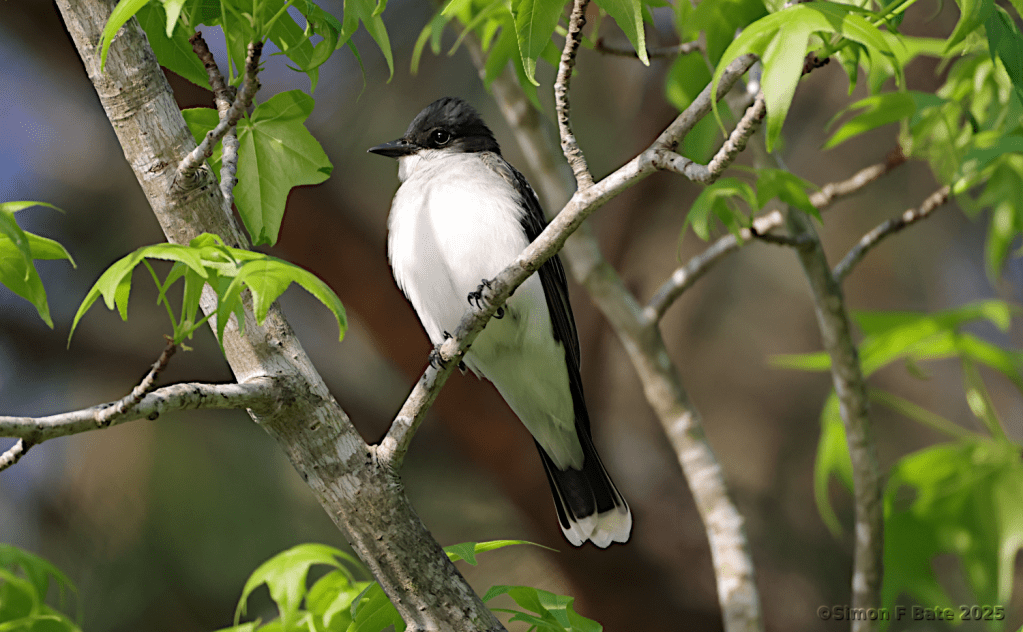
Two of my favorite summertime birds at the pond are the Great Crested Flycatchers and Eastern Kingbirds. Usually both are difficult to photograph, because they’re often found in the tops of the tallest trees. Last week they both appeared well within photographing range on just about the same branch, one right after the other.

I like the Great Crested Flycatchers because of their distinctive police whistle call, along with their sharp ascending call. Both calls mark the arrival of summer. I also think the color of their bellies is one of the most pleasing colors I know.

Eastern Kingbirds stand out because of the white band across the end of their tail. They’re some of the most aggressive birds I know. I’ve seen them chase hawks and crows away with no fear at all.

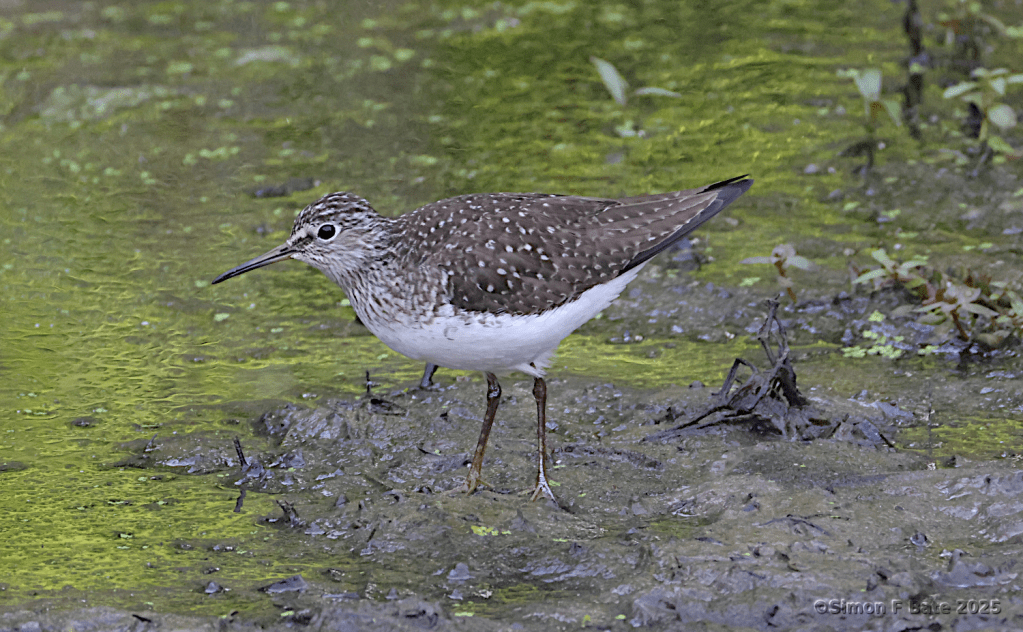
In past summers, I’ve encountered Spotted Sandpipers around the pond and in the settling pond behind the Seagroves townhouses. Last week I got a surprise to encounter a Solitary Sandpiper, in its breeding plumage, at the settling pond. I saw a pair of sandpipers flying today, but didn’t get a close enough look at them to get an identification.

Like what you see? Let me know!

Follow the blog to get updates (with any luck, I’ll be able to post more soon).

Merganser Courtship

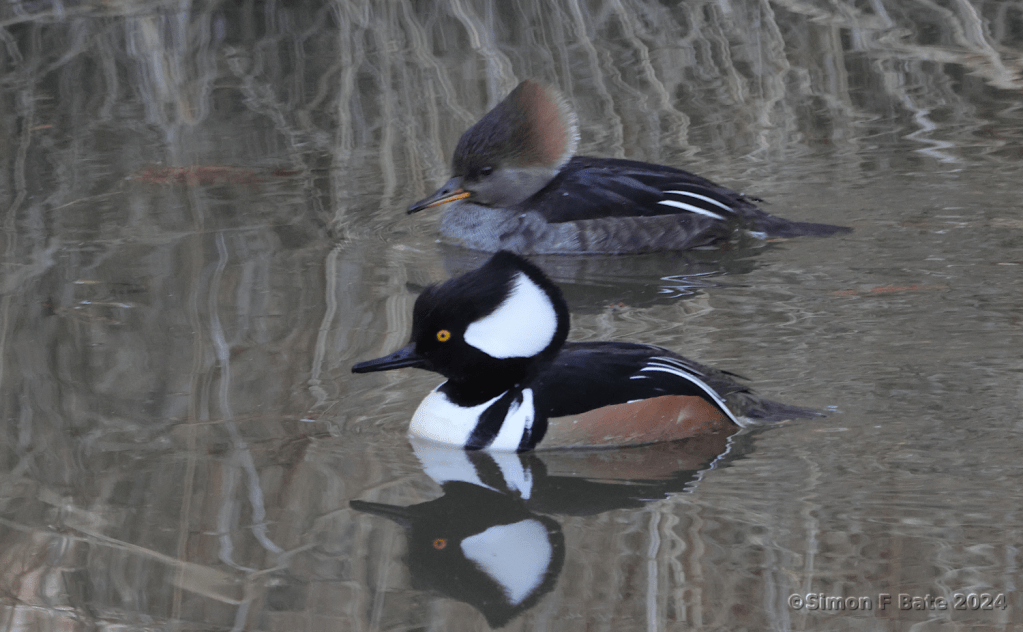
With the return of the colder weather, we’ve also seen the return of the Hooded Mergansers to the pond.

Mergansers do not take life partners, but are monogamous during the breeding season. They pair up in the winter and remain a pair until the hen begins incubating eggs in her abdomen. At that time, the male leaves, which seems to be a common behavior among ducks.

Last week there were six or more Mergansers on the pond. The males were in full courtship display. The sun was not quite directly behind the ducks, so it shone through their crests, both male and female.

The down side, was that their faces and other dark areas were not particularly well-lit.

However, any downside was offset by the males’ performances.

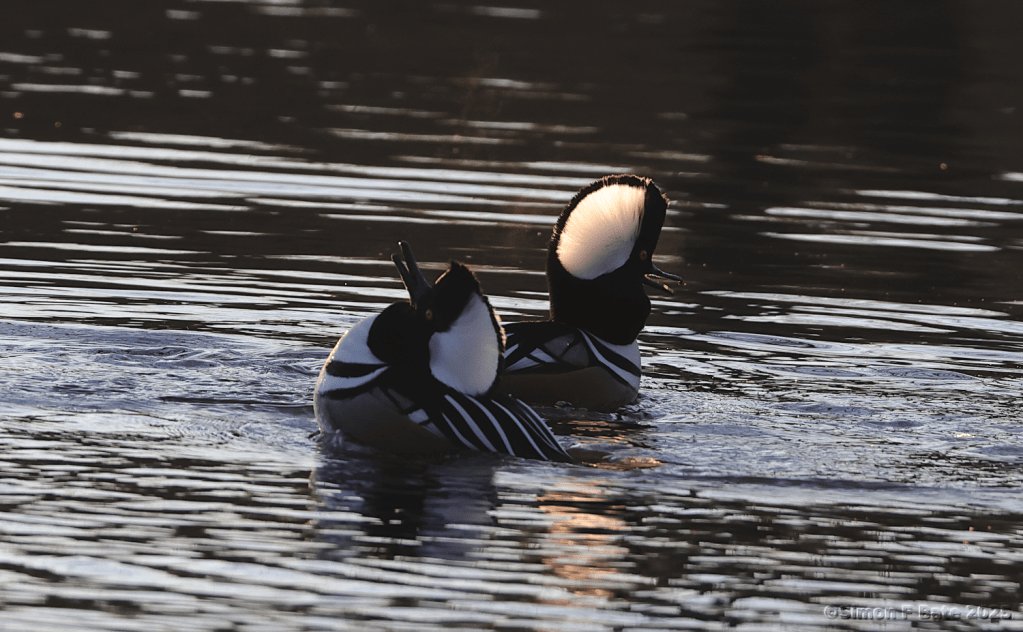
This is the full courtship pose of the male. It rears back, touches its back with its crest and emits a very strange, low croak. Almost as if its saying (with a vocal fry) a long drawn out “helloooo babeeeeee.”

When not rearing back, they keep their crests as high as possible.

Most of the time there was quite a confusion of males and females, but I like that they got themselves nicely in a row for this shot.

Let me know what you like about the pictures!

Follow the blog to receive updates!

The return of Quick Posts

I’ve got a big backlog of pictures. I think the best way to clear them is with a few quick posts, so…here we go.

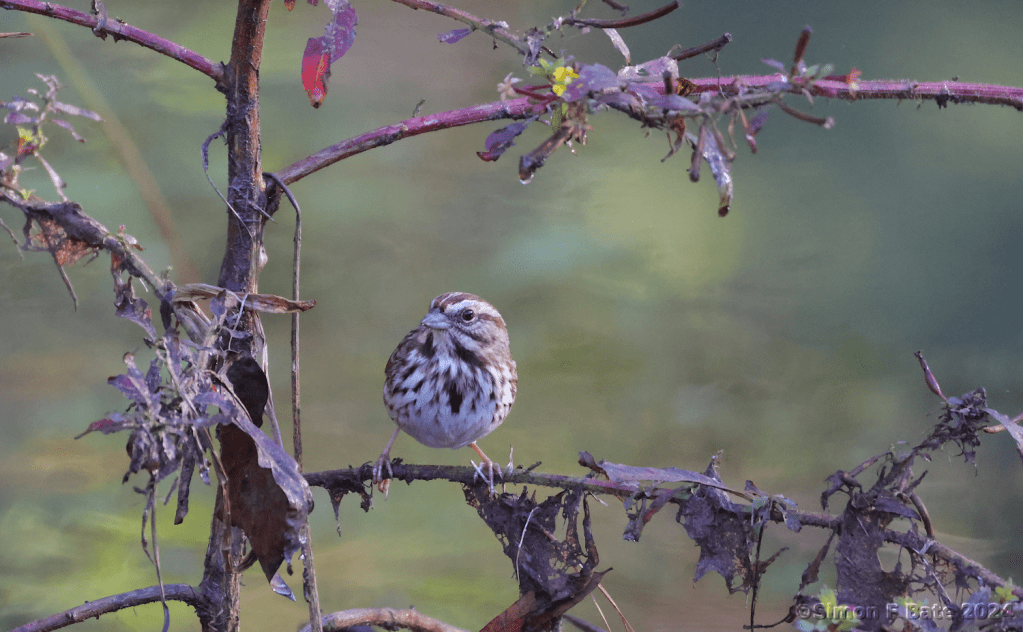
The Song Sparrow can be rather an ordinary-looking bird, but there are times and poses when one stands out. A little bit of decorating, courtesy of the most recent high water in the settling pond helps frame it nicely.

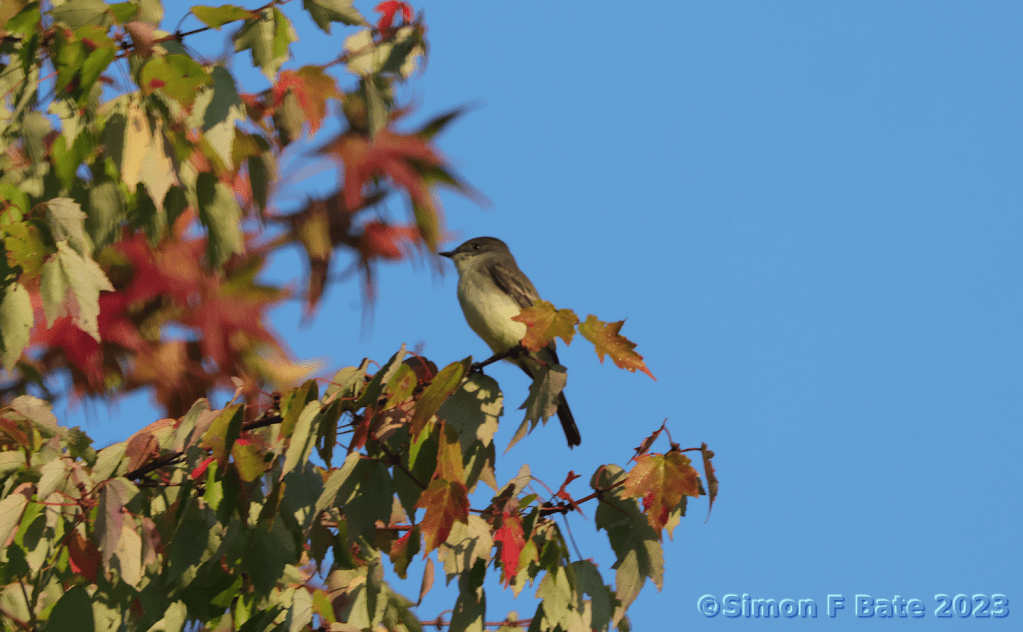
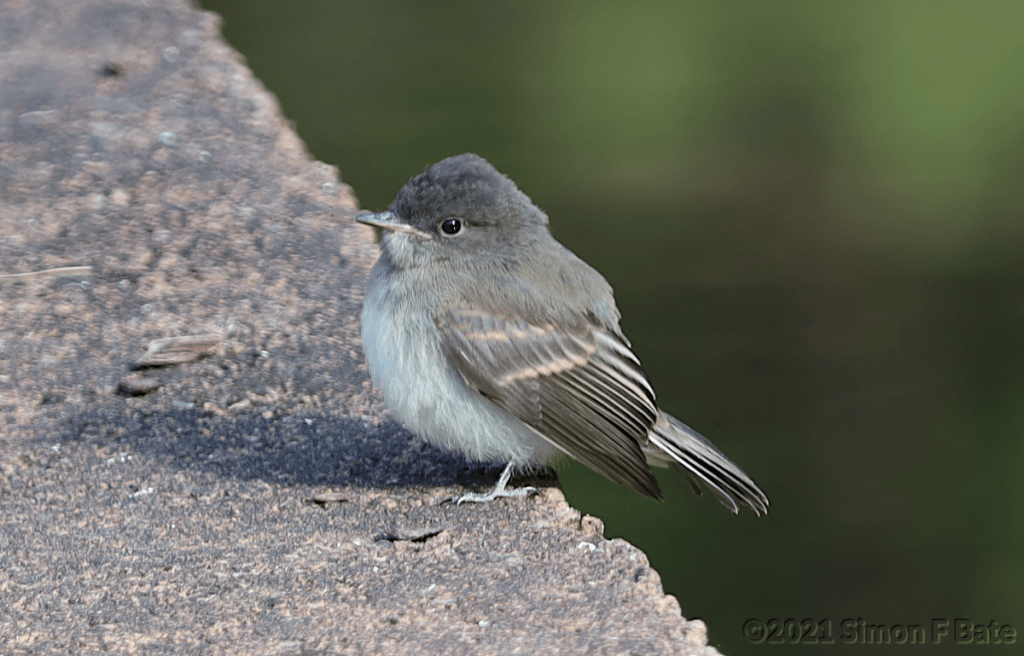
Over the past few months I’ve tried to take pictures of an Eastern Phoebe that show off its plumage. Problem is, it’s quite contrast-y and some aspects will fade, or stand out too strongly, depending on the light. Over the past couple of days, I’ve taken pictures that do the species justice. Of course, it takes two pictures to show if off properly.

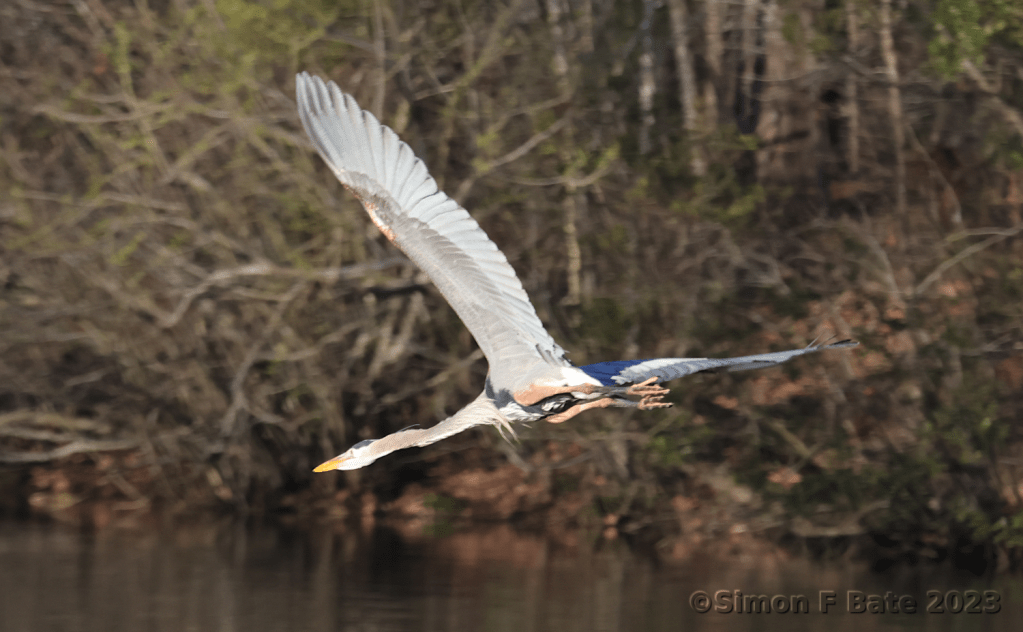
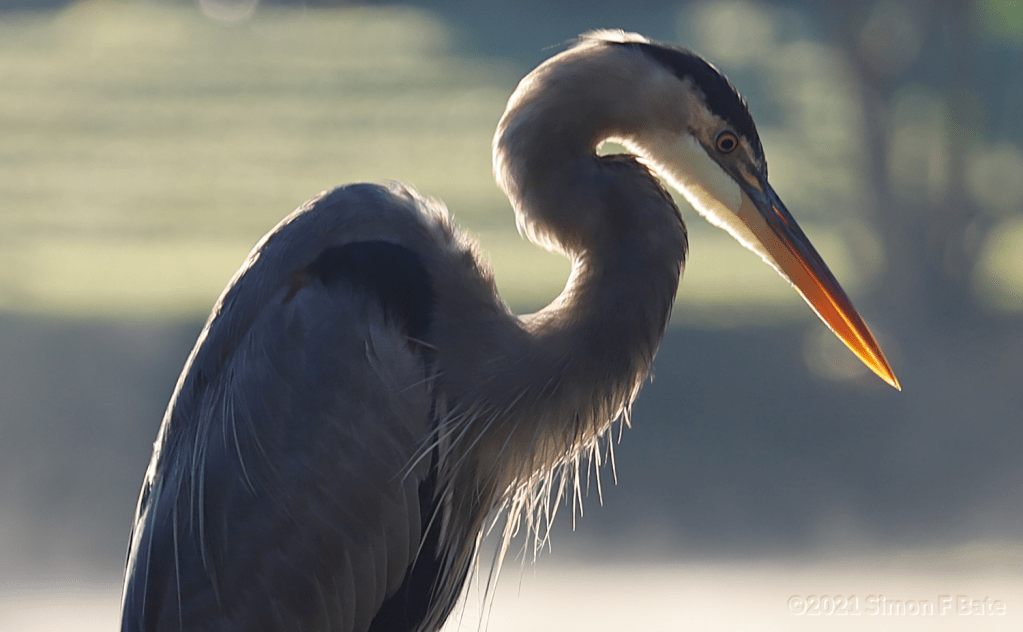
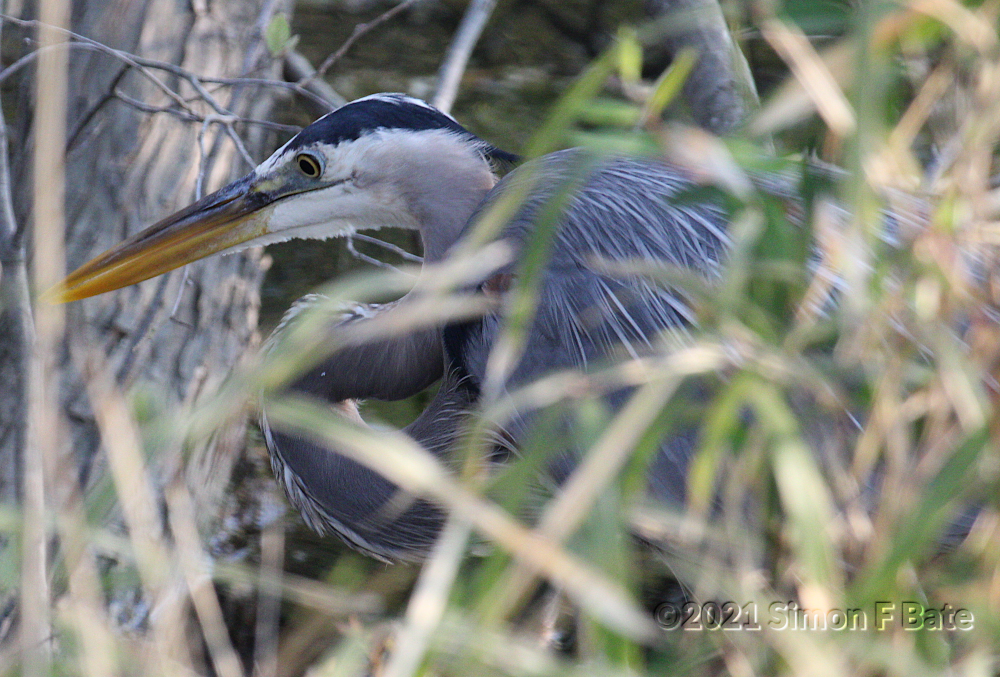
I’ve got hundreds of pictures of Great Blue Herons, yet I keep taking more. This one flew over me while I was on the pier. As it flew, it had its neck extended which reminded me of watching Sandhill Cranes. I noted where it landed and it was still there when I got to the other side of the pond. Not a 100% clear view, but I like the effect.

Like what you see? Leave me a comment!

Follow the blog to get updates.

Cold-season Arrivals

As if someone threw a switch, the humidity departed, the air got colder, and two winter residents made their first appearance.

In the shrubs by the pier I encountered a number of Yellow-rumped Warblers. While the leaves are still on the trees, it’s quite hard to get a picture, because they move around so quickly. This female paused for just long enough.

On the same day, by the settling pond behind the town homes, I found a couple of Ruby-crowned Kinglets. Here’s the female (there’s a trend here).

At this time of year, there are still a few summer stragglers. This female Ruby-throated Hummingbird also appeared beside the pier.

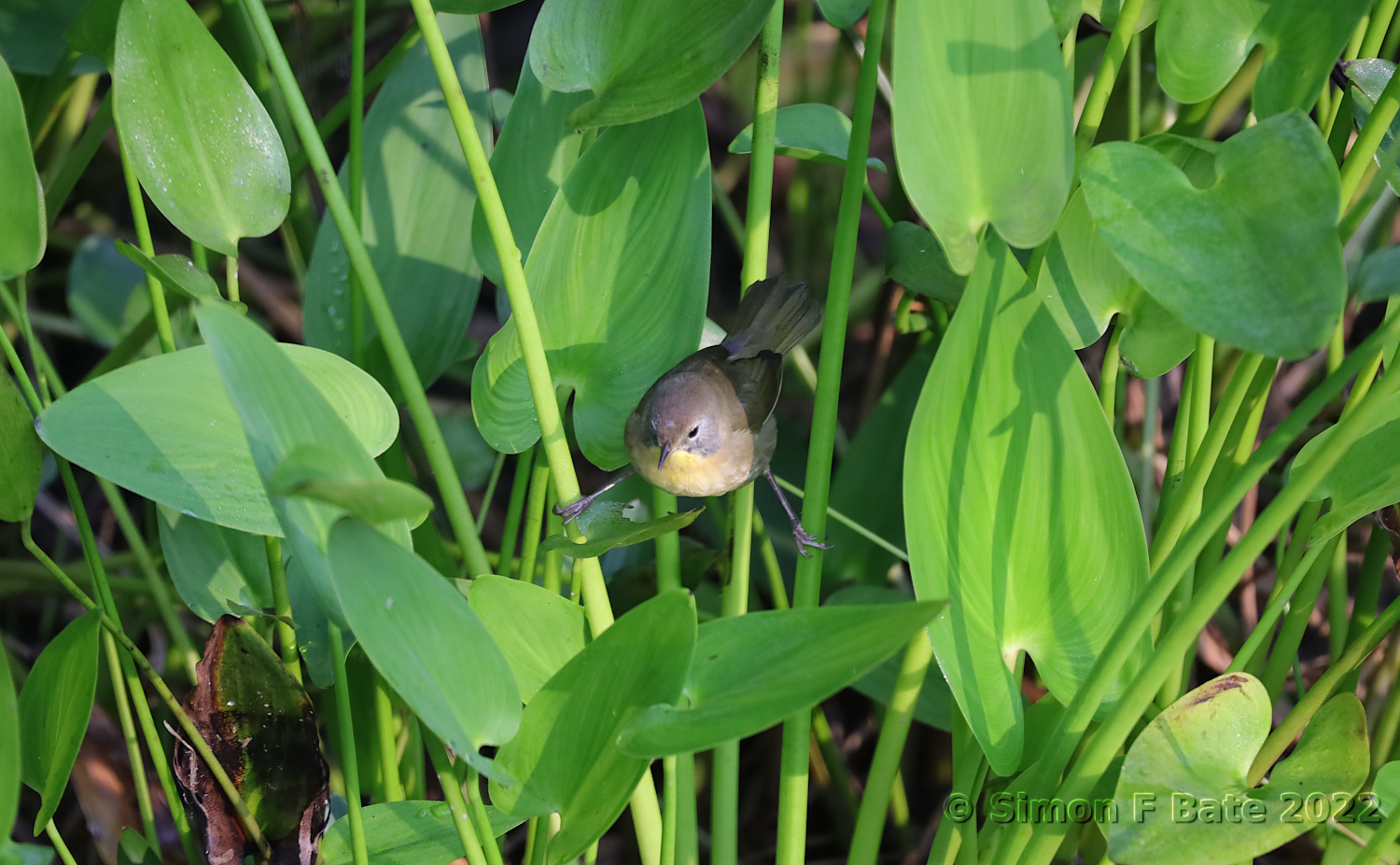
My bird books say we’re right on the cusp between summer and year-round residency for Common Yellowthroats, which might explain why I mostly see them in the spring and fall, but still do seem them around the calendar. I love this female’s jaunty, defiant pose.

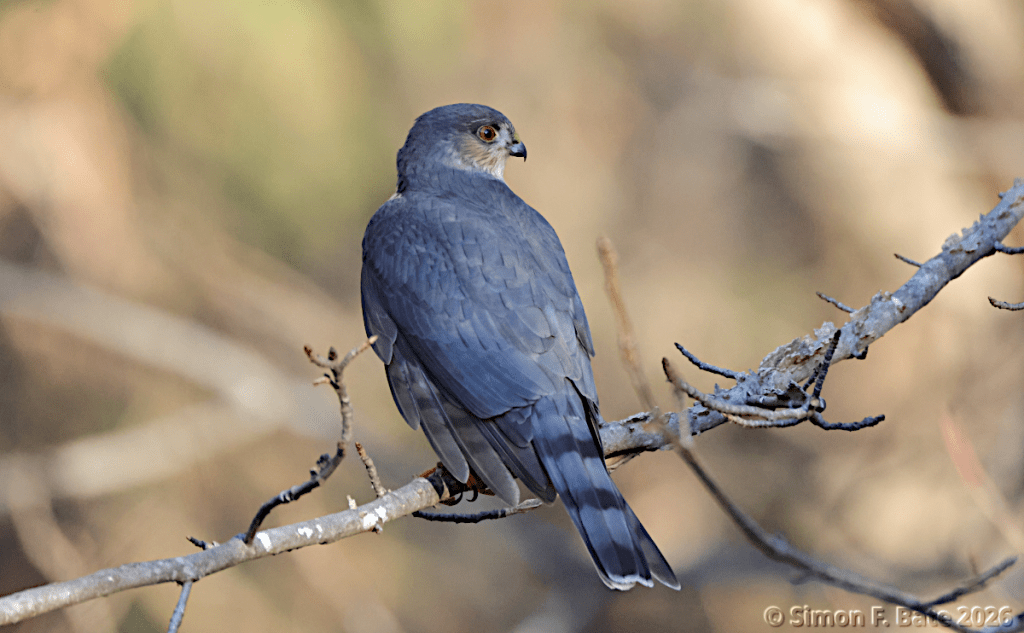
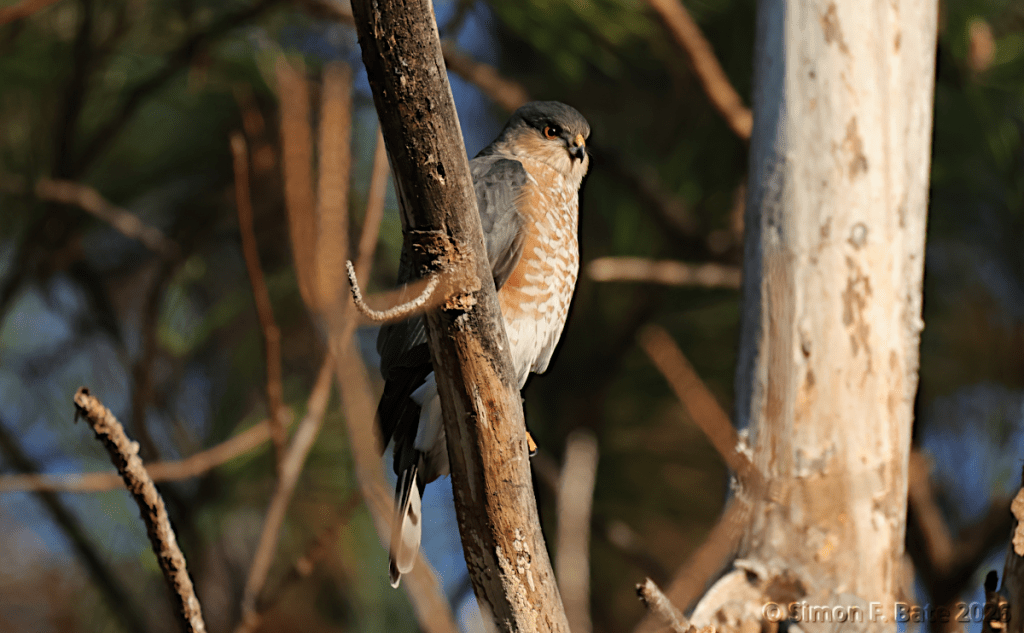
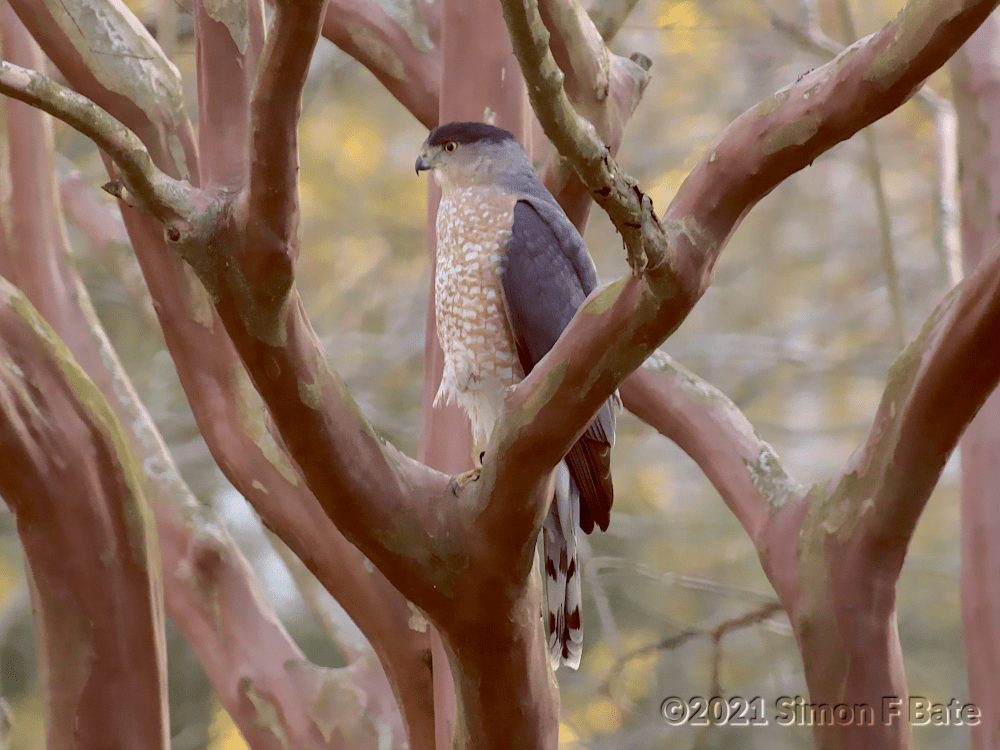
There are also a few of this season’s juveniles around. Here’s an immature Cooper’s Hawk (can’t distinguish the sex).

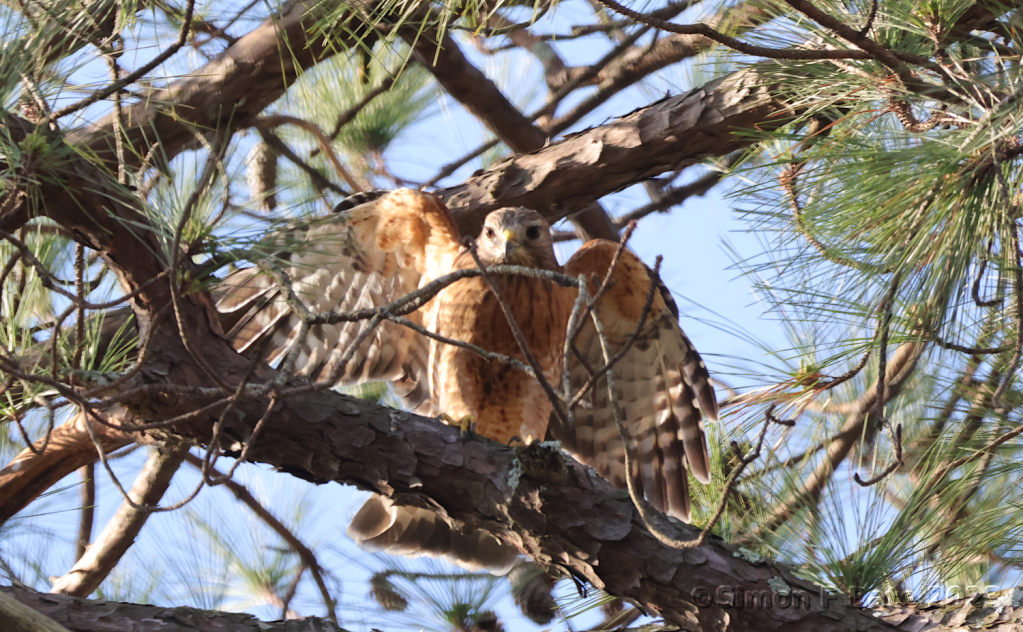
And, of course, the year-round residents appear regularly. Staying with the raptor theme, I had a close encounter with a Red-shouldered Hawk the other day.

Eastern Phoebes seem to be everywhere right now. Perhaps it was a good year for nestlings.

Pine Warblers are with us all year around, but have only started to become more visible.

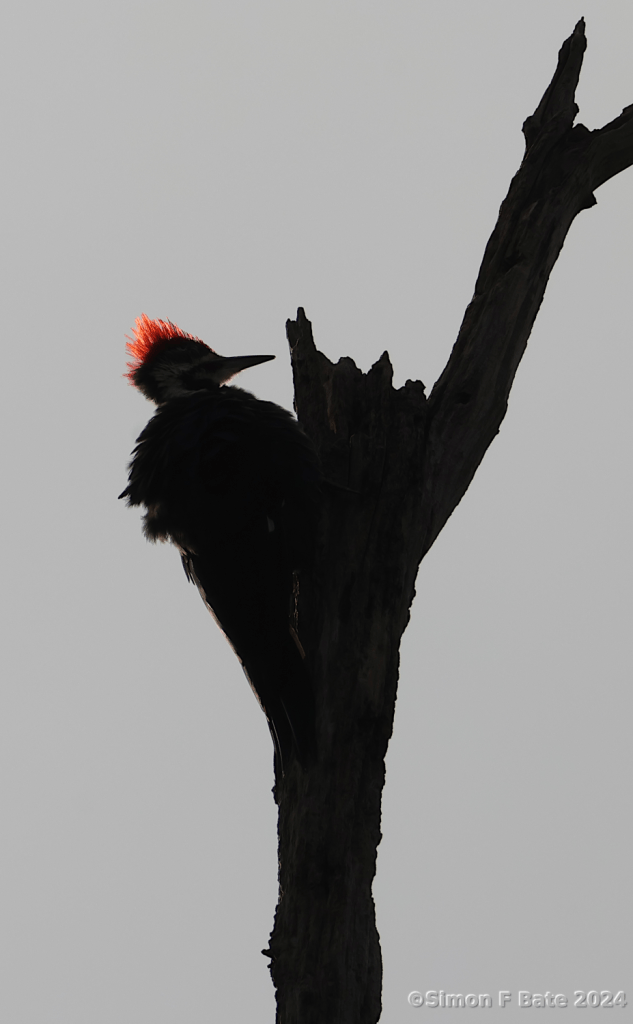
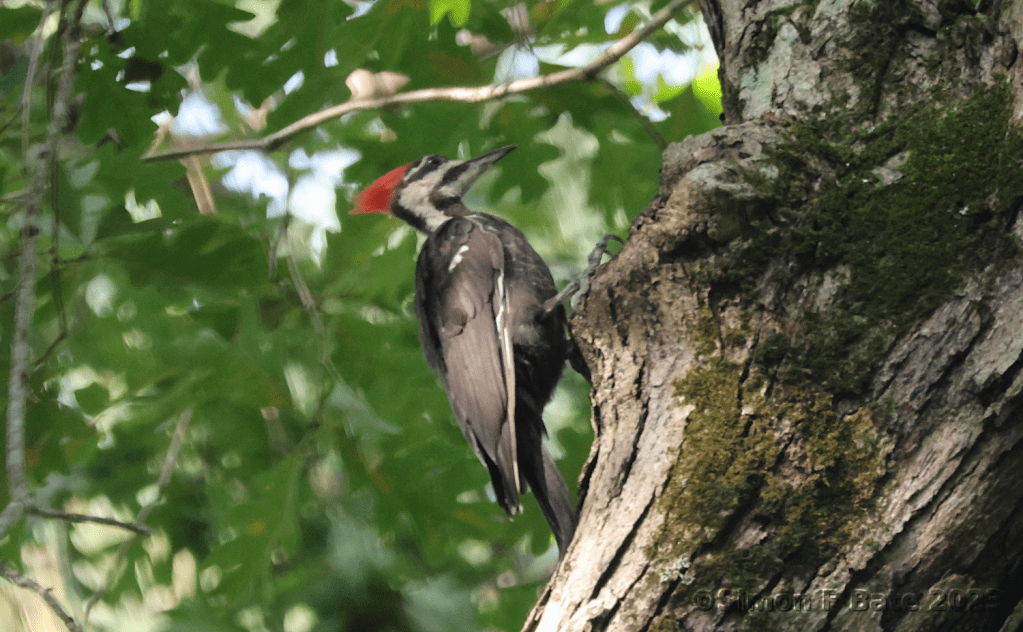
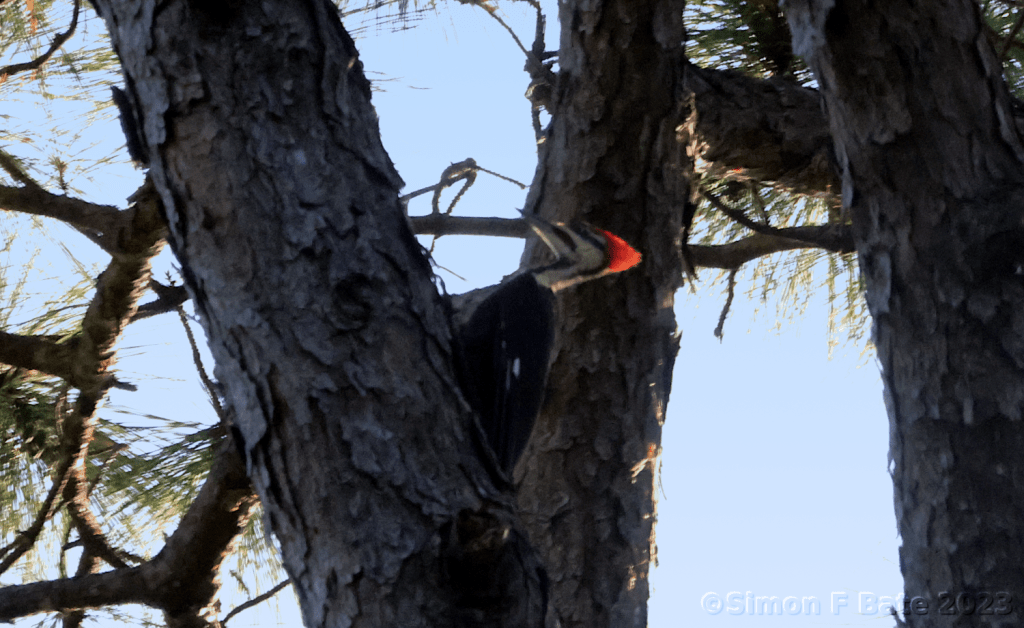
Finally, the Pileated Woodpeckers pop up every once in a while. I have yet to get a good full image of one using my new lens, but I was happy I could take some advantage of the strong silhouetting on this one (yet another female).

If you like something, leave me a comment!

Follow the blog to get updates!

August is slow

Although I’ve been walking every day (apart from a three-day trip to the beach), I just haven’t been seeing much to photograph. I’ve written before about how August to early September is a slow time for birds.

Nevertheless, I have seen a few birds worth showing here.

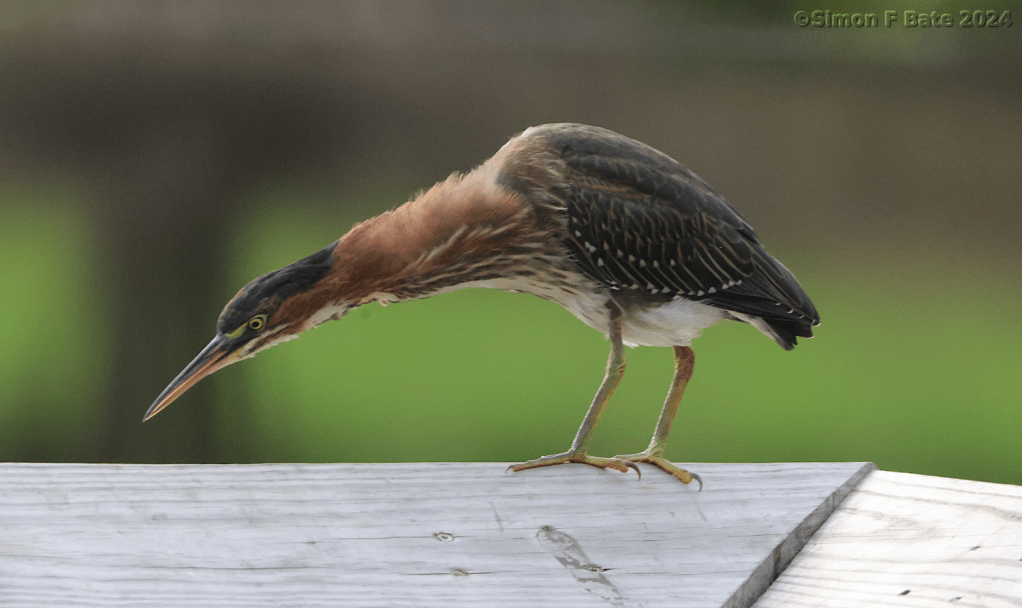
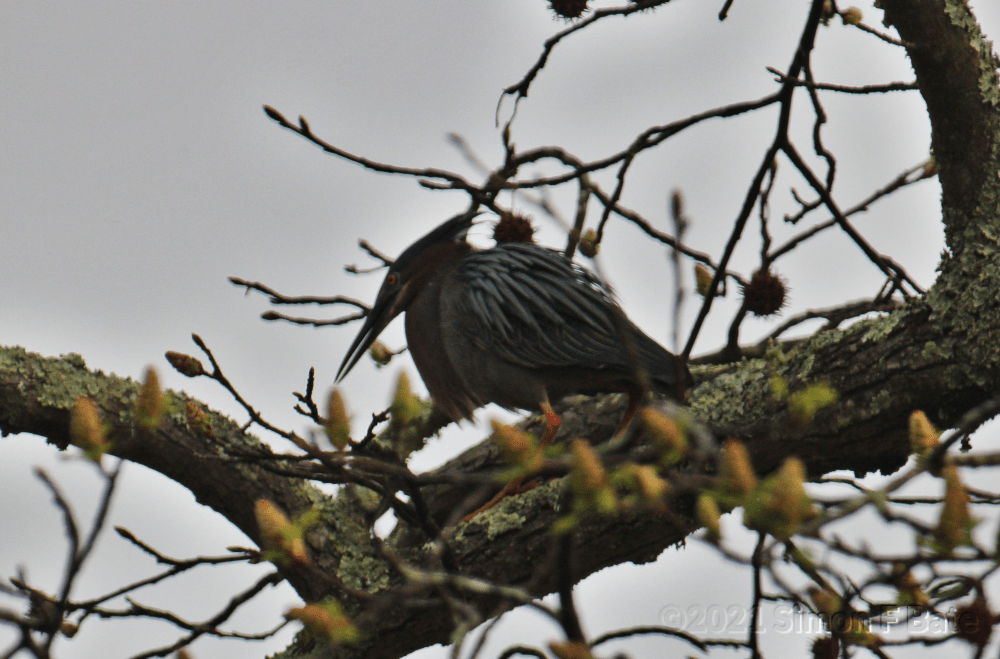
As predicted, the Green Herons have left for the year. Here’s a look back to July when a young one was sunning itself on the pier.

Shortly after I got my new lens, I spied a young Eastern Bluebird on an oak-leaf hydrangea.

One of the distinctive features of the Eastern Kingbird is the white bar across its tail. Unfortunately this one would not cooperate, it just wanted to show its front (and a pretty one, at that).

Another look back to the Green Herons. This one is also a juvenile, although somewhat older.

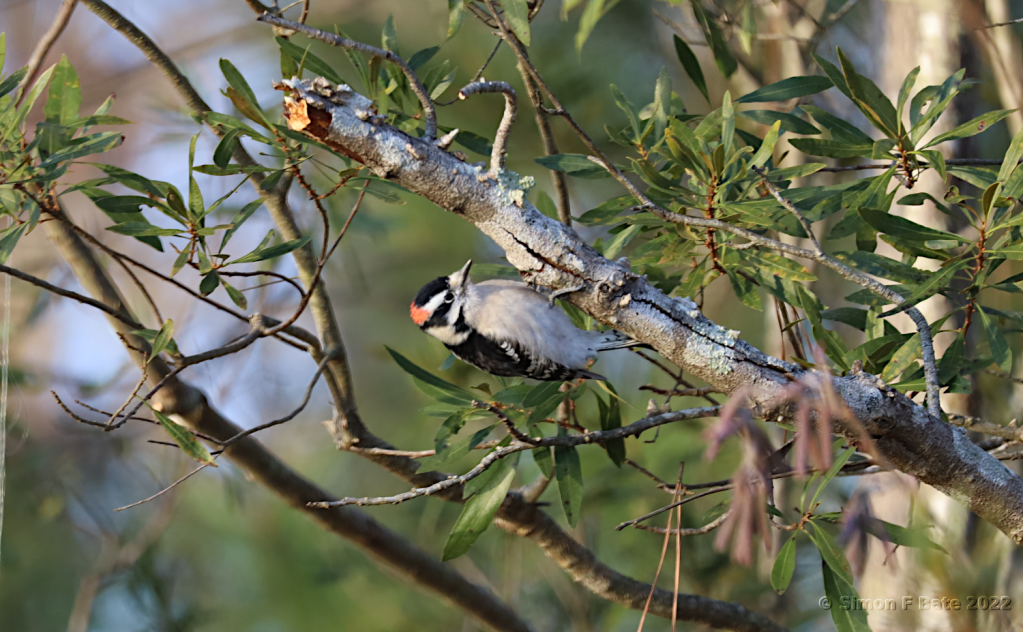
Woodpeckers don’t always walk up trees. Sometimes the walk across branches. But if you rotated this image, it would certainly look like this Downy Woodpecker was walking up the branch.

And last, here’s a Red-tailed Hawk. I’ve remarked earlier, they don’t often venture past the west side of the pond. This one is following the unwritten rule: it’s just outside Seagroves Park, to the west.

Not showing a lot of red tail, but it does have it nicely folded, like a Japanese fan.

Like what you’re seeing? Let me know!

Follow the blog to get updates!

2024 Fledglings (part ii)

I’m still finding more fledglings (and nestlings), and I’m not done yet!

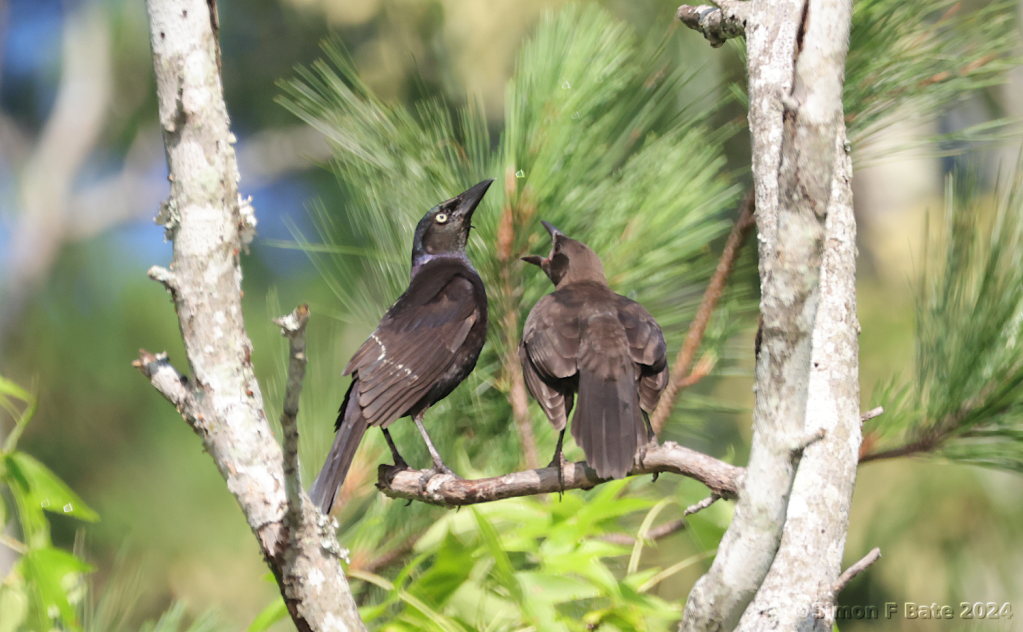
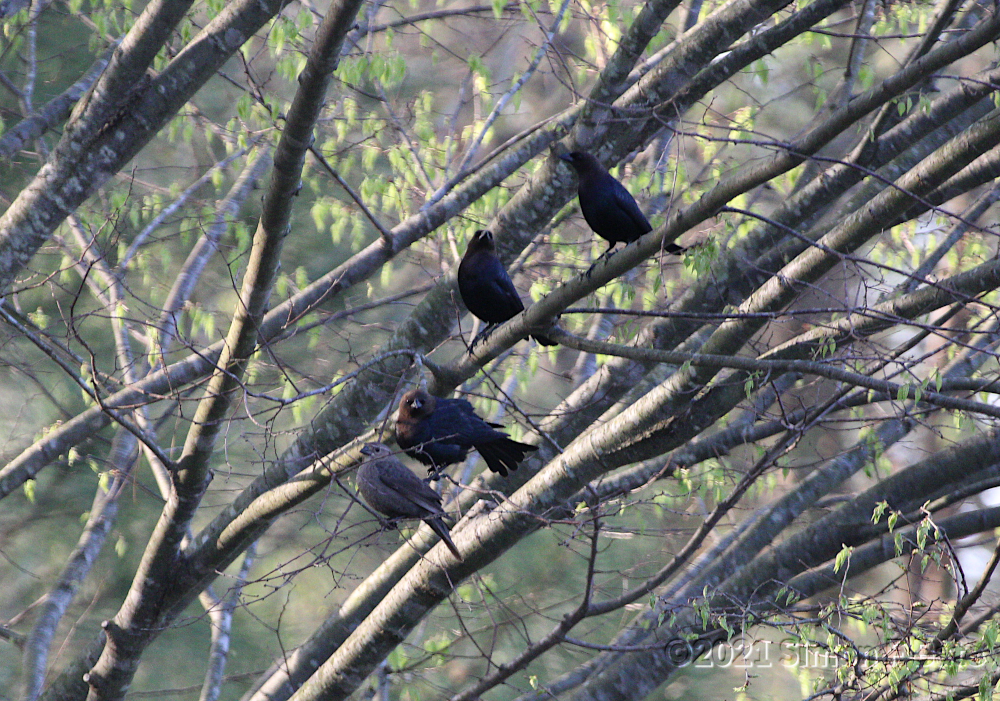
Here’s a Common Grackle and its young begging for a snack. I keep looking at the series of pictures I took and making sure it’s not a young Brown-headed Cowbird. I’m pretty sure it isn’t by its size and the immature Common Grackles’ irises don’t turn yellow until September.

In the woods, I found a young Downy Woodpecker (looks a bit grumpy).

I’ve got my eye (and lens) on a couple of Green Heron nests. The parents are now on their second clutch of eggs/nestlings. One nest is about 3 weeks old; another probably 1 week old. I think my next post will be these young Green Herons. In the mean time, here’s a fledgling from the year’s first clutch; by now it’s quite independent…and stretchy, too.

Being mostly a buff color, the Rough-winged Swallows aren’t quite as impressive as some of their cousins, but they’re still beautiful flyers and are cute when they pose. (I like the grain in the wood in this picture, too.)

But nothing compares to catching the adult back-lit as it feeds a youngster.

Let me know what you like. Follow the blog for updates!

Fledglings, etc. (2024 edition)

Yikes! It’s been two months (or more) since my last post. Perhaps the birds just haven’t been as exciting, or perhaps I’m not pleased with the pictures I’ve been taking. Also, my mobility has been limited, because I have to wear a boot to heal a stress fracture.

Anyway, enough of excuses. In the past few days, I’ve been able to capture several pictures that are either interesting or attractive (or both).

Most of what I’m seeing right now are this year’s crop of young birds.

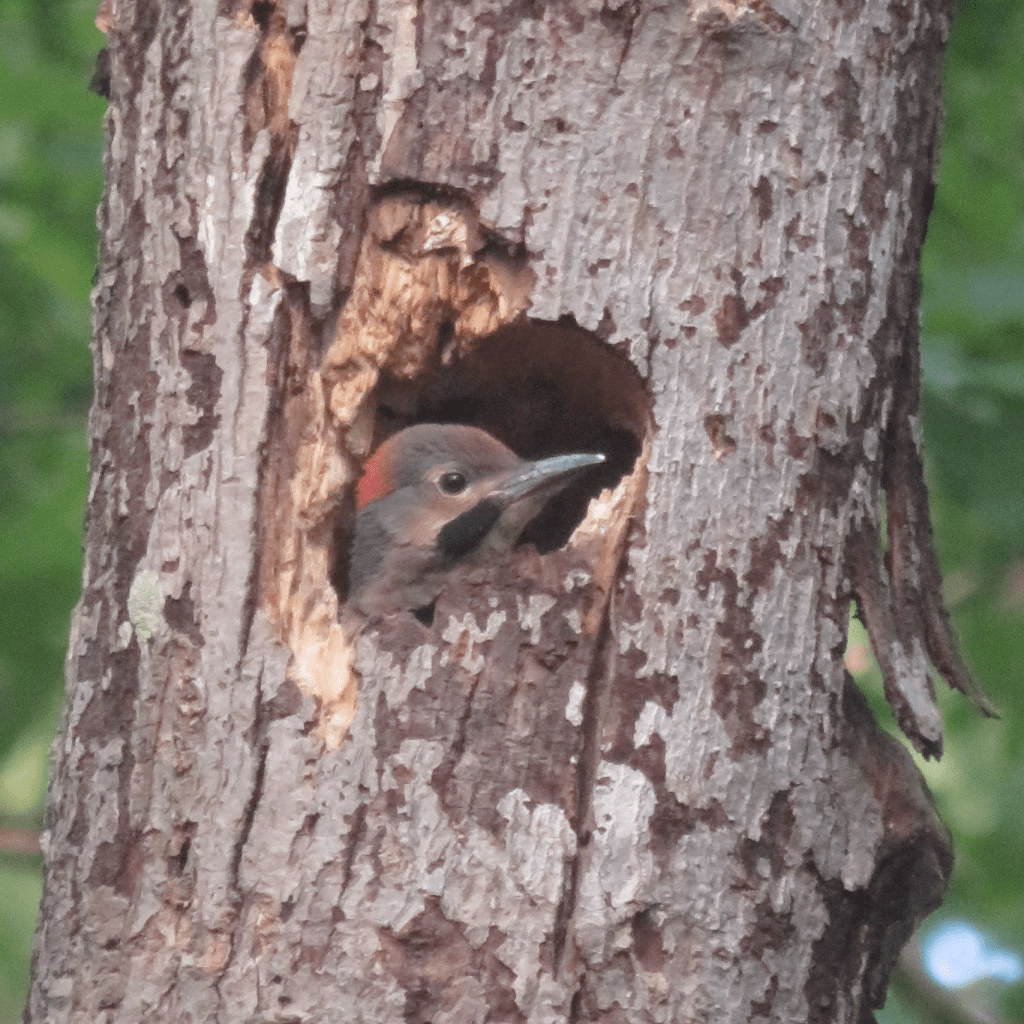
In years past, I’ve seen Red-bellied Woodpeckers raise their young in concealed holes. This year, a pair of woodpeckers dug a hole in a tree in plain view. I’d been watching the hole for a couple of years; I think it was originally created by a Downy Woodpecker. The hole got a whole lot bigger this year, then I saw the Red-bellies. Here’s the young ‘un looking out.

Here’s the male. I love the reds and greens in this picture.

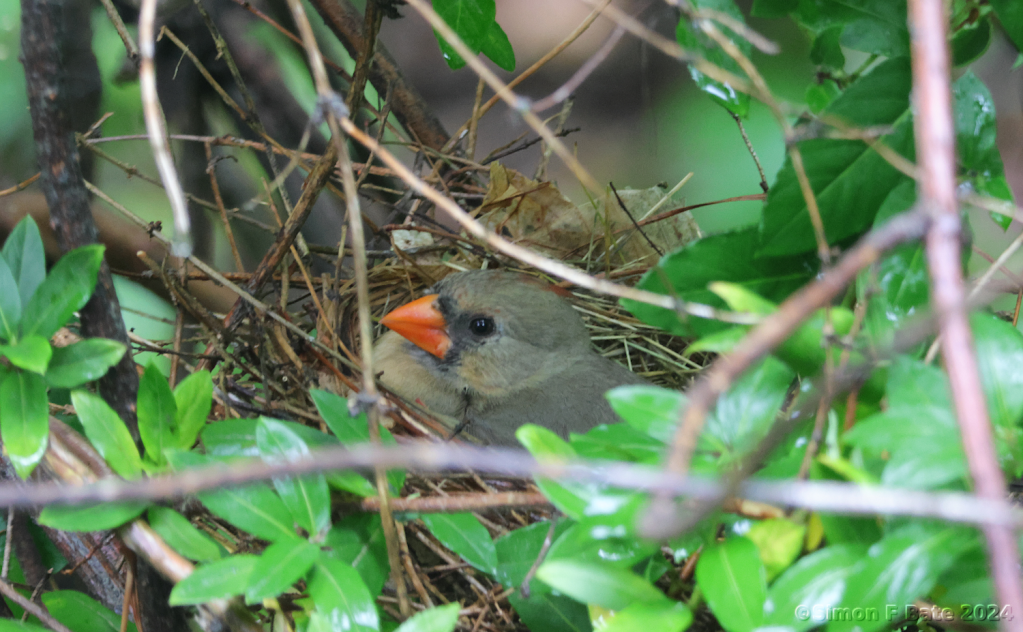
A few days ago, I saw a female Northern Cardinal fly into a bush just off the south bridge. Watching her for a few minutes, I saw her hop to a nest and settle in. She’s still settled at this writing; no evidence of eggs yet, but I’ll see what develops.

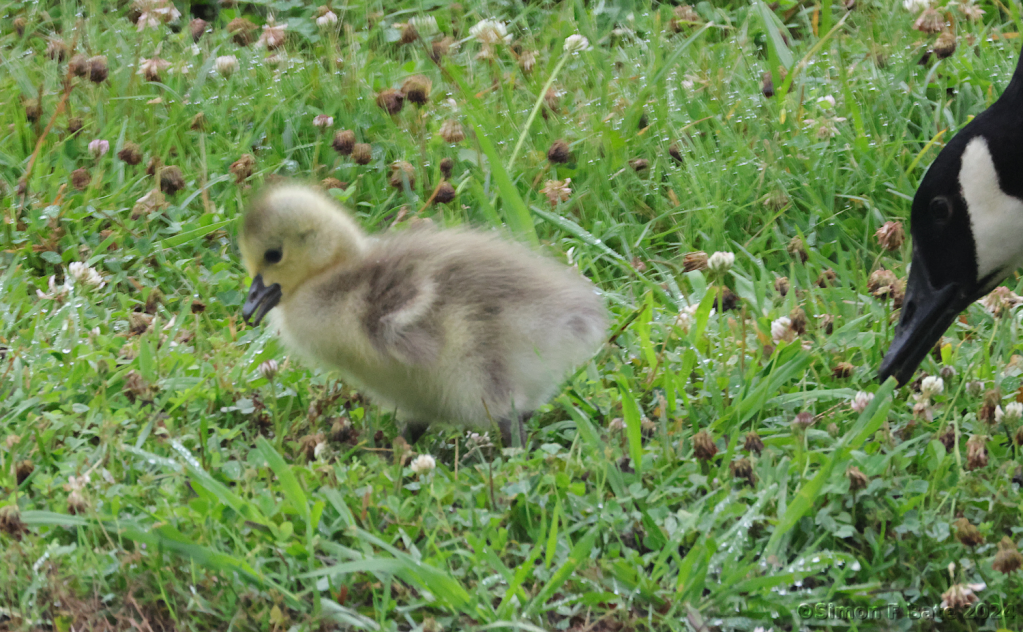
We get Canada Geese throughout the year, but this is the first year in memory that there have been goslings around the pond. Yes, they grow up to be geese, but while they’re goslings, they’re cute.

Shortly after seeing the gosling, I looked across the grass and noticed a recently-fledged Brown Thrasher.

Finally, this morning, I encountered a male Northern Cardinal that clearly wanted it’s picture taken, so I did.

Like something? Leave me a comment.

Follow the blog to get updates!

Three birds; four pictures

This last week I took several pictures I’m quite happy with (for one reason or another).

Let’s see if I can get to the pictures and keep the words to a minimum!

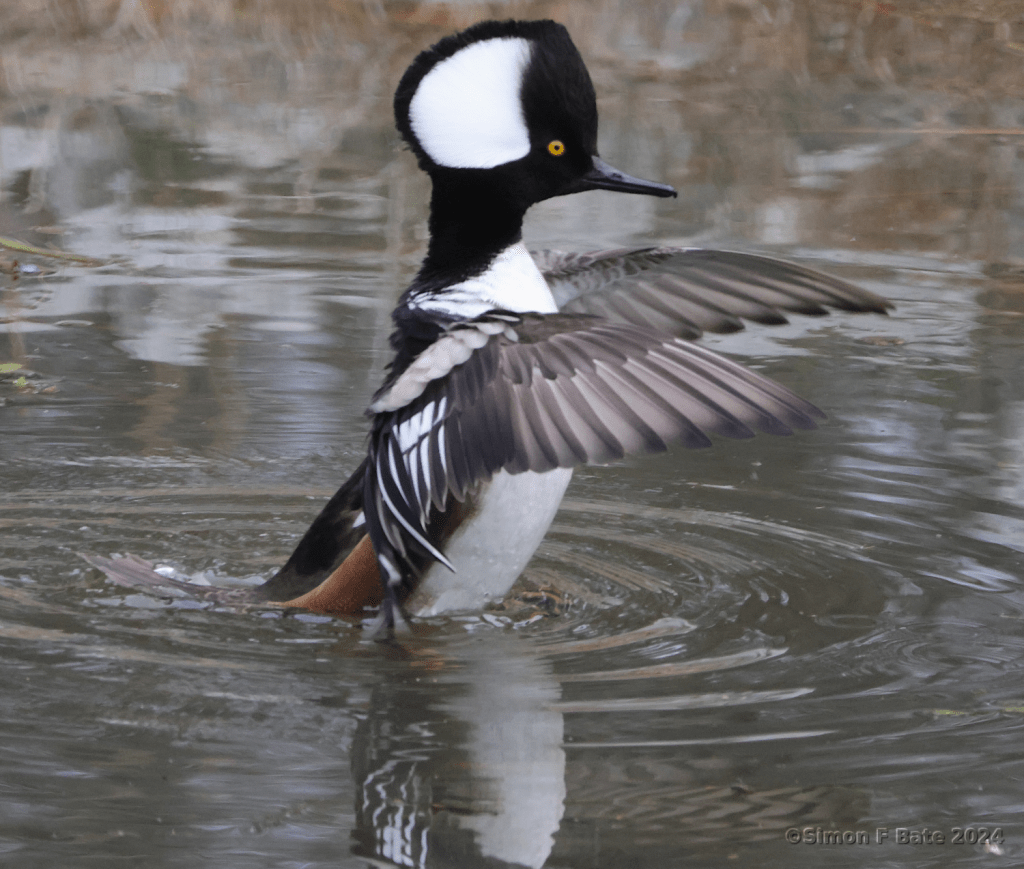
I’ve frequently seen mergansers and other ducks make a display like this, but usually it’s on the other side of the pond. I got lucky on this one. I suspect that rather than a mating behavior, it seems to be the final “settling” of feathers after preening.

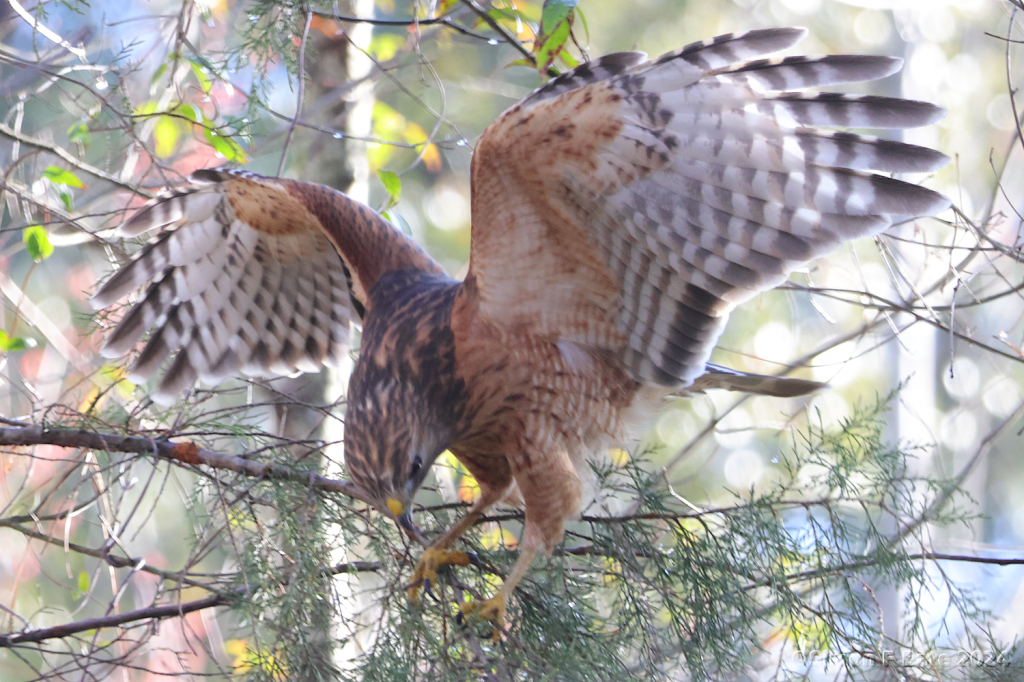
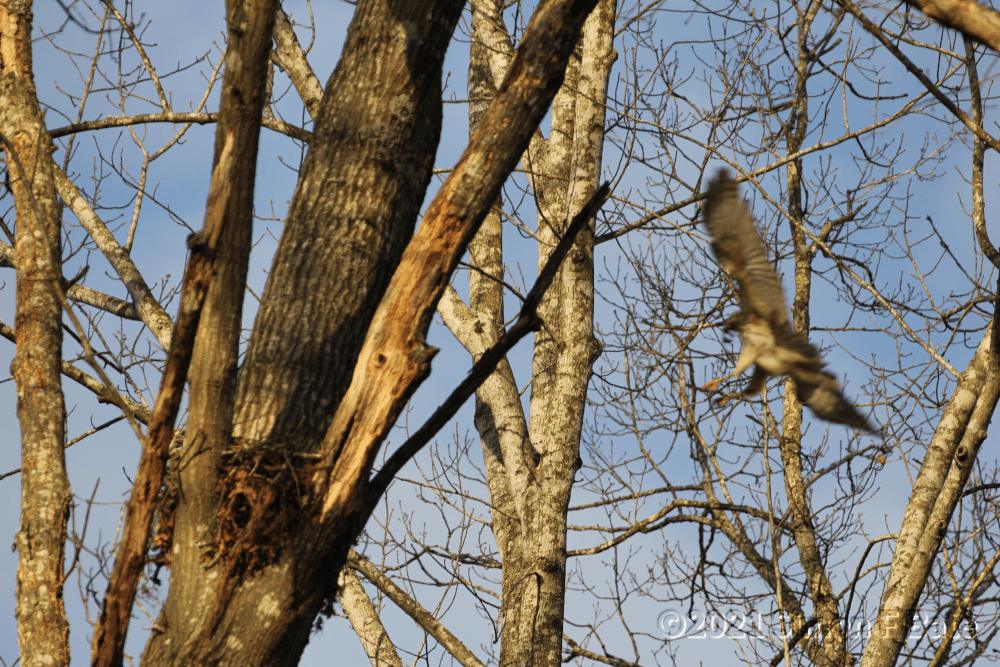
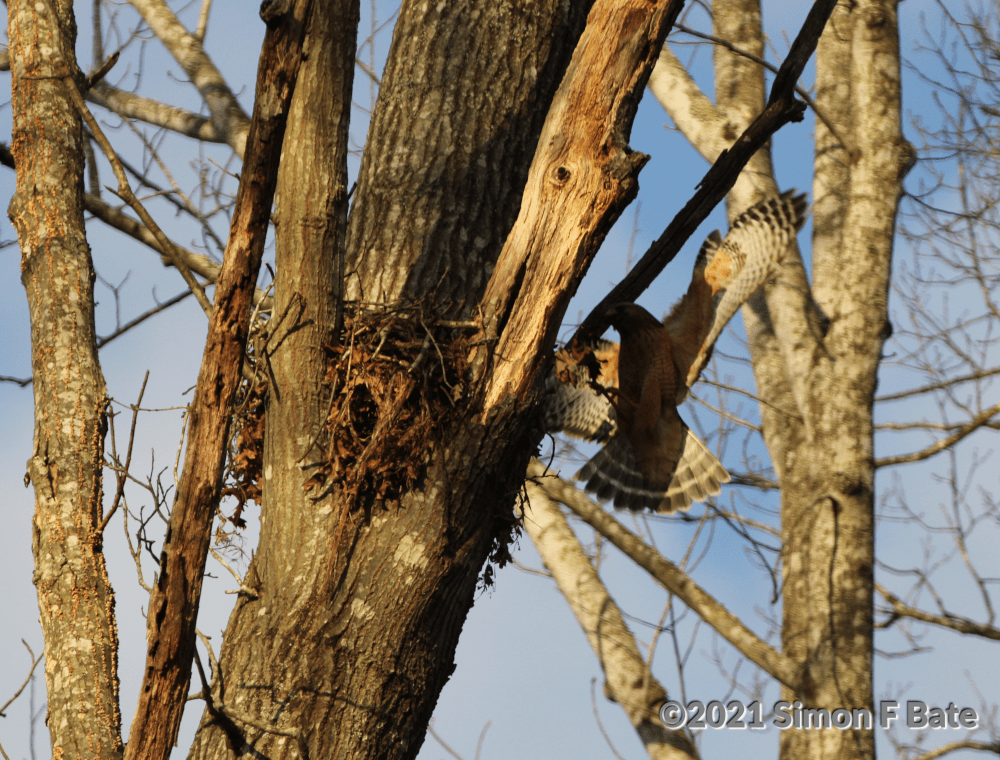
A pair of Red-shouldered Hawks is practicing nest building near the north bridge. This one was after some softer material, but couldn’t quite get a branch free.

I’ve read that the female Ruby-crowned Kinglet does have a tiny crest of red, but it usually doesn’t show (as with this one). Because kinglets are constantly in motion, I was happy this one came out just about right.

Let me know what you like; tell me why!

Follow the blog to get updates!

Cold-blooded breakfasts

This morning I saw two hunters having their breakfast. One was somewhat expected; the other was a surprise.

I usually think that hawks eat rather large-sized prey (squirrels, voles, jays, and the like), but the truth is they eat just about whatever they can find. At first I thought this Red-shouldered Hawk was eating a frog. After all, it had just flown up from a stream to its “breakfast table.” But when I downloaded the pictures, I was surprised to see pincers. It had a crayfish.

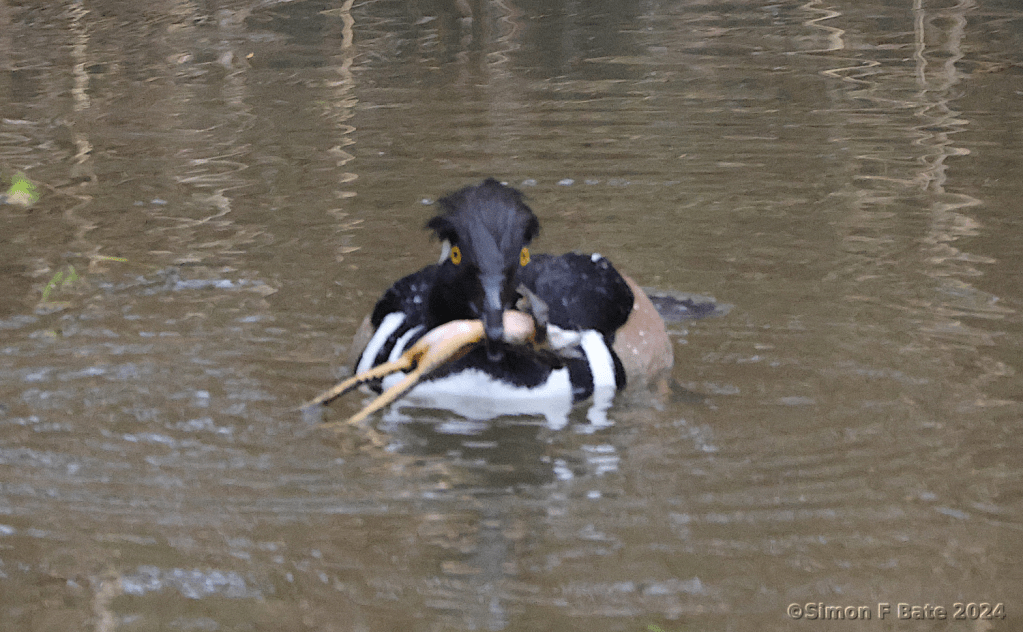
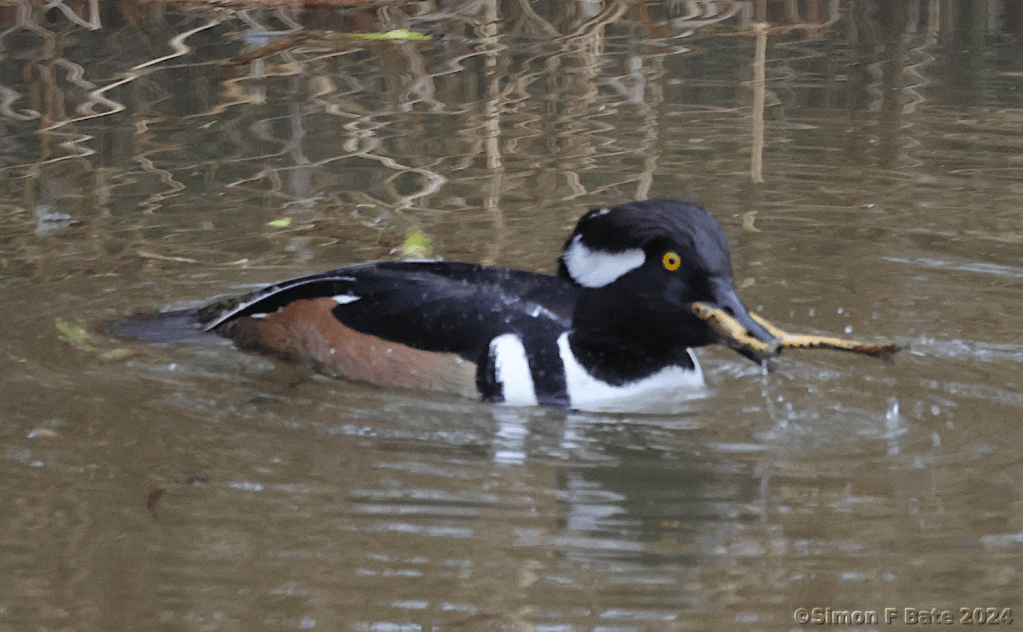
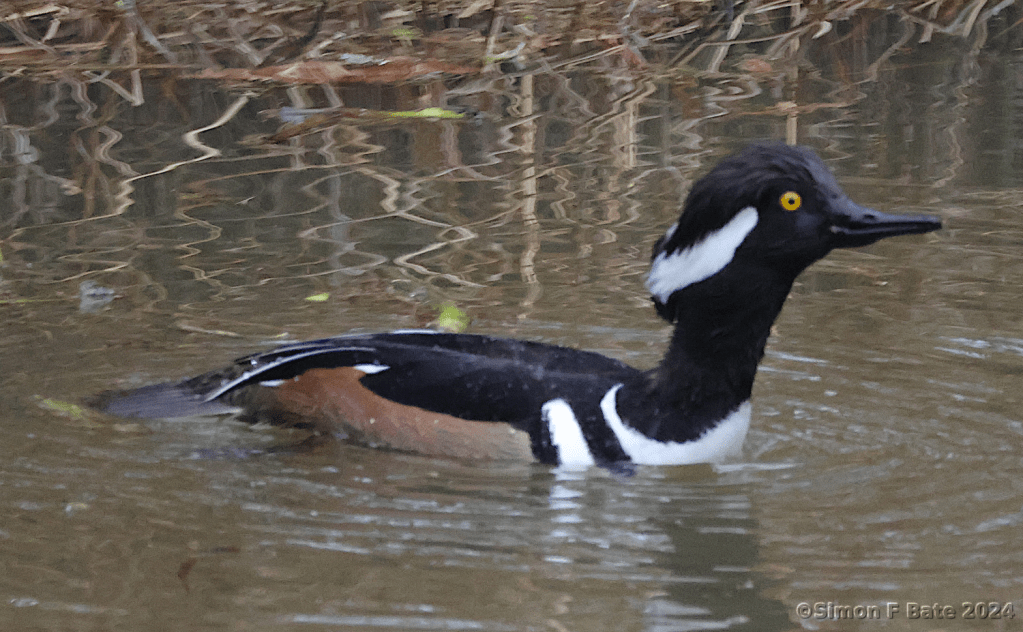
In another assumption blown, I thought of the Hooded Mergansers we see on the pond were sweet, fluffy ducks. I assumed they ate insects and small fry. Nothing like the Great Blue Heron I saw last summer consuming a bullfrog.

Not any more.

I was watching as this male surfaced and started to prepare a rather large frog (relatively speaking) for breakfast. I took a large number of shots, but I think this gallery summarizes the action quite well.

So what did you have for breakfast? Did you see any carnivorous birds at work?

Leave me a comment telling me what you like (or not).

Follow the blog to get updates.

Not from here

Last week I visited family in southern Oregon. Of course I took my camera and encountered a few birds. Two species were new additions to my life list (Red-breasted Sapsucker and Varied Thrush). I captured a few “ok” pictures of the sapsucker; I’ll have to wait until next time to get the thrush. Many other birds I had seen before; it was nice to make their acquaintance again.

As we have Yellow-bellied Sapsuckers during the winter, Red-breasted Sapsuckers—their western cousins—can be found all along the west coast, all the year around.

Before I had identified it, I was pretty sure it was a sapsucker because of the rows of marks on the tree, a trademark of sapsuckers.

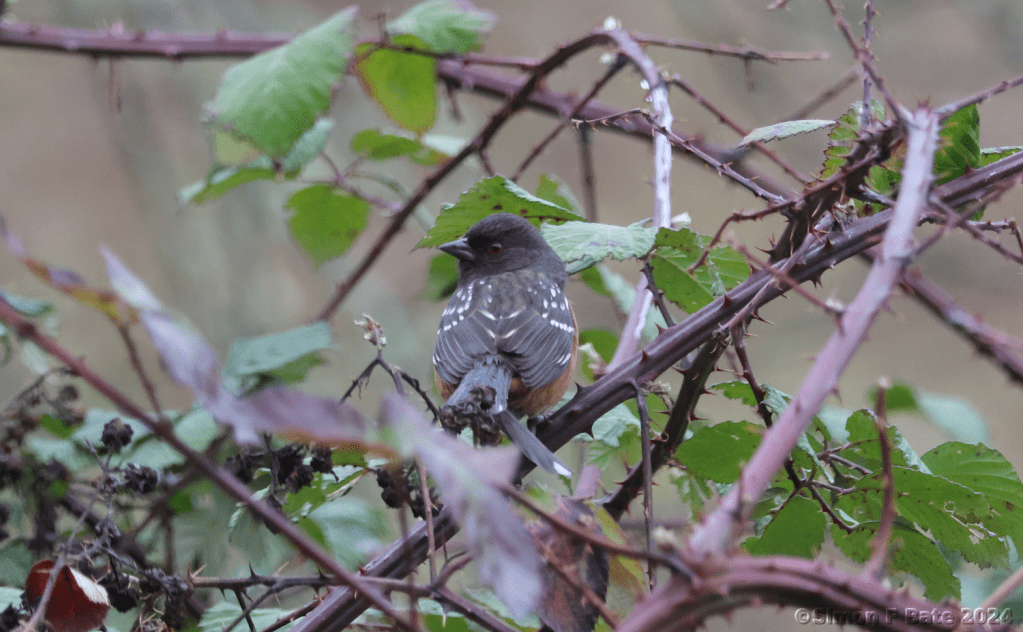
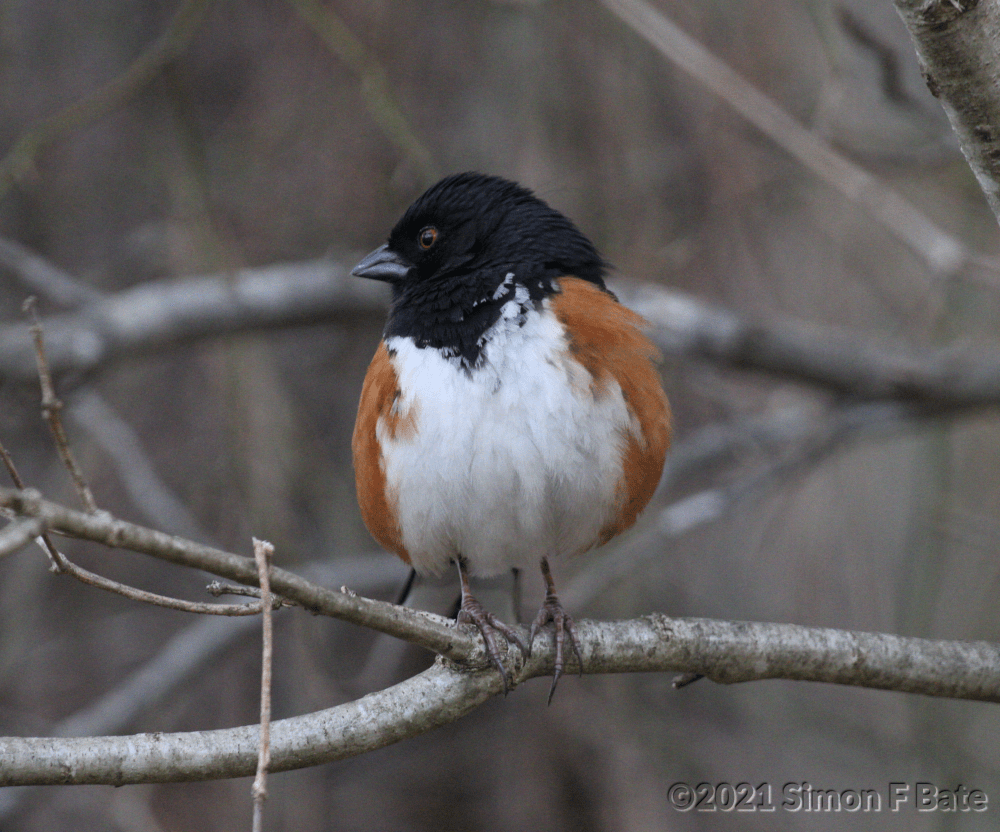
Here’s another western cousin of one of our birds. Eastern Towhees are quite common east of the Great Plains. In the west, you’ll find Spotted Towhees. The two species were actually considered different races of the same bird (Rufous-sided Towhee) up to a few years ago.

Wild Turkeys are found across the United States, all the year around. I’ve never encountered one in Apex, but I’ve heard them by the Jordan Lake dam. These two toms were accompanying a hen across a meadow, strutting their stuff and putting on a full display. The first picture has better detail, but I liked seeing them pose almost back-to-back.

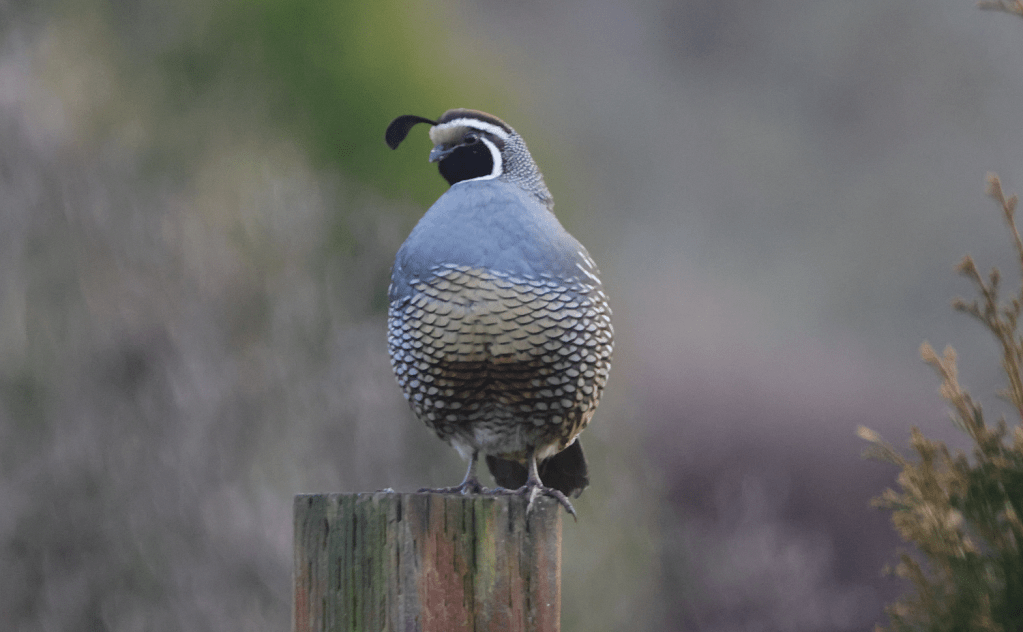
A distant cousin of the Wild Turkey, California Quail are found over much of the west coast (not just California). This male posed nicely for me.

Give me a like if you’re enjoying the birds! Follow the blog for updates!

Catch Up (part ii)

Last week I said I was catching up with a backlog of pictures [Catch Up (part i)]. Today I’ll continue with a number of January pictures that are worth sharing.

In addition to the Hooded Mergansers and Yellow-bellied Sapsuckers, I’m always happy to see the winter return of the kinglets. Here’s a Ruby-crowned Kinglet showing just a bit of its crest.

A few minutes earlier I had found him preening, stretching, and showing his crest. There are too many twigs in the way, but the crest is something special.

I take dozens of pictures of Red-shouldered Hawks, Great Blue Herons, Green Herons and the like. Maybe it’s because sometimes I capture a picture that I really like.

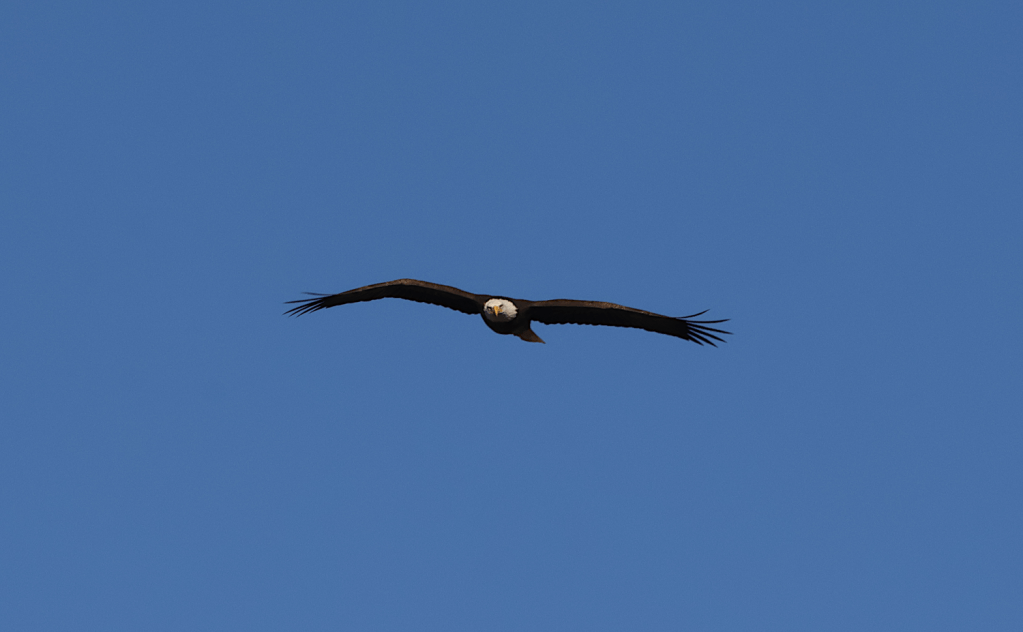
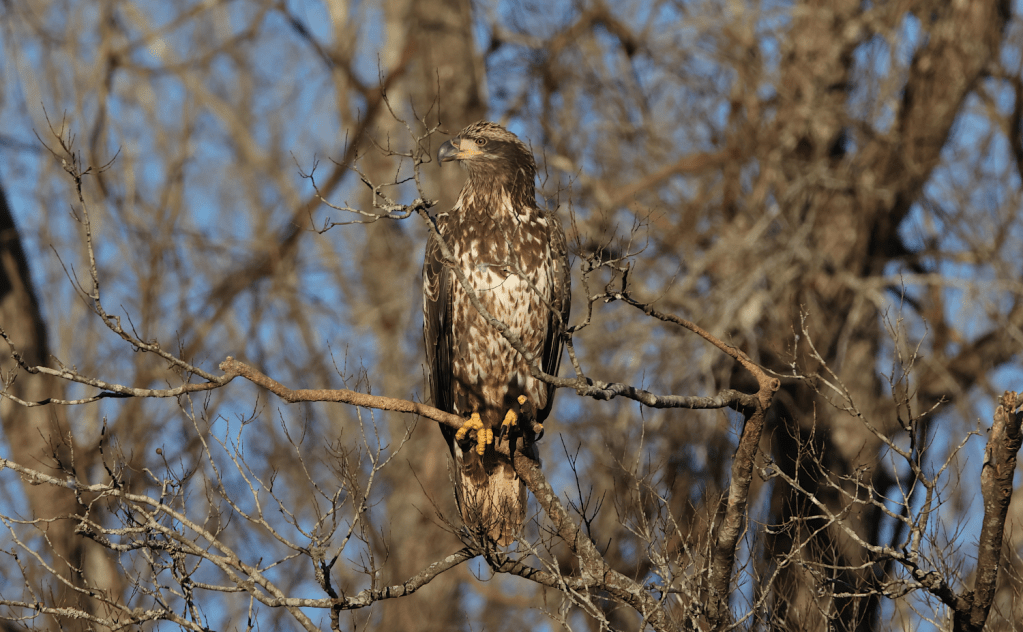
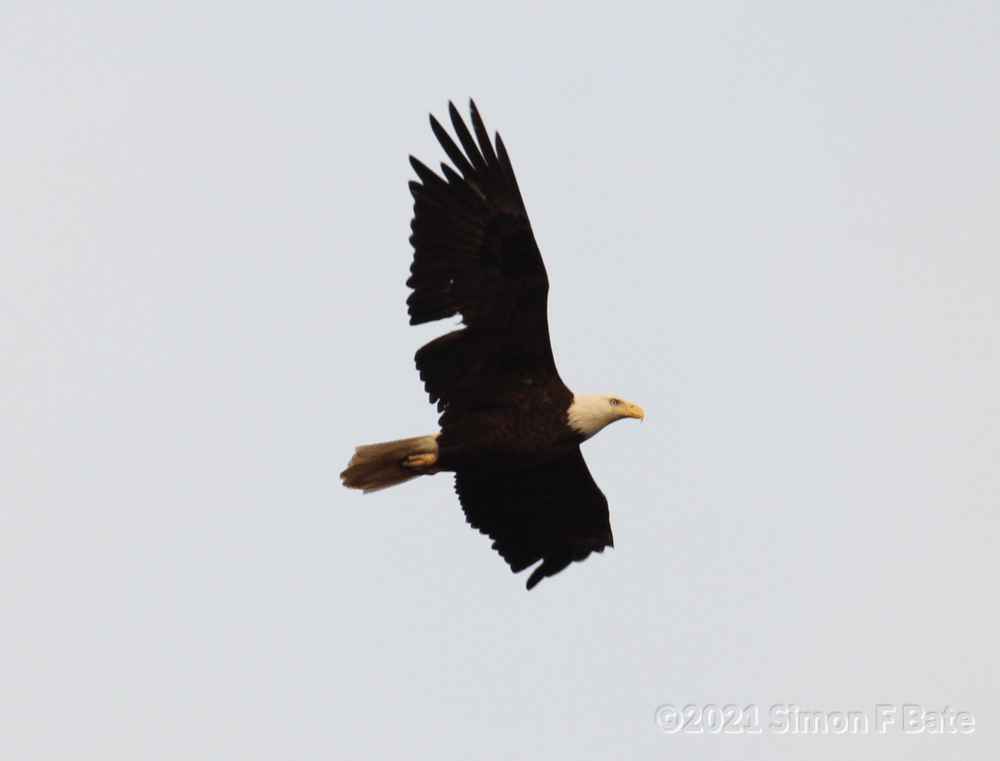
Stepping away from the pond for a bit, you may have seen in news reports that at this time of year the Bald Eagles gather at the Jordan Lake Dam spillway. I have been do the dam a couple of times this winter. Perhaps I’ll go again. I’m not thrilled with these shots, but perhaps I have an ideal of perfection in mind.

This is a juvenile, perhaps first year. I ran into T at the dam and he let me take a few pictures with his massive zoom.

Let me know if you like a picture in this post! Let me know what you like about it.

Follow the blog for updates.

Catch Up (part i)

It’s been a while since I posted. I’ve been collecting a bunch of pictures, but haven’t had time (or, I’ll admit, inclination) to post. Call it the January blues.

In the spirit of hustling to catch up with my backlog, I’ll post a few pictures here and try to limit my verbiage. If I’m lucky (and inclined) I might get a “part ii” out by the end of this weekend.

It has been chilly, so the Hooded Mergansers are back. I frequently find this pair in the holding pond behind the town homes. My win, because they’re quite close and can’t go much further away.

A Great Blue Heron has been putting in occasional appearances. Here the direct view is somewhat obscured by twigs, but the reflected view is just about as clear, and it doesn’t have twigs.

There’s nothing like having a bit of color to brighten up a dull January day. A Pine Warbler gives a nice flash of yellow that’s just what the doctor ordered.

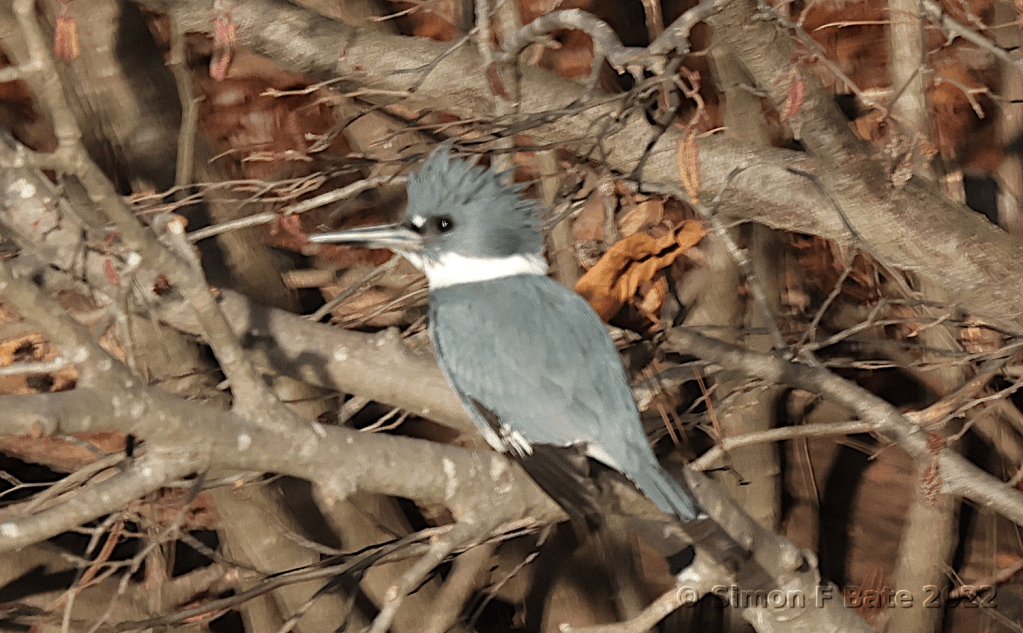
I think my nemesis, the Belted Kingfisher, is a bit off its game. Usually the slightest movement (such as raising my camera to my eye) causes it to fly off making its rattling trill. Earlier this week, I was able to sneak up on it and get some closer shots. The light was low, but it’ll take what I can get.

Let me know what you like, and what you like about it.

Follow the blog to get updates!

A Straggler and an Old Friend

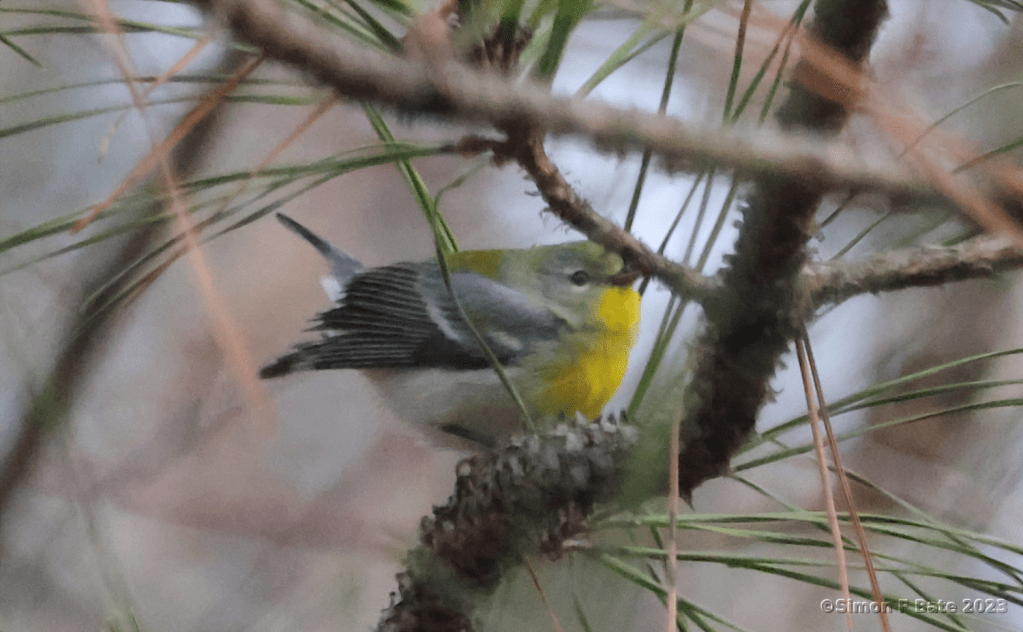
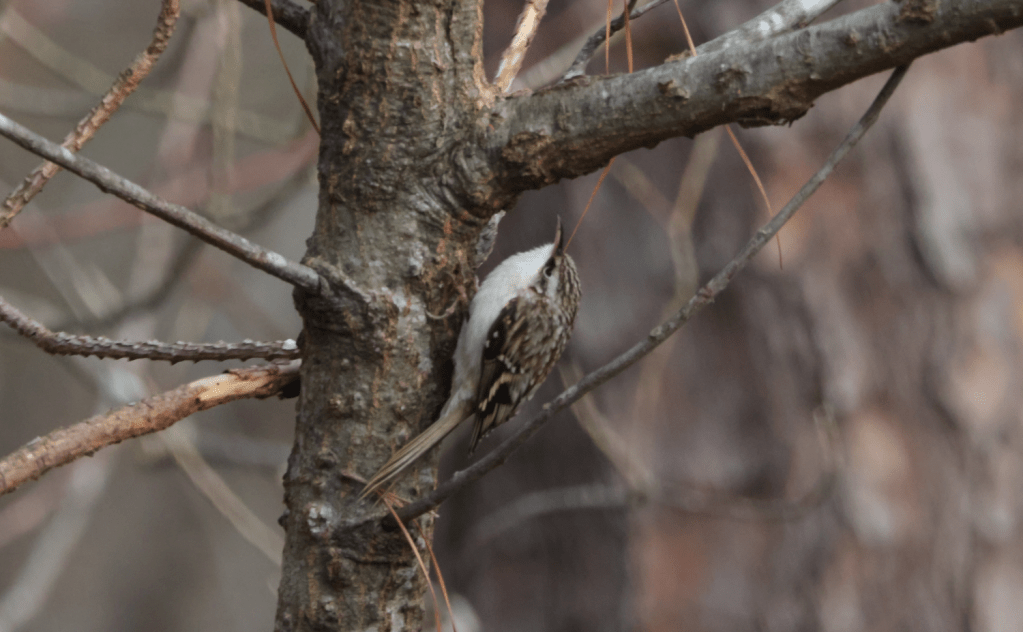
This morning I stood for a long time on Waterland Drive as it goes between Seagroves and Waterford Green. After standing still for a while, the birds started to move. First there were a few Goldfinches and a Song Sparrow. Soon I noticed some smaller bird activity. There were at least two Ruby-crowned Kinglets and a Pine Warbler. As I watched, there came two standouts.

The first I easily dismissed as a Pine Warbler, but took a picture just because it was small, pretty, and yellow. When I got home and was reviewing my pictures, I realized the markings were wrong for a Pine Warbler; it was a Northern Parula. The Northern Parula is a relatively common sight around the pond in the summer months, but in the closing days of December, it is quite a rarity. I only got two pictures, because it was quite active. This is the better of the two. Not perfect by any means, but it does show off all of the distinguishing characteristics.

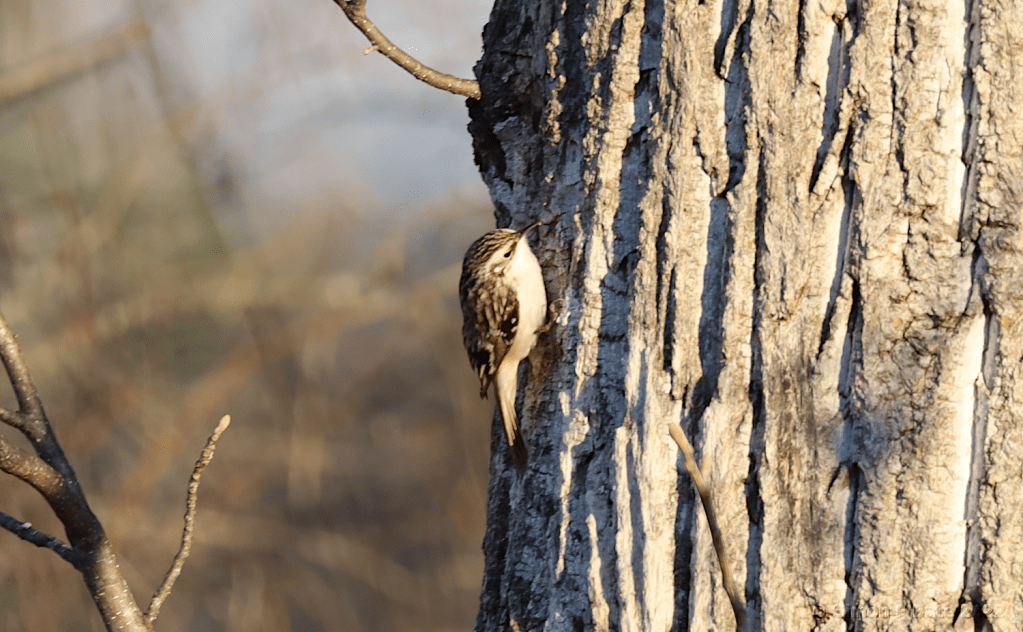
As I continued to watch, I noticed the other standout: a Brown Creeper. Two winters ago I saw them fairly frequently; last winter, I didn’t see one at all. I’m quite happy to see one again. The mottled pattern on their backs renders them practically invisible against the bark of tree trunks. Because this creeper is on a tree with a smaller diameter, the white underparts (not normally seen) are quite visible.

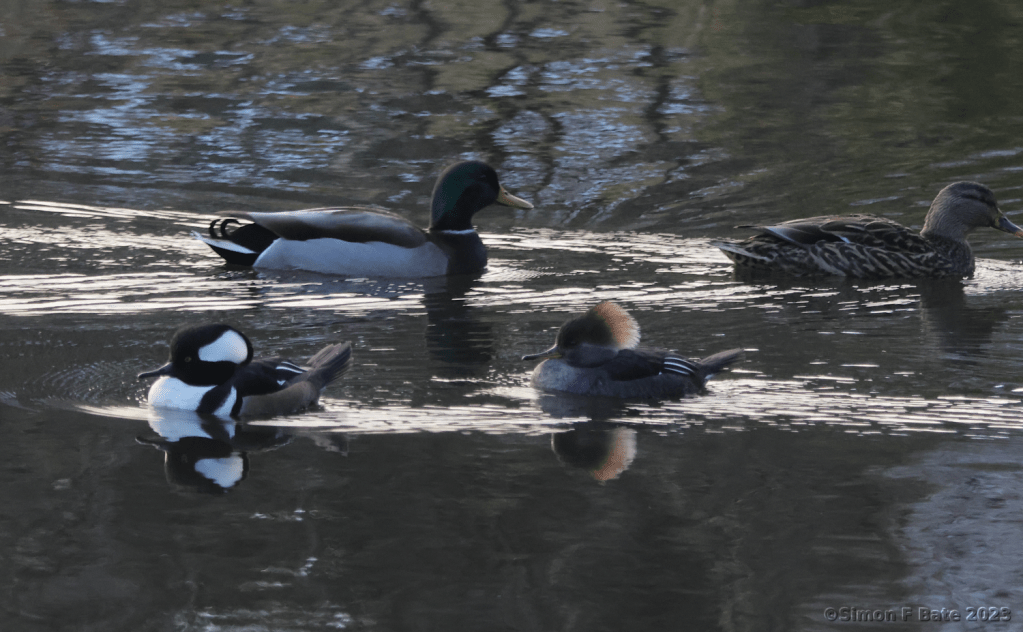
Back at the pond, there were a pair of Hooded Mergansers (as the numbness in my fingers showed, it certainly was cold enough for them). I took this shot quickly when I saw the mergansers and a Mallard pair swimming toward each other. I was hoping to see some interaction, but actually I’m happy with the way this shot worked out. I often say that the Hooded Mergansers are small ducks; this image shows quite clearly how much smaller they are than the Mallards.

I also was able to play around a bit with a technique I’ve been seeing in bird photography videos. They say for ducks and other water birds, it’s best to get as close to the water level as possible. I set my camera down on the floor of the pier and photograph the mergansers under the fencing. This had the added advantage that they couldn’t see me, and thus were not quite so spooked. I got both birds, but I was most pleased with this picture of the male.

The hawks have been quite active in the past few days. Last Wednesday, this Red-shouldered Hawk chose to sit on a branch right above the south bridge. It might be the same one that we’ve seen eating breakfast in nearby trees. I wasn’t concerned about people walking under it (perhaps 15 feet below), and it was barely phased when a couple of dogs decided to bark at each other.

I’m not too keen on wildlife feeling comfortable around people. Although it’s great to be able to photograph the hawks at close range, I’d rather that they were a bit more skittish.

They should take lessons from the Kingfishers.

Leave me a comment if you see something you like. Follow the blog for updates!

Christmas catch up

Over the past few weeks I got a bit behind on downloading and processing images. Now I have some time off, I’ve been able to get to a few them.

The Pileated Woodpecker (pair, I believe) stayed around for a while, but I haven’t seen them for a week or so. As a parting gift, the male posed nicely for me.

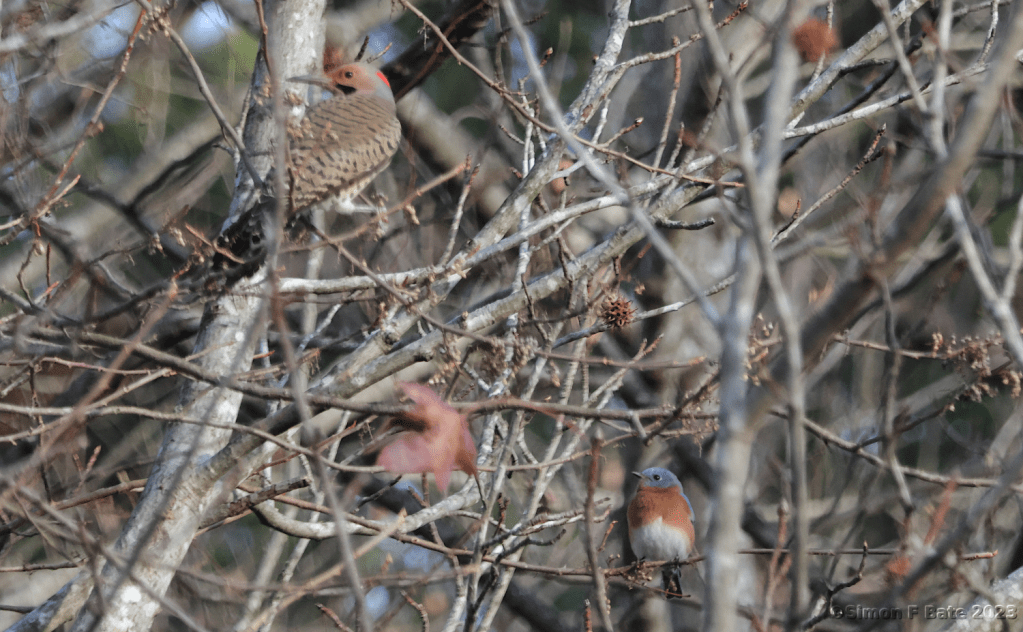
Another day, at the same location, an Eastern Bluebird and a Northern Flicker had the good sense to sit in almost the same focal plane. This perhaps should be two separate images, but I like seeing them both looking in the same direction.

In the past few days, we’ve had our share of hawks eating their breakfasts in front of us (I’m not showing those images out of consideration for my more squeamish readers). This one was resting—and perhaps digesting—very close to the south bridge. After a while, it noticed me and gave me “the eye.”

Finally, with the return of the (almost) cold weather, the Hooded Mergansers have started to make an occasional appearance. I’ve taken too many pictures of the male. Here’s a nice look at the female.

Give me a like, if you like what you see! Follow the blog for updates!

Woodpecker edition

It has been a thrilling week. For the past several days I’ve heard or seen a Pileated Woodpecker in the pond’s environs. Usually they’ve made rare appearances around the pond, although some have told me there are plenty in the woods between Seagroves Park and Old Raleigh Road.

I like the picture because you can see her tongue sticking out.

The Pileated Woodpeckers’ sudden appearance has helped me in my numeric goals. Early last week I was thinking that I had made one of my records by seeing all five common woodpeckers in a single day (Downy, Red-bellied, Pileated, Yellow-bellied Sapsucker, and Northern Flicker) when I realized that I had forgotten one: the Downy’s larger cousin, the Hairy Woodpecker.

Not to worry, just a few days later I saw a Hairy Woodpecker and all the remaining five, making it all six common species.

There is a seventh species, the Red-headed Woodpecker, but I haven’t seen one around the pond in a number of years. (If you do want to see one, there’s quite a colony by the boat ramp at the Jordan Lake dam.)

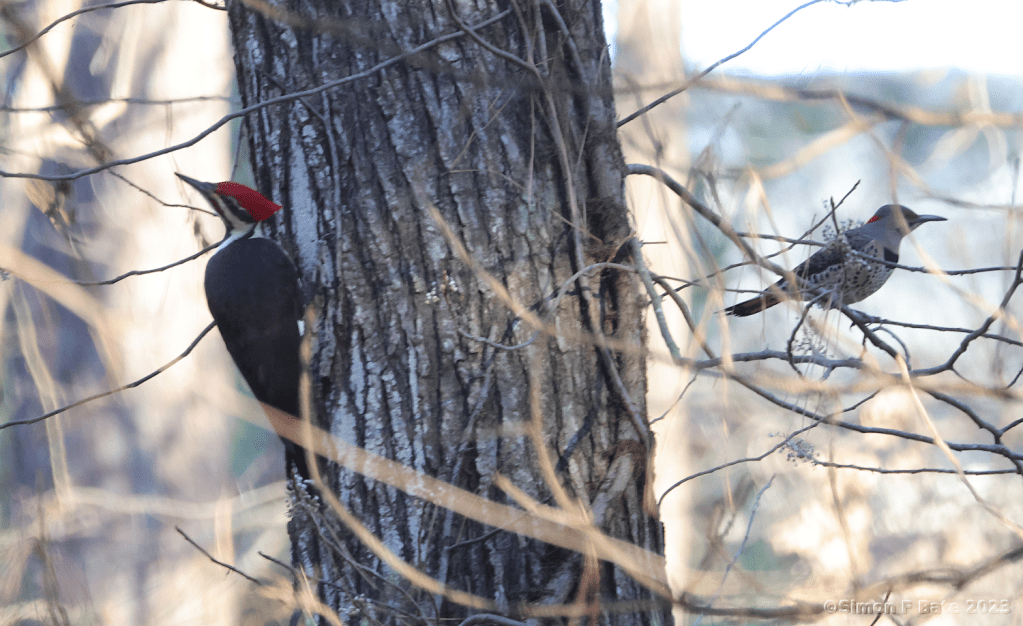
I don’t have pictures of all the species I saw on the six-woodpecker day (that’ll be my next goal), but it was nice to get a Pileated Woodpecker and a Northern Flicker in the same frame (despite the branches obscuring the Flicker).

They were both eagerly snacking on the berries in the woods around them. The Pileated (in this case a male) put on some acrobatic feats while feeding.

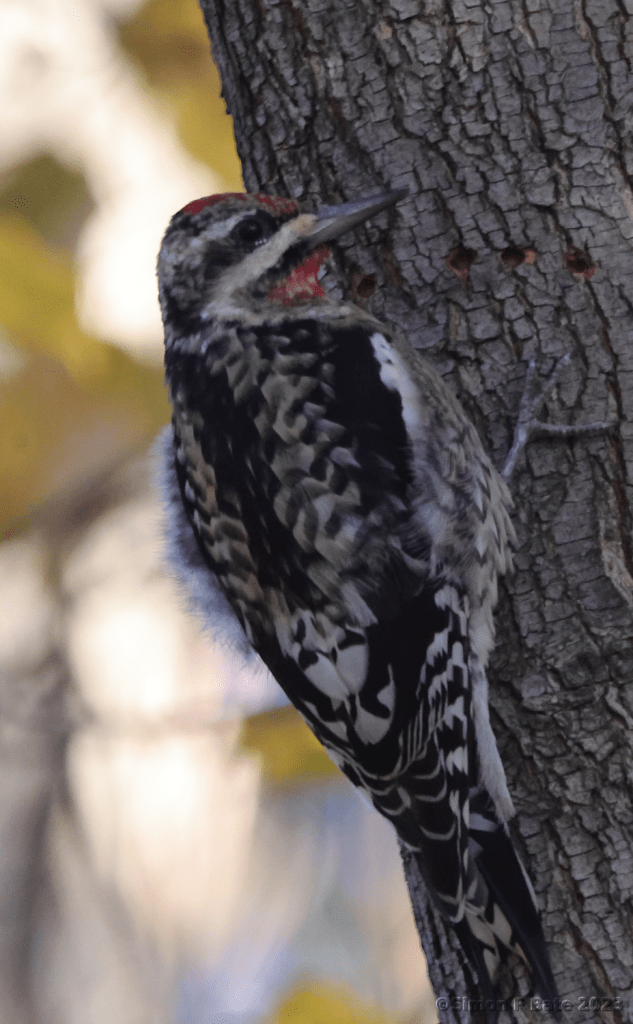
I really should say “7 winter species” because the Yellow-bellied Sapsucker is with us only from October through March. This juvenile came surprisingly close to me.

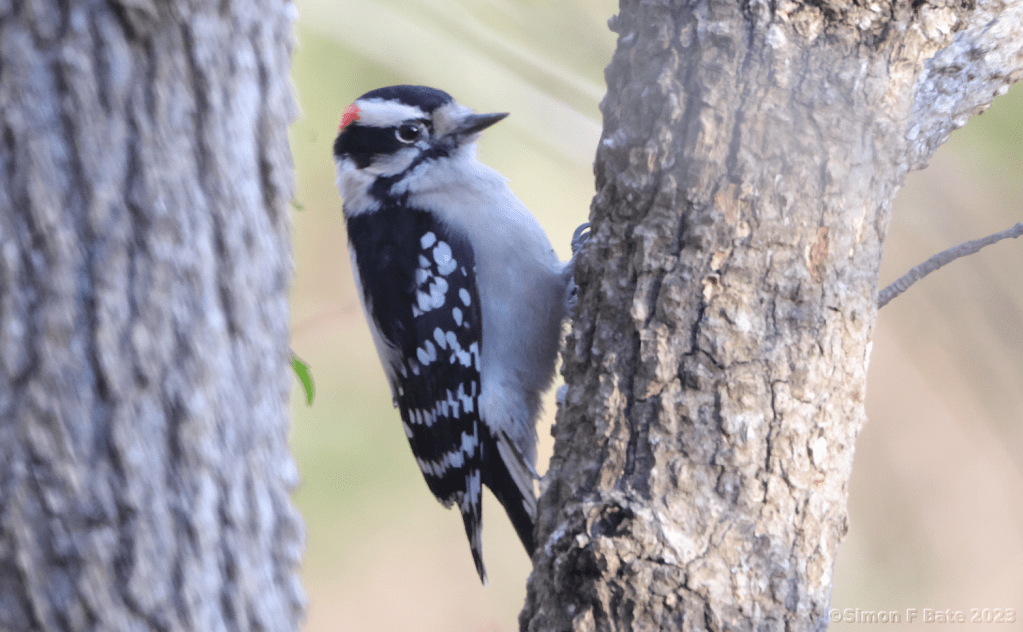
Speaking of close-by, this Downy also came quite near, on the six-woodpecker day.

Let me know what you like! Follow this page for news about updates!

Birds first

Usually I start a post with ideas about what to say, then add the pictures as I go.

Today, I’m dropping the pictures in first, then adding the words to “decorate” them.

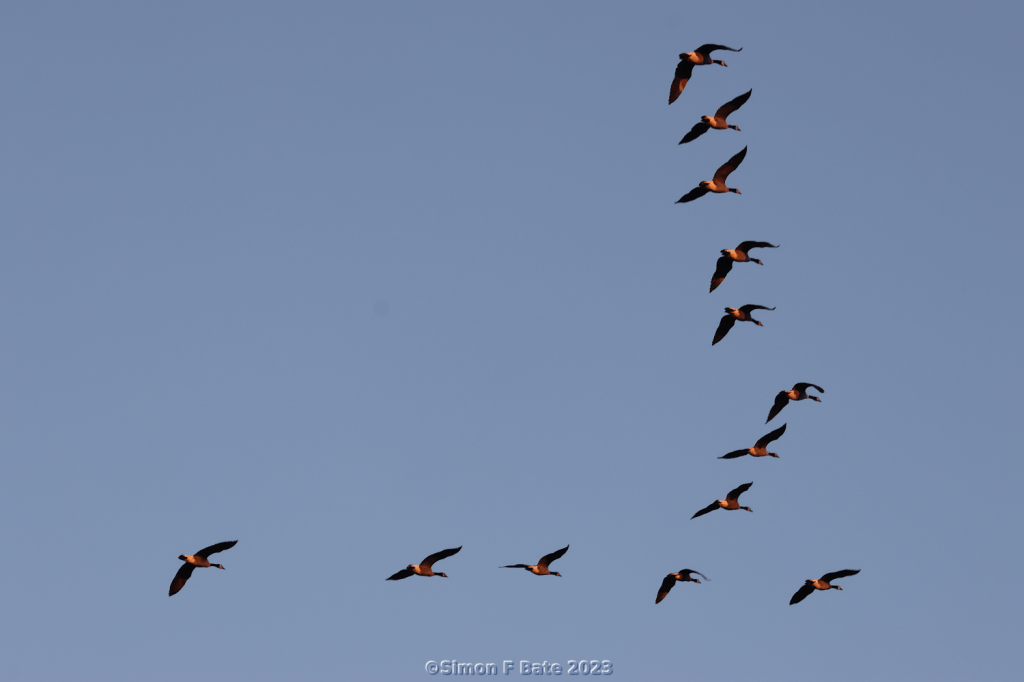
Caught this almost-a-vee of Canada Geese in the glow of the dawn sun. Not a perfect vee, no uniformity of wing beats, but nature is like that.

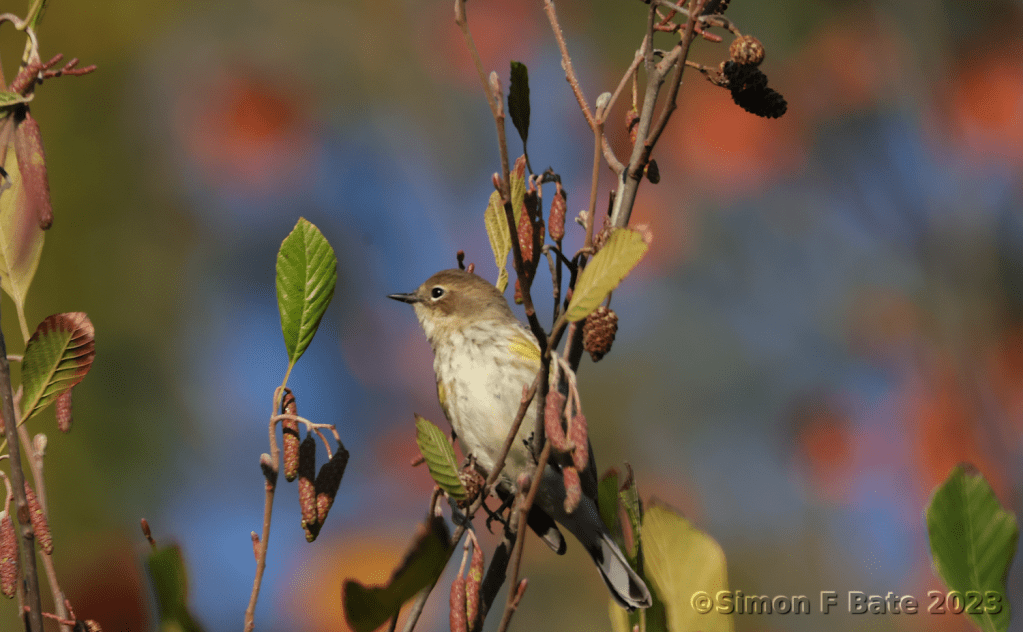
As predicted, the Myrtle (Yellow-rumped) Warblers are back in numbers. I particularly liked the fall leaves behind this one.

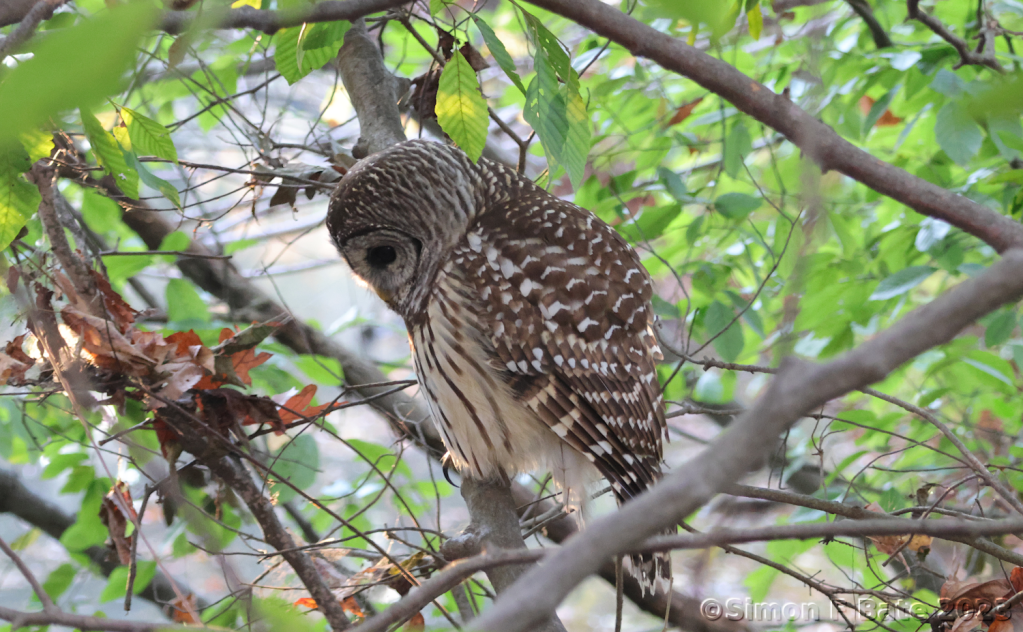
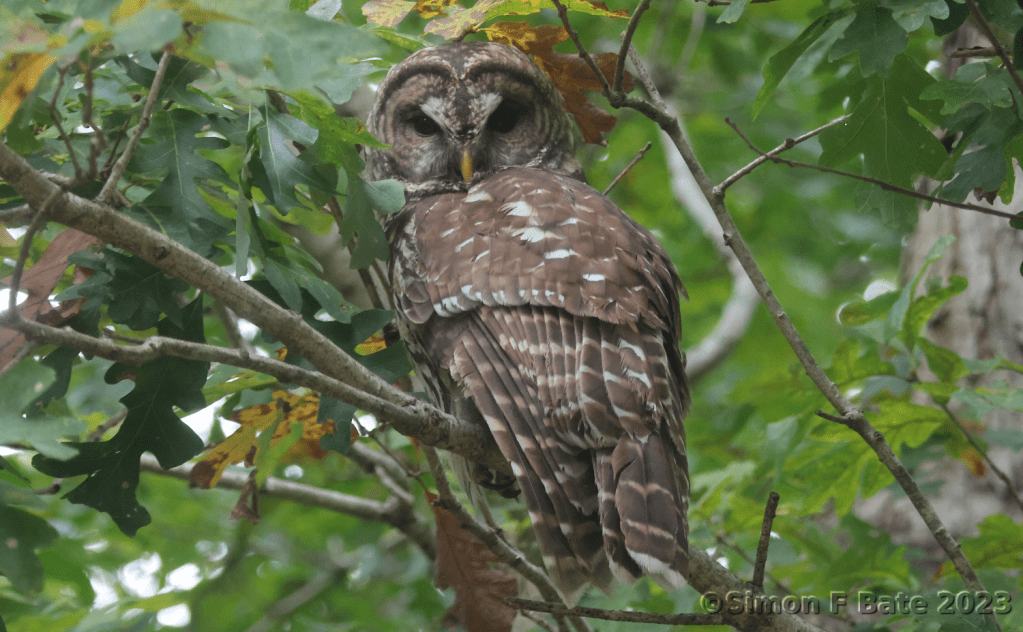
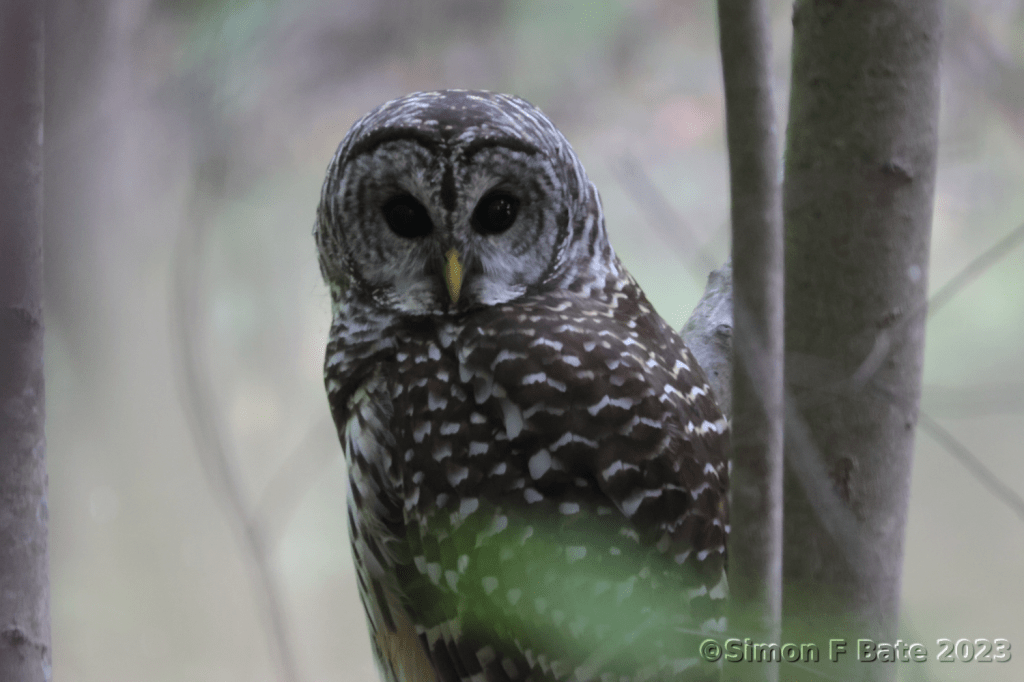
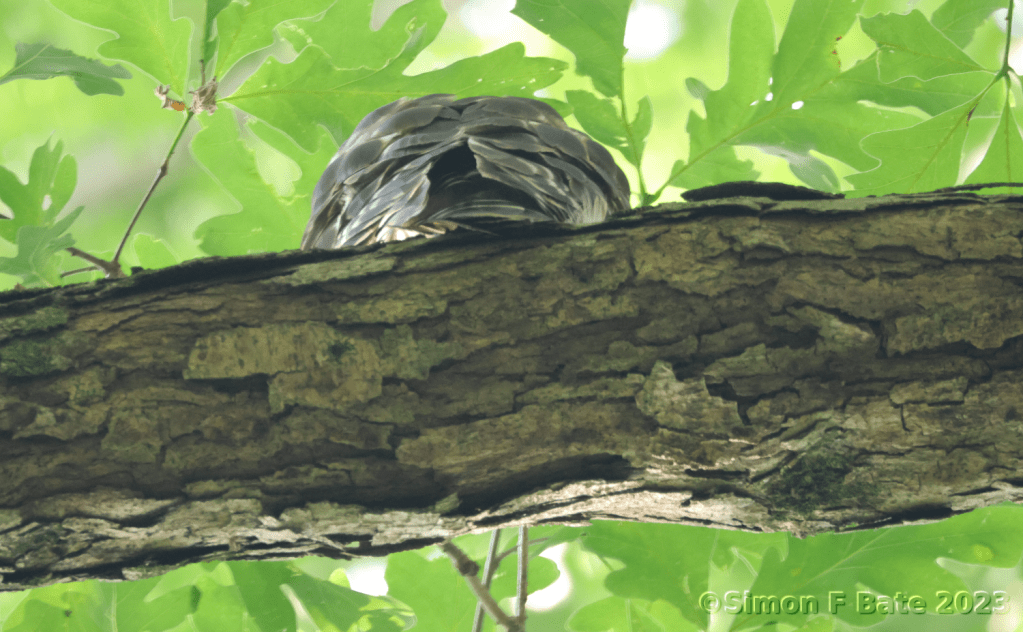
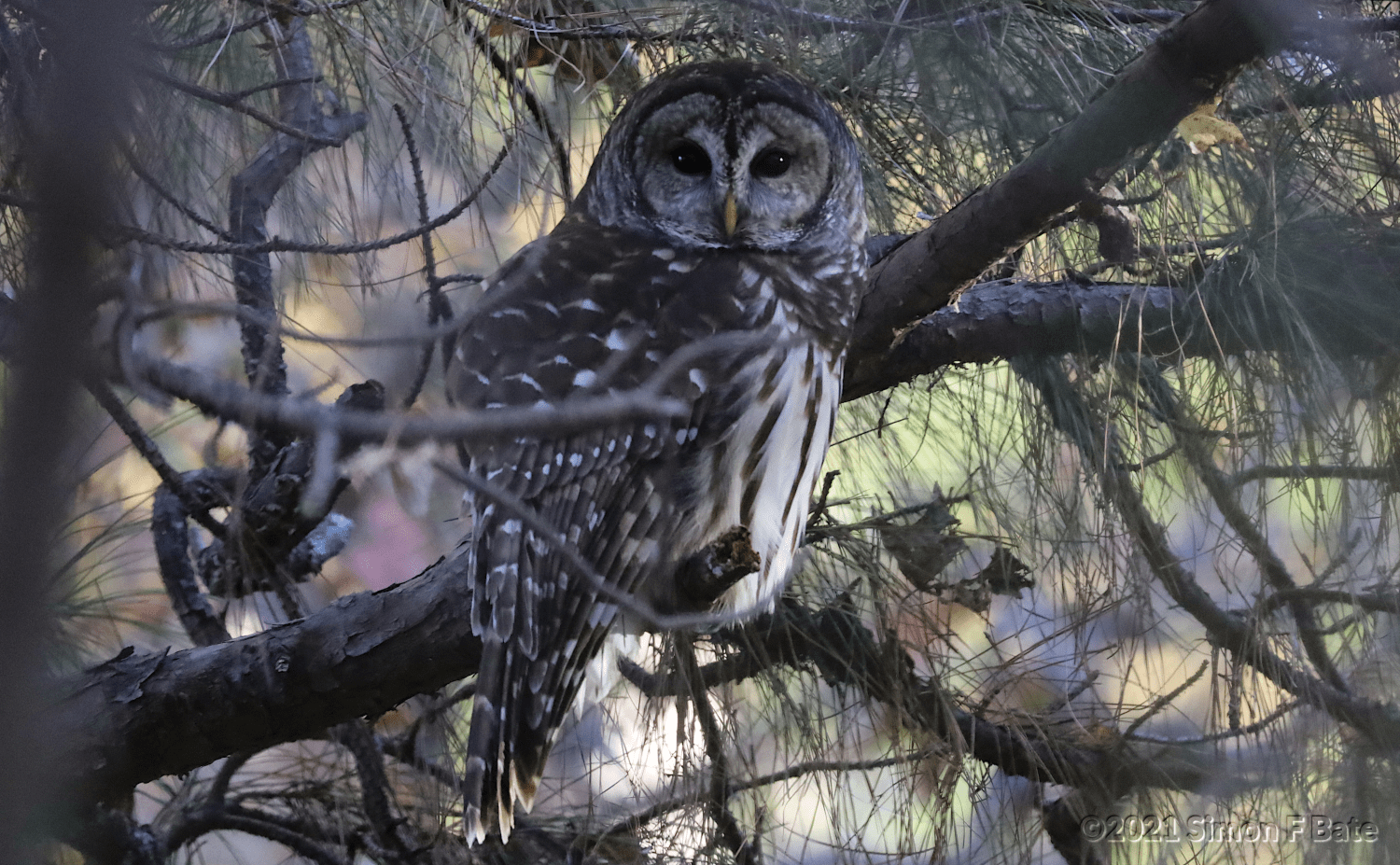
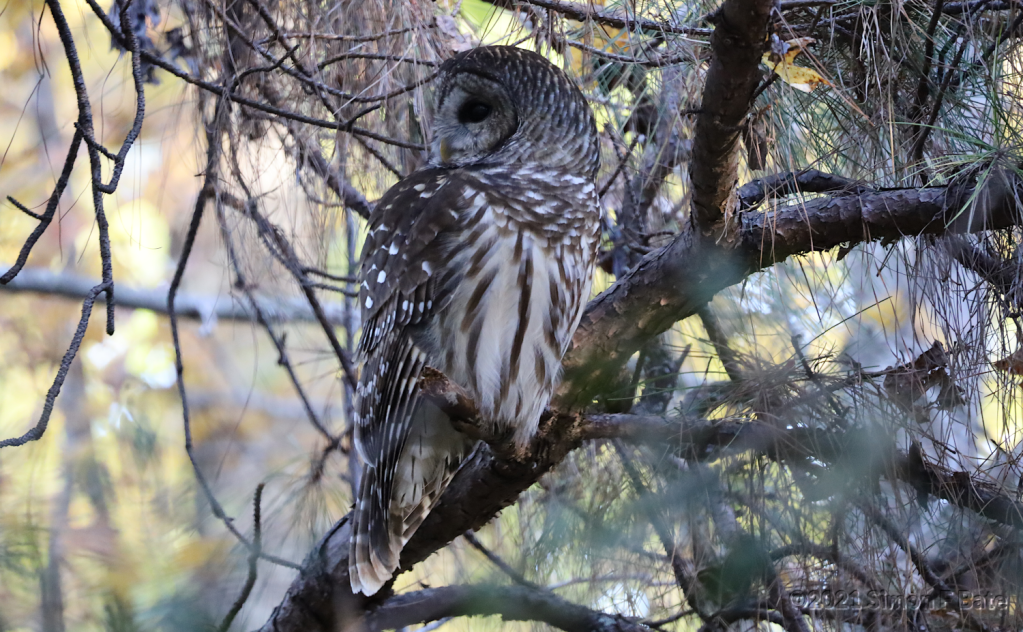
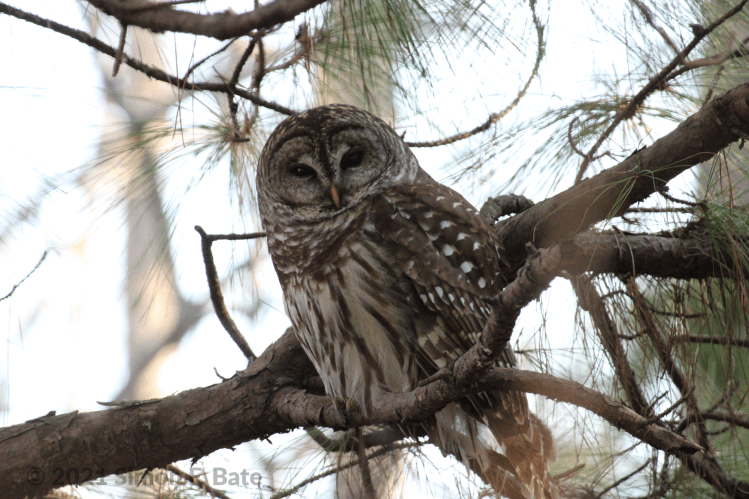
The Barred Owl put in a spectacular appearance beside the south bridge a few weeks back, but seems to have found somewhere else to roost. Maybe it’ll be back. It always looks so soft and cuddly; then you notice the talons on the branch.

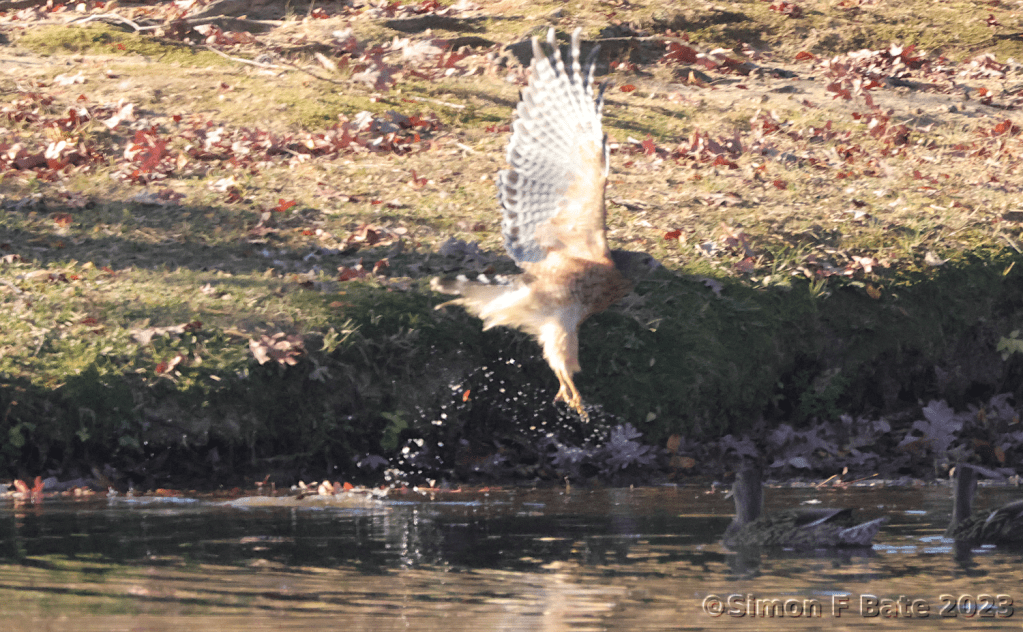
And this was something I’ve never seen before. A Red-shouldered Hawk flew out of a tree and landed in the shallows of the pond. It waded for a few minutes, then took off with a small splash of water. Note the surprised Mallards in the lower right.

Arriving and Departing

This post was going to be about fall and winter species arriving for the season. However, this morning I ran into a bird that I know is around during the summer, but which I have not seen recently.

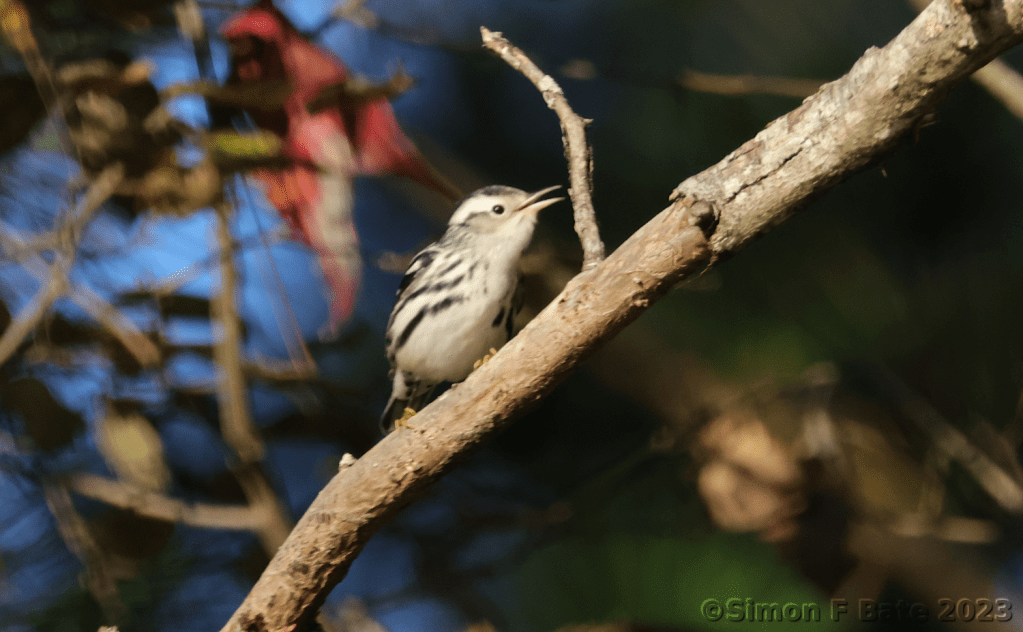
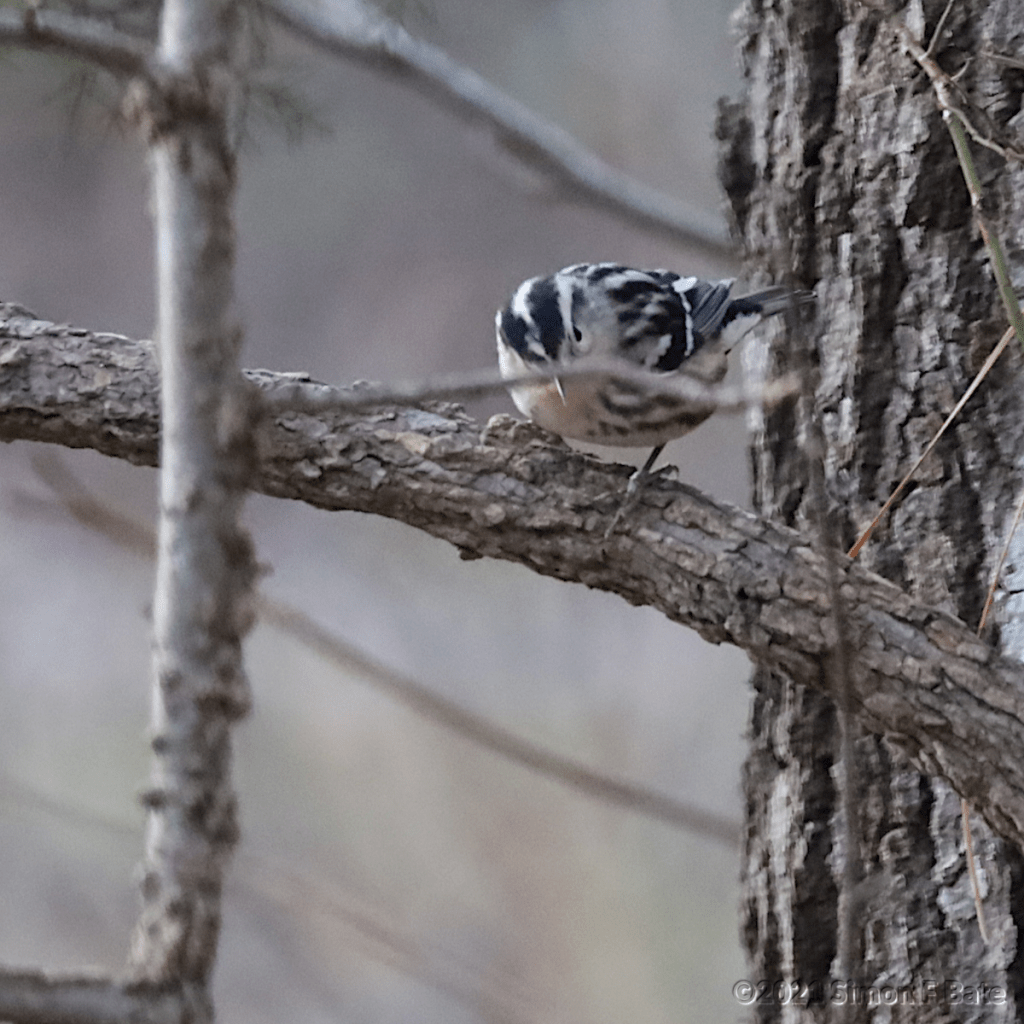
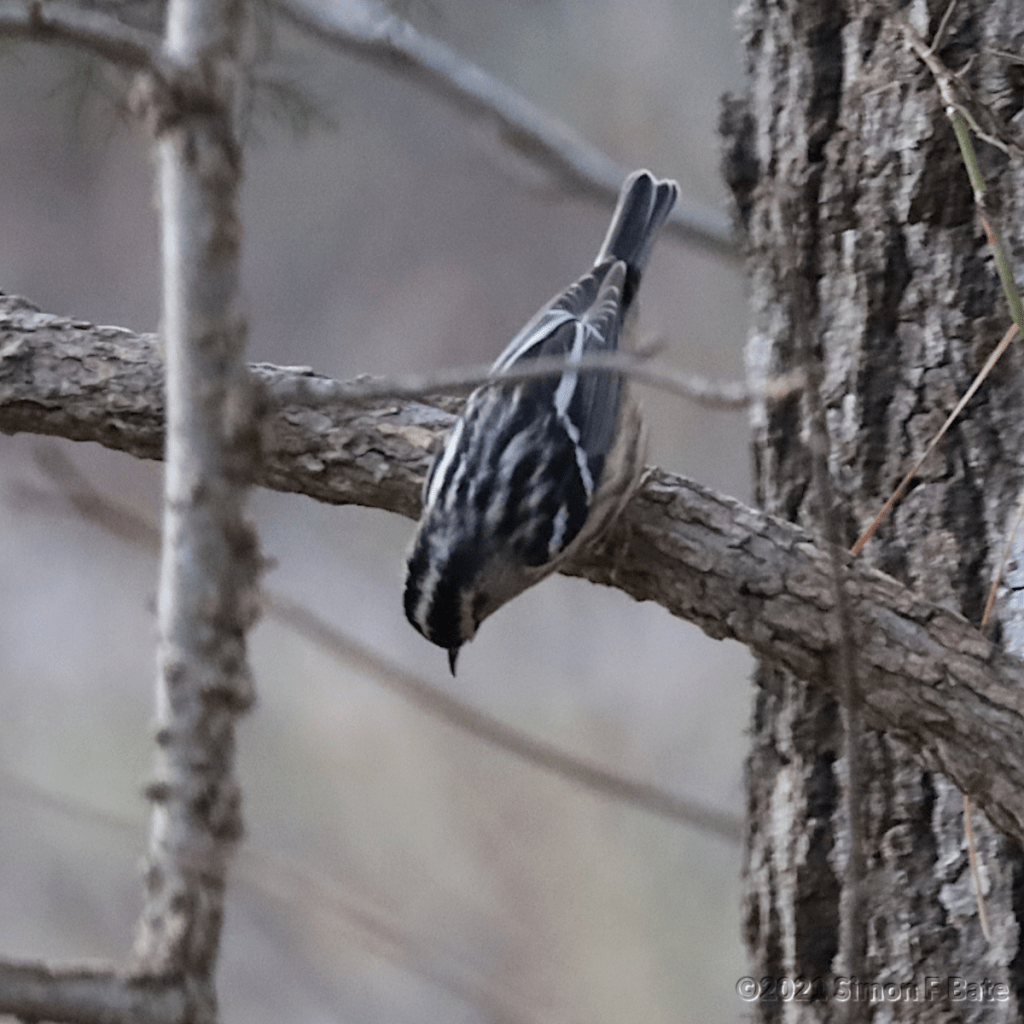
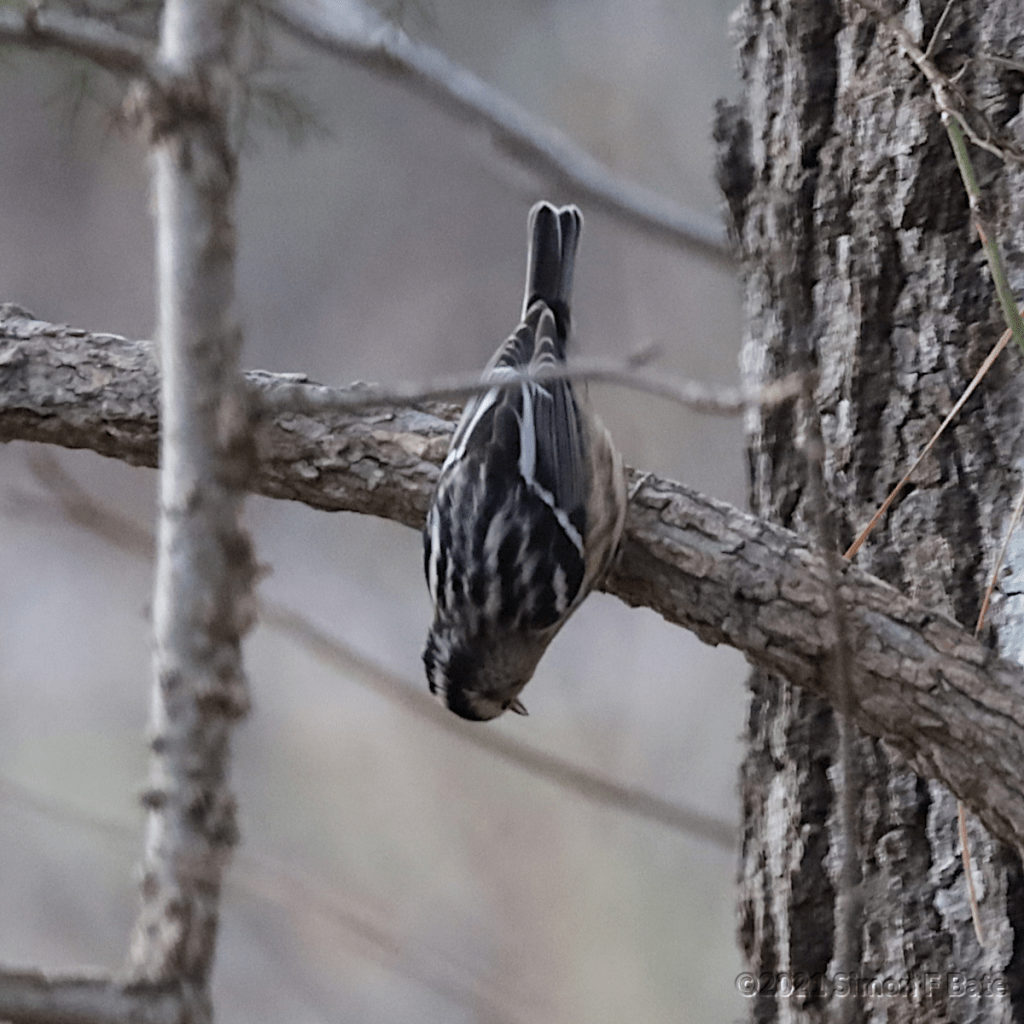
The Black-and-white Warbler doesn’t fit the model for warbler coloration. My expectation of a warbler is a bird in yellows and sometimes blues, but plain black and white makes it an outlier.

Additionally, along with nuthatches, Black-and-white Warblers are one of few birds that can walk down a tree.

On the arrivals side, this last Sunday I saw two “FOS” or first-of-season birds: a Yellow-bellied Sapsucker and a Yellow-rumped Warbler.

The other six species of woodpeckers that we see around the park are year-round residents, but the sapsucker heads north for the summer. Not a great shot, but it’s the first of the season. Fairly soon, I’ll be able to see them daily.

Speaking of daily, here’s the first Yellow-rumped Warbler I’ve seen for the fall. In all likelihood, there were probably a couple others around, but this was the first I saw. I like how it was playing peek-a-boo.

In a few weeks it will be possible to see a dozen or more Yellow-rumped Warblers every day around the pond. The Yellow-rumped Warblers are unusual among warblers in that they are quite social, often seen in small flocks.

A Month Behind

Again, it has been a while since I last posted. Here’s a quick post with three of my favorite images from the past few weeks.

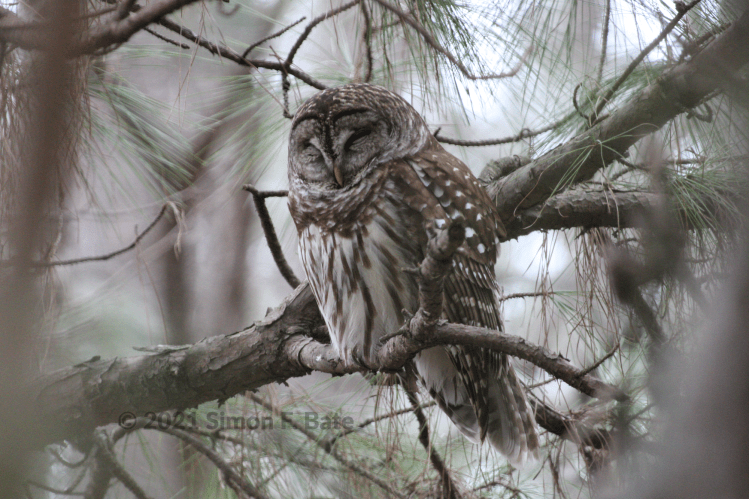
I haven’t seen the Barred Owl for more than two weeks now. It’s probably still out there, but finding craftier places to spend its days.

The Eastern Phoebes have been quite active around the pier. One rested in a juuuust turning sweet gum for a few moments so I could take its picture.

I’ve probably said before: although Great Blue Herons feed along banks and streams, they don’t roost there. For roosting (and nesting) they prefer to be high up in trees, pine trees in particular. On the same day I took the phoebe picture on the north side of the pier, this heron was up in a pine tree on the south side.

I’ll be back soon with some fall arrivals.

Smaller, Faster

I’m back. Rather than the larger and slower birds I’ve been featuring recently, today’s post features a couple of smaller, faster birds.

It’s clear that summer is winding down around the pond. The weather has cooled noticeably and my species counts are going up. It’s odd, because for the most part I’m seeing all the same species that I’ve been counting all summer. It’s just that they’re all showing up every day, rather than a small subset showing up from one day to the next.

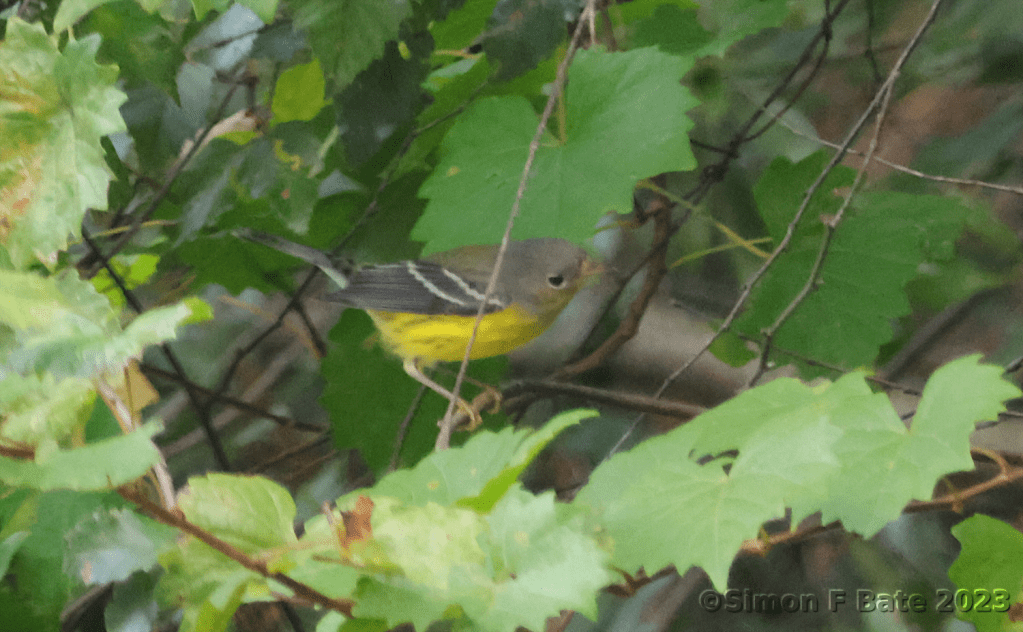
The counts are also going up because I have started seeing more warblers, migrants and non-migratory. These include a Kentucky Warbler (no picture, sad to say), a number of American Redstarts, the year-round-resident Pine Warblers, and a Magnolia Warbler.

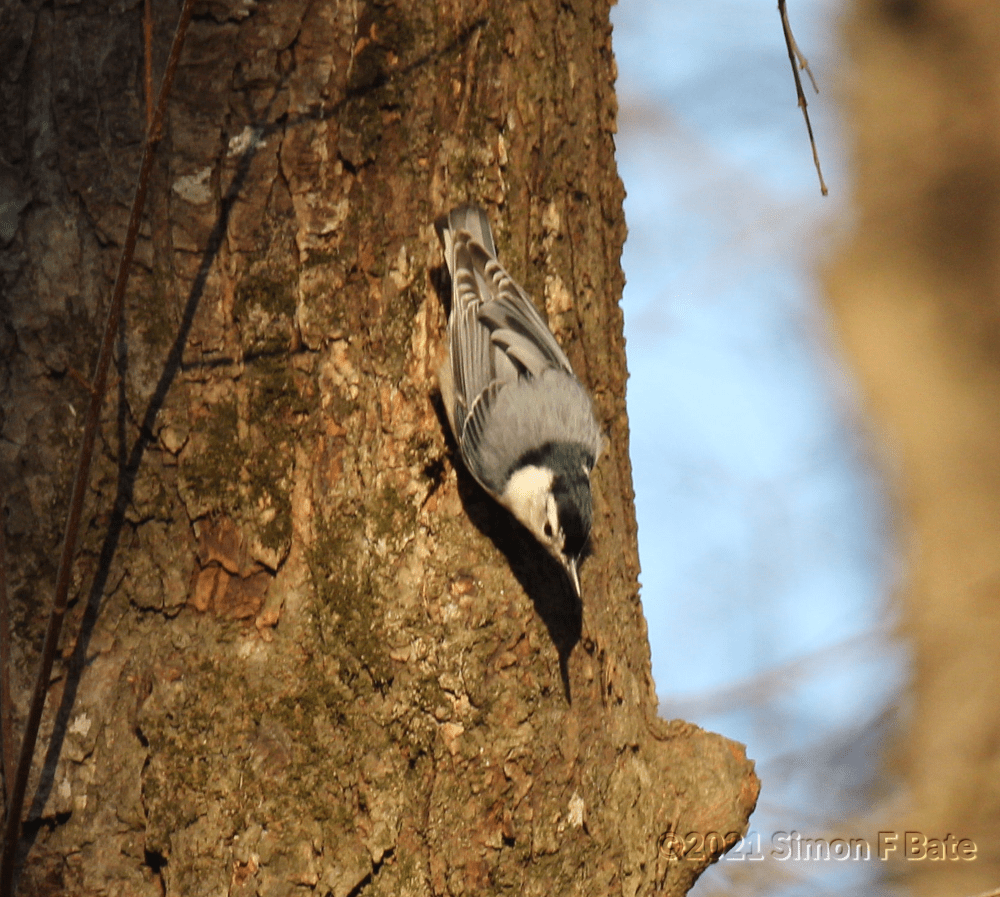
I’ve been trying to get a descent picture of a White-breasted Nuthatch, doing its nuthatch thing. Yesterday I came pretty close.

Raptor Respite

No owl today. No Red-shouldered or Red-tailed Hawk, either (I’ll get to the Red-tailed in my next post).

This morning I got my best view of a Pileated Woodpecker I’ve ever had, when my camera was at hand. This one called from one of the trees near the shelter, then moved over near the pier (where I took this picture). Last I saw, it was pecking and dropping bark and twigs onto the north bridge.

The best view of Pileated Woodpeckers I’ve ever had (without a camera) was on Orcas Island in Washington state. I took a walk in the woods and encountered five of them, all very interested in the base of a large conifer. I kicked myself for not having my camera with me, and this was in the days before smart phones. I was close enough to them—and they didn’t seem to care about me—that a phone camera would have been quite sufficient.

Fluffing and Stretching

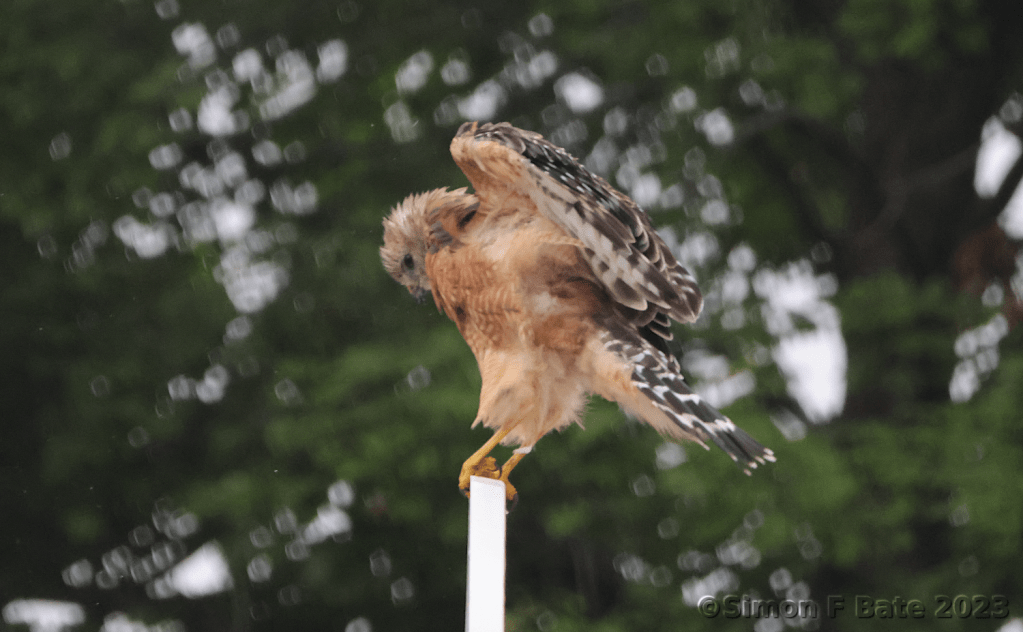
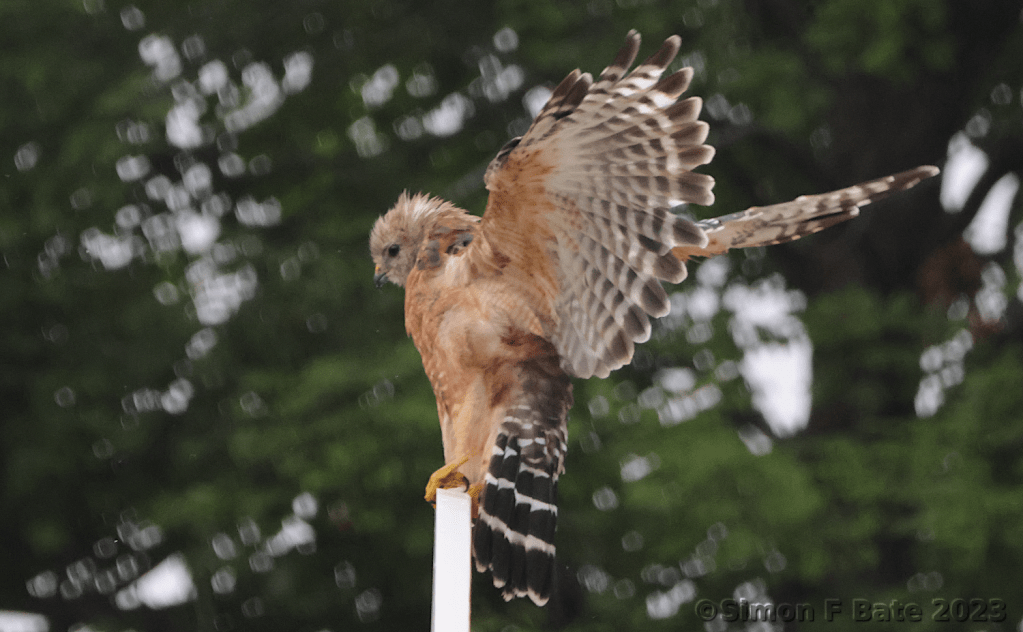
After preening, it’s nice to be able to shake and stretch things out. This Red-shouldered Hawk gave me a prime view of its stretching routine yesterday. Not your typical bird pictures, but I think they’re special in their own way.

Imagine having 5000 feathers and having to make sure they’re all preened, oiled, and in the right place.

As I’ve said before, I prefer to take pictures in natural settings. In this case, the bird was on a basketball backboard, but since it’s end-on, you can’t really tell.

Who cooks for you?

The young Barred Owl is back in the north cove. I got a few nice shots before we had a sudden shower and the skies opened.

I can’t take credit for finding it. B & P told me about it and where it was before I got into the wooded portion of the park.

While mostly fledged at this point, its facial markings haven’t quite filled in. We had an adult that was a regular visitor a couple of years ago. Note that instead of “eyebrows” this one has a ring all the way around its face.

Two herons

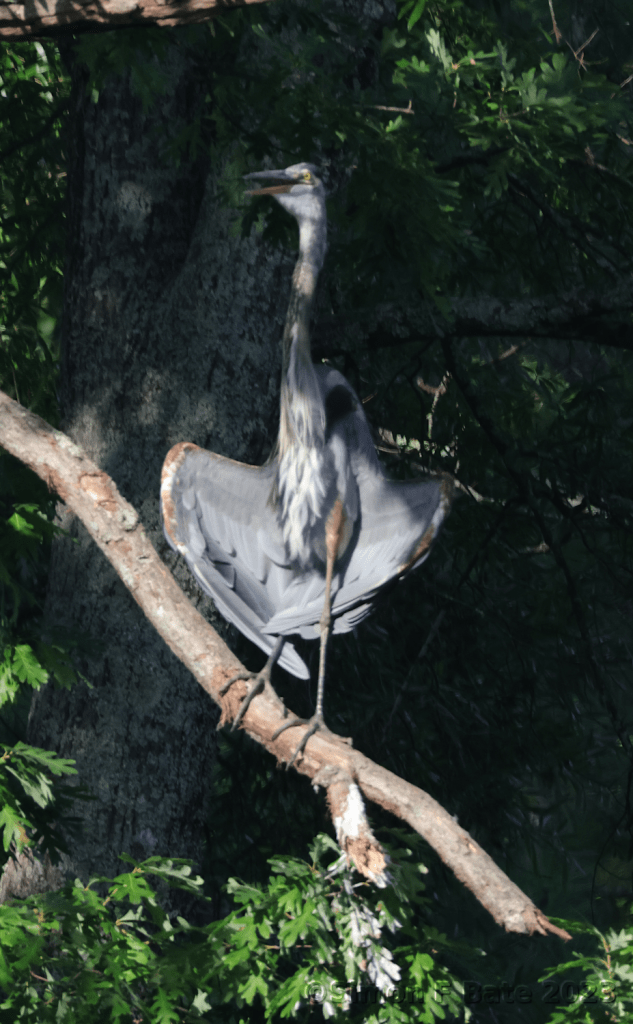
Here are a pair of herons. On the left, an immature Green Heron; on the right a Great Blue Heron, striking an interesting pose (more on that below).

We can tell that the Green Heron is immature, because of the streaked breast. As they grow older, the breast becomes a solid rufous color.

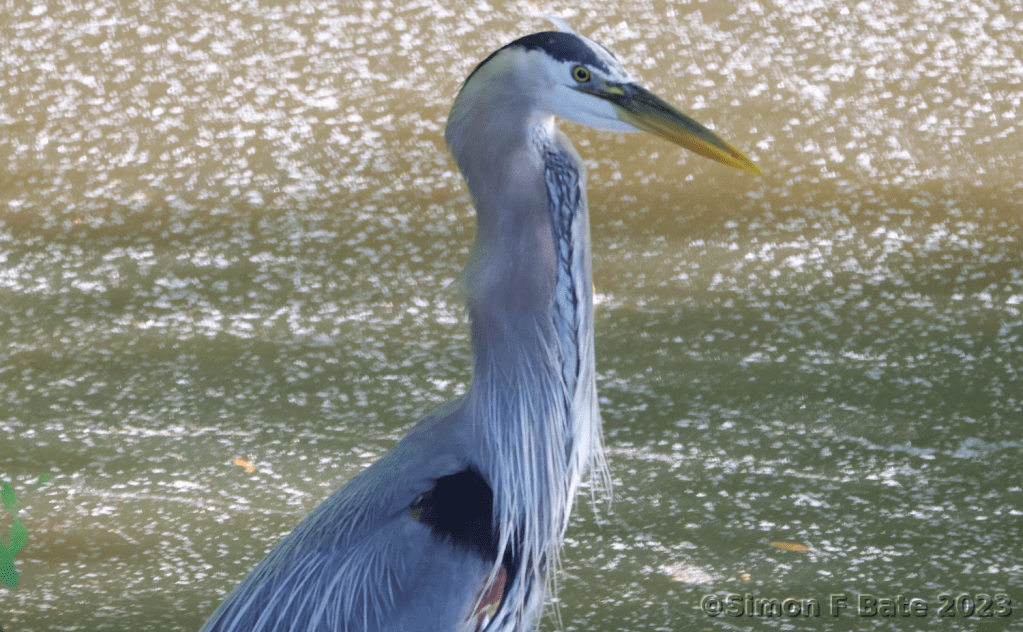
Don’t ever worry if you see a Great Blue Heron standing in the pond on a freezing winter morning; they can keep quite warm all on their own. However, keeping cool in the summer is another matter. In very hot weather, the heron will set its wings out away from its body in a bowl-like configuration, so they can catch cooling breezes. I’m not sure what advantage this arrangement has over simply holding its wings out. Could be that it takes less energy. Also, it seems that there’s less chance of a strong gust blowing the bird around than if it had its wings fully out.

If you notice, the heron’s bill is open. If I had taken a video, you would see that it is vibrating or fluttering its throat (gular) tissues. This “gular fluttering” circulates air around the moist tissues in their upper throat, which cools the bird by evaporation. It’s a bird’s equivalent of dogs panting. Not all birds do it, but it is known in herons, cormorants, crows, and nightjars (whip-poor-wills and their allies).

Two days; two birds

We’re in the summer doldrums right now. I’ve talked about them before. The birds aren’t very visible, and they’re not calling the way they do in mating season. My daily species counts are in the 14-18 range, rather than 24-28.

At this time, I think about the camera slung over my shoulder and I wonder if I should just walk without it for a few weeks. I then remind myself that you never know what you might see. That point was driven home over the past two days.

Pileated Woodpeckers are relatively common in other woods around us, but don’t often come through Seagroves Park. Yesterday I was chatting with R & C when a woodpecker flew across the pond. At first I thought it was a Flicker, but as it called and got closer, I realized it was a Pileated Woodpecker. It flew over our heads to a tree across the road from the park, which meant I had to shoot into the sun. I always seems that when I see Pileated Woodpeckers, the conditions are not ideal. But I got a shot and with a bit of doctoring, it’s not too bad.

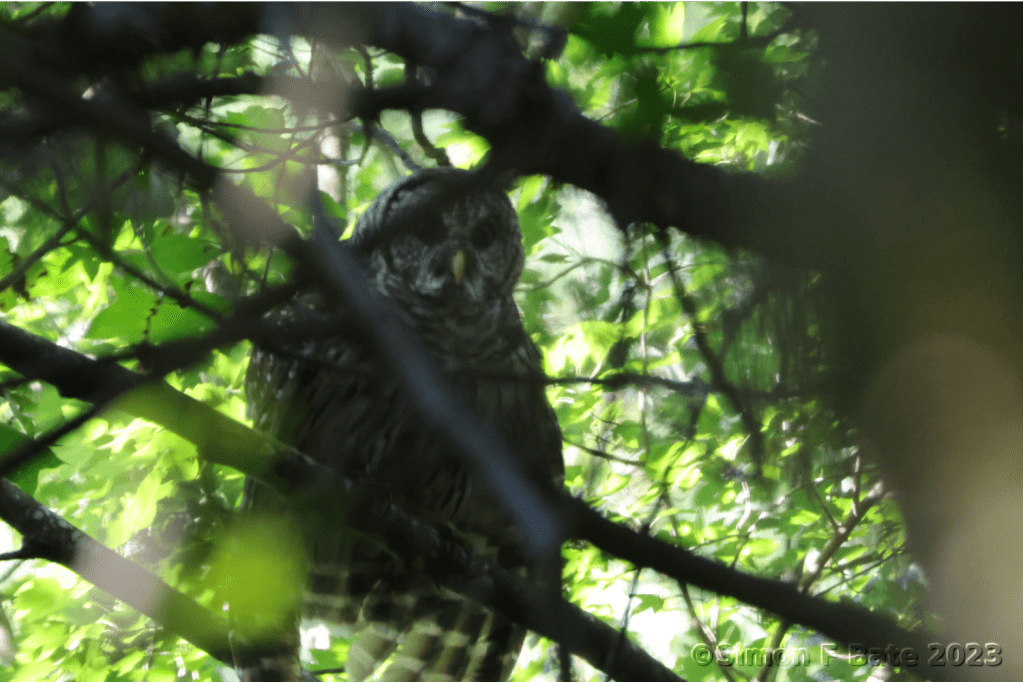
Today, I had another encounter with a special bird in “compromised” photographic circumstances. I heard some calling in the woods and noticed when a large bird fluffed its feathers. My initial take was that it was an immature Red-shouldered Hawk, as it was very close to the nest I was following in early June. But as I looked at it and as it moved, I realized the face was not quite that of a hawk (I had my doubts, even from the start). Eventually I got a good enough look at it to realize it was an immature Barred Owl.

Identifying it was one thing. Getting a good picture was an entirely different problem. It was in some dark trees, with sun-lit trees behind it. In addition, it was deep in the woods, with almost no clear lines of sight. I can’t say this is a great picture, but it’ll do.

Back to the hawks

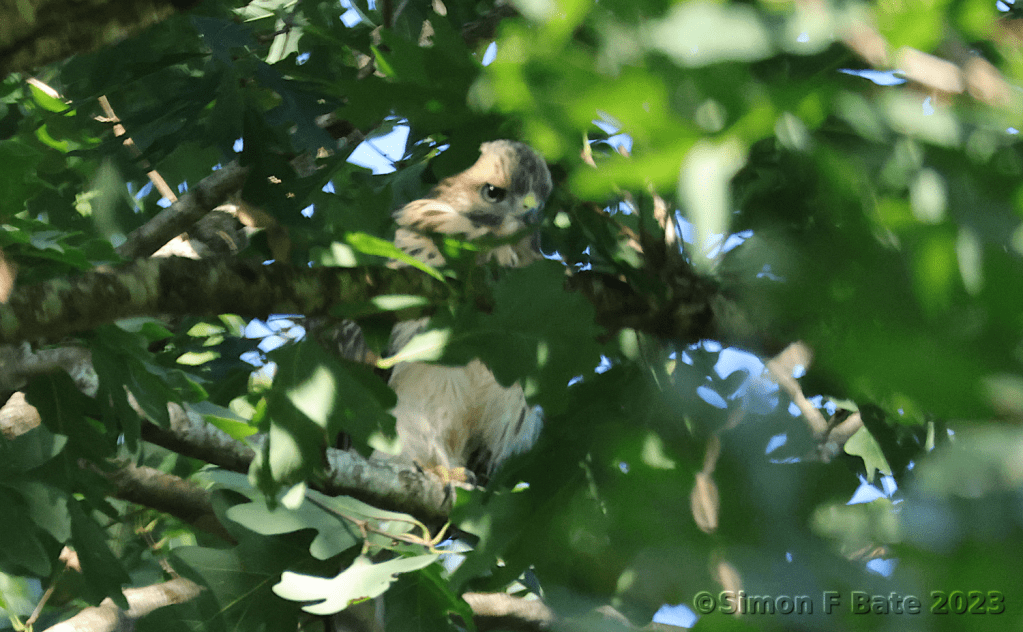
This weekend, a Red-shouldered Hawk was calling from high up in the canopy. The calls were persistent enough I thought it was a young hawk waiting to be fed. I spent 15-20 minutes on Saturday trying to see it, but couldn’t. Sunday, my luck was better. Sort of.

The hawk was well hidden, but its call gave it away. We played peek-a-boo until I could get a somewhat-decent face shot.

The bird was within 20 feet of the nest I was watching a few weeks back. So there’s a possibility that this is one of the fledglings.

This morning it was having breakfast somewhere else.

Not three, four!

Yesterday when I stopped to look for the Green Heron nestlings, I only saw one, and what I thought were two additional pairs of feet to the right of it. When I processed the pictures today, I realize, there are three additional pairs of feet, making a total of four nestlings.

This morning the boldest nestling (I’ll call “Alpha”) stood out and gave me some nice poses.

The sun has been quite hot the past couple of days. I retreated to the shade to cool down a bit. When I walked back onto the dock, I realized all four of them were visible (to a greater or lesser extent). They moved around a bit, and finally settled into some kind of order.

Two of three

As hinted at in yesterday’s post, we have three Green Heron nestlings visible from the dock. This morning only two of them wanted to be seen; the other one was hiding in the background.

Even though they’re young “greenies,” this pair make me think of Heckle and Jeckle (who I always thought were crows, but it turns out they were magpies).

Not in the daylight!

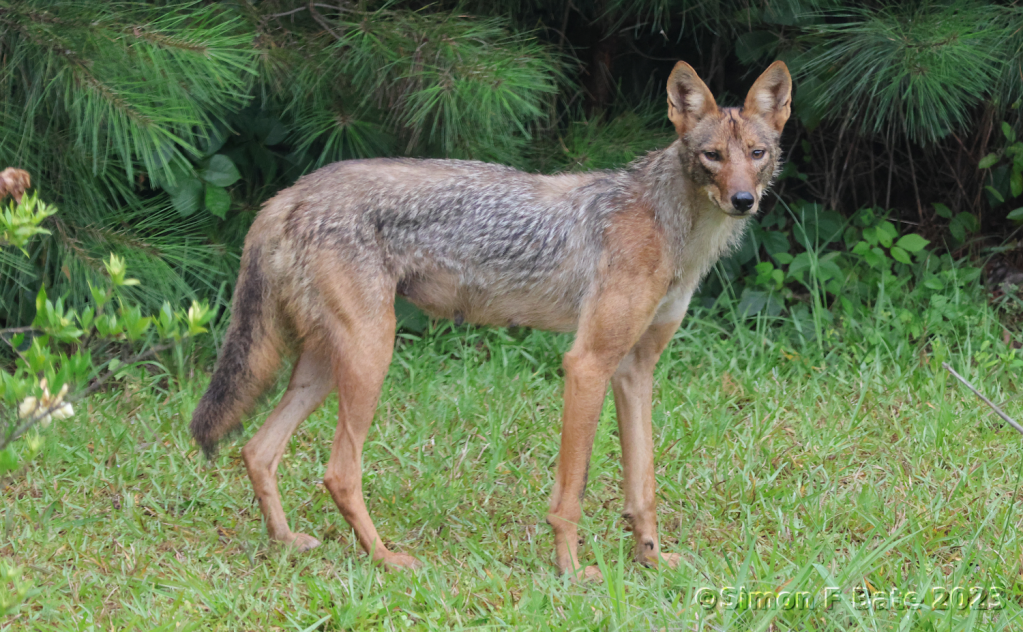
Last week I had quite a surprise. As I reached the settling pond behind the townhouses, something like a deer or dog moved behind a bush. It kept on walking and emerged on the other side of the bush. Certainly not a deer. Nor a dog.

We looked at each other for a couple of minutes, long enough for me to get the initial rush of adrenaline under control, so I could take a few pictures. She (as a closer inspection of the picture shows) turned and disappeared into the woods behind her.

I’ve never encountered a coyote in broad daylight like this. It is concerning. We’re not going to get rid of them, but I would prefer that they remain afraid of being out while people are active.

But it was a great opportunity to take a great picture.

“They grow up so fast…”

I do have pictures of other birds to publish, but for now I’m focused (ha ha) on the Red-shouldered Hawk nestling(s). I first saw one a couple of weeks ago, then saw it again about a week later.

The following day the nesting was even more visible, and didn’t have the annoying branch across its face.

Four days or so later, there was bigger news: there wasn’t just one nestling, there were two!

After a few rainy and windy days, they both stood up tall enough to be seen together.

Last Friday, one of them was brave enough to walk out onto the branch to the left of the frame. Perhaps it got tired of the nest, or maybe there wasn’t enough room for them both there. It was also stretching and testing its wings.

Saturday and Sunday, they weren’t visible. I wasn’t sure, they might have left the nest, but they might be further out on the branches.

However, yesterday (Monday), they weren’t on the nest again. I was fairly sure they had fledged.

As I walked down the hill from the nest, I heard Red-shouldered Hawk cries from two different locations. These were persistent “find me food” type cries. As I walked further on, they both took flight and flew over me, circling each other. I knew they were the immature fledglings, because their tails didn’t have the prominent banding that is seen on a mature Red-shouldered Hawk.

I couldn’t get a picture of both, and I considered myself lucky to have taken a halfway descent picture of one of them in flight.

I hope to see them again over the next few weeks. They’ll stay close to the nest and their parents until they decide they need a bit more independence.

Keeping Tabs

A quick, quick post.

The Red-Shouldered Hawk nestling is getting bigger. I’ve seen it on and off over the last week. Monday morning was rainy and momma was on the nest, sheltering the chick.

I’m guessing (with very little info to go on) that the nestling is about 21 days old now.

Saturday Surprise

This morning reminded me, once again, why I walk every morning. It’s almost my mantra: most days you’ll see the same things, but some days you’ll see something exceptional.

The exceptional thing this morning was discovering a Red-shouldered Hawk nestling.

I and other morning walkers had noticed the hawks building a nest. This was their third or fourth attempt at nest building (as I’ve documented earlier), but nothing seemed to happen in the nest and things got quiet. However, in the past few weeks, I’ve noticed that the Red-shouldered Hawks seemed to be particularly active in the same area. But they never got near the nest. Just a few days ago, I wrote this post, the pictures for which were taken very near to the nest.

This morning the hawks were in the same area, so I thought I’d take a look at the nest.

I found someone looking back at me.

Red-shouldered Hawks fledge in about 35 to 45 days. I suspect this one is about 14 days old, perhaps a bit more. They’re able tear apart their own food in about 18 days and I think this one is nearing that.

A Mistake Corrected

For the past several years, I’ve seen two species of swallows around the pond: Tree Swallows and (what I thought were) Bank Swallows.

The Tree Swallows have iridescent blue backs and contrasting white undersides. I’ve mentioned them in this blog a number of times. Just this year I’ve shown them here and here.

The other swallows are less remarkable in appearance, in various shades of brown. This year I’ve shown them here and here.

The other day, I was looking at a discussion in the Carolina Birders group on Facebook and realized that what I’ve been seeing are not Bank Swallows, but Rough-winged Swallows. (True Bank Swallows are quite similar to Tree Swallows, but have brown backs, rather than blue.)

This group of Rough-winged Swallows were part of a gang of five. The other two were around the corner, but I couldn’t get them all in a picture. The one on the right looks like a fledgling, as does the one shown in the next picture. This youngster still has a wide “gape” on the sides of its mouth and seems to be shedding downy feathers.

Now I have to go back and correct my mistake in previous posts and in my list of Bird Species at Seagroves Park.

Save the best for last

Toward the end of my walk, I sometimes think that I’ve seen all there is to see and I might as well head home.

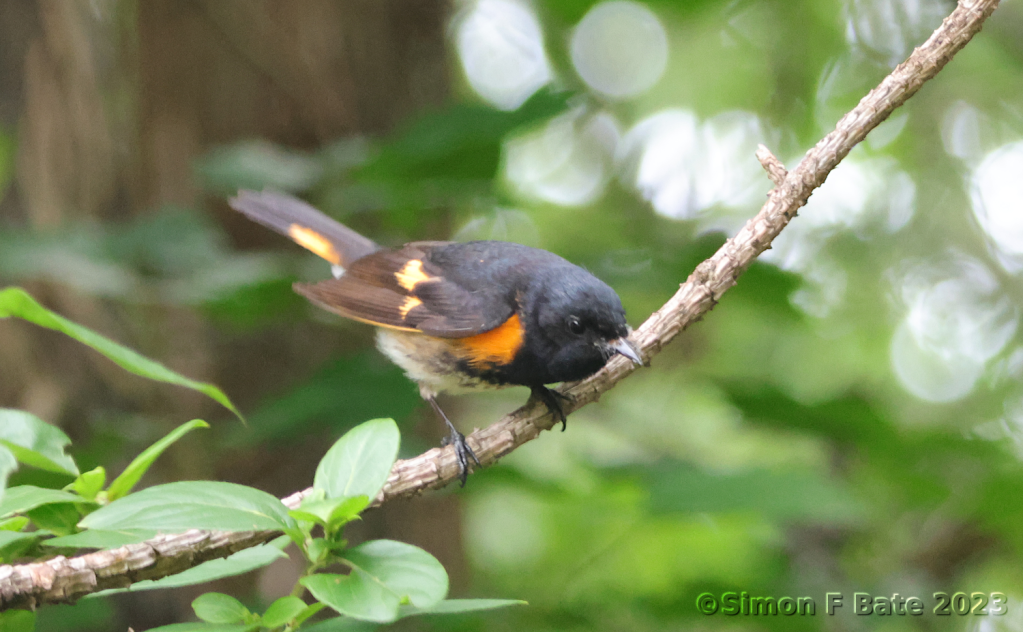
Yesterday I was thinking that as I left the holding pond behind the townhomes. For no reason at all, I paused by some bushes and saw some movement. Probably a Chickadee, as I had seen a few just before. I watched for longer and eventually an American Redstart emerged on an exposed branch. I stayed and watched it patrol all the nearby shrubs for insects, never staying in one place for long. Along the way I was able to take a few picture, one of which was fairly descent.

Although the Redstart looks large-ish in this image, unfortunately there’s nothing for scale. As a member of the warbler family, it’s actually quite a small bird, about 5 inches long, including its rather-long tail.

I’m always looking out for migrating warblers in the spring and fall (as with the Palm Warbler I wrote about a few weeks ago). However, the American Redstart is one that will stay with us all summer. You can easily identify them in flight, even from underneath, by the two yellow-orange patches on either side of the tail. The one pictured here is a male; the females are more gray, with yellow patches.

Red-eyed Vireo

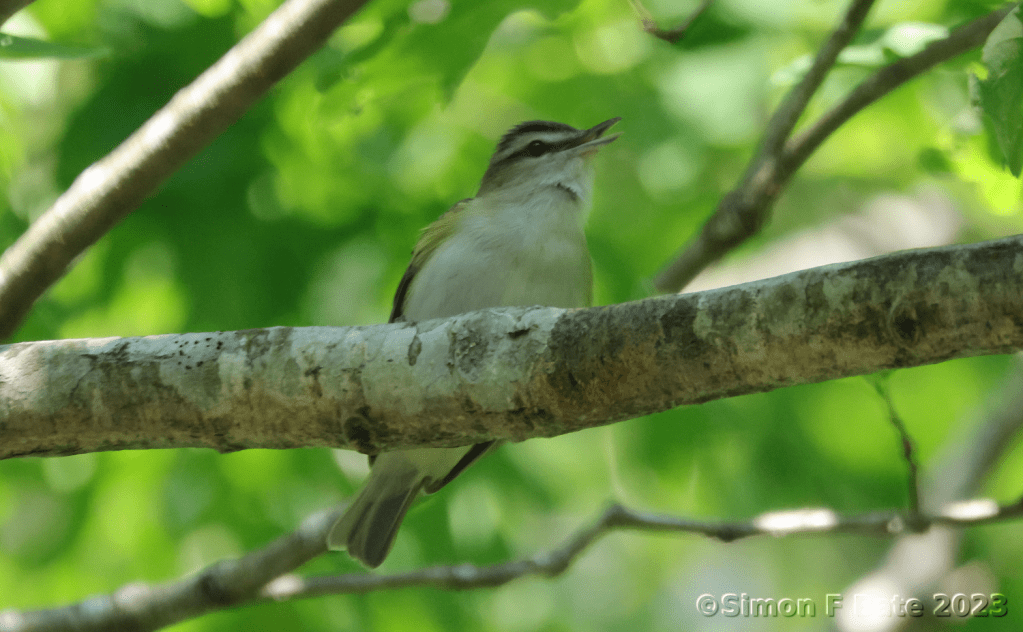
A few weeks ago we had White-eyed Vireos swinging through on their spring migration. Currently their red-eyed cousins are having their turn.

It’s not hard to catch the Red-eyed Vireo with its beak open. It frequently vocalizes, saying two phrases every two seconds or so. The first phrase is on a straight or slightly falling tone. The second phrase usually goes up in pitch.

It took me about ten minutes following this bird to get this shot. The whole time I was chasing it, it was saying: “here I am” “in the tree?” “over here.” “see me?” over and over again.

Jack and Myrtle

When I walk around the pond, I’m usually looking at birds. But I do keep my eyes open on other fauna…and flora. There are some surprising things along the paths. Last fall I discovered a persimmon tree in plain sight. I had been walking by it for years but never noticed it.

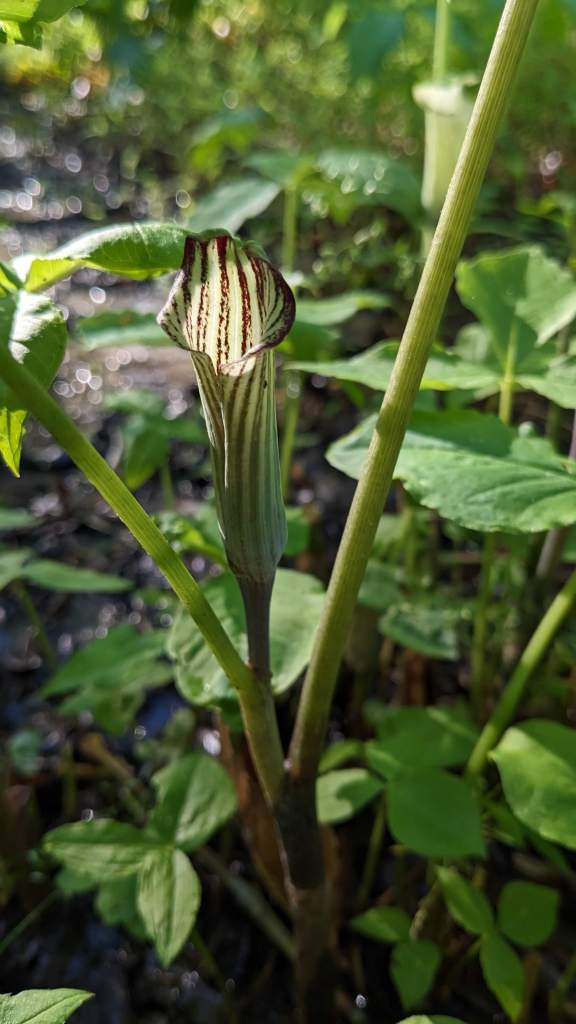
Today, while chatting with J and J (Jack and Odie, too), I noticed some plants in a boggy area just off the path. I looked closer and they were almost what I thought they were. Only—at the time—I misidentified them.

The first name to come out my mouth was Pitcher Plant. On further inspection (and with some help from Mr. Google), I realize these are Jack-in-the-Pulpits. There is an important difference: Pitcher Plants are carnivorous, Jack-in-the-Pulpits are not. J-i-t-Ps use a similar shape to attract insects, but they merely use the attraction to encourage fertilization. They let the insects leave and do their thing in another flower. Pitcher Plants keep visitors as a nice snack.

I have to explain why I get excited about plants such as these. Growing up in Colorado—a semi-desert—Pitcher Plants and Jack-in-the-Pulpits were something that I saw in books, but never thought I would encounter in real life. Now I live in North Carolina where things get very green in the spring and summer. Here I can see things I never thought I would see.

OK. I just can’t do it. I thought maybe I could write a post without a bird picture. This Myrtle Warbler in breeding plumage says not.

Grenouille Crue

There was quite a spectacle this morning at the pond. I was chatting with J when a Great-blue Heron walked up from the water onto the grass. It soon went back down the bank and into the channel, where it took three quick steps, darted its neck, and came up with a large frog.

David Sibley often states that herons don’t stab their prey; they grab them with a quick snap of their bill. In this case, however, I think in its haste, the heron actually did stab the frog.

For the next five minutes or so, we watched as the bird made sure its prey was dead, then—in a series of motions—it flipped the frog around so it was ready to go head-first down the bird’s gullet.

Once the frog was pointed in the right direction, it didn’t take long for the heron to finish the job. (Click on the images to see them in their gory detail.)

Most days I’ll walk around the pond, seeing the same birds doing the same things. But I walk every day, because on any day, there might be something surprising.

Swallow on the Wing

The other day the Bank Swallows were flying low over the pond, catching insects. I thought it would be a good opportunity to experiment with photographing birds in flight.

Rather than use auto-focus, I switched to manual and tried to catch swallows as they zoomed near me, focusing as best as I could (they dip and move very quickly). I took a lot of pictures that I trashed as soon as I saw them, but there was one that jumped out at me.

Perhaps not a traditional in-flight picture, and just dumb luck to get its “face” so well in focus, but I’m happy. Maybe I’ll try again, another sunny day.

Get Your Heron Straight

This is the third in my series of posts about how I (sometimes) categorize my pictures.

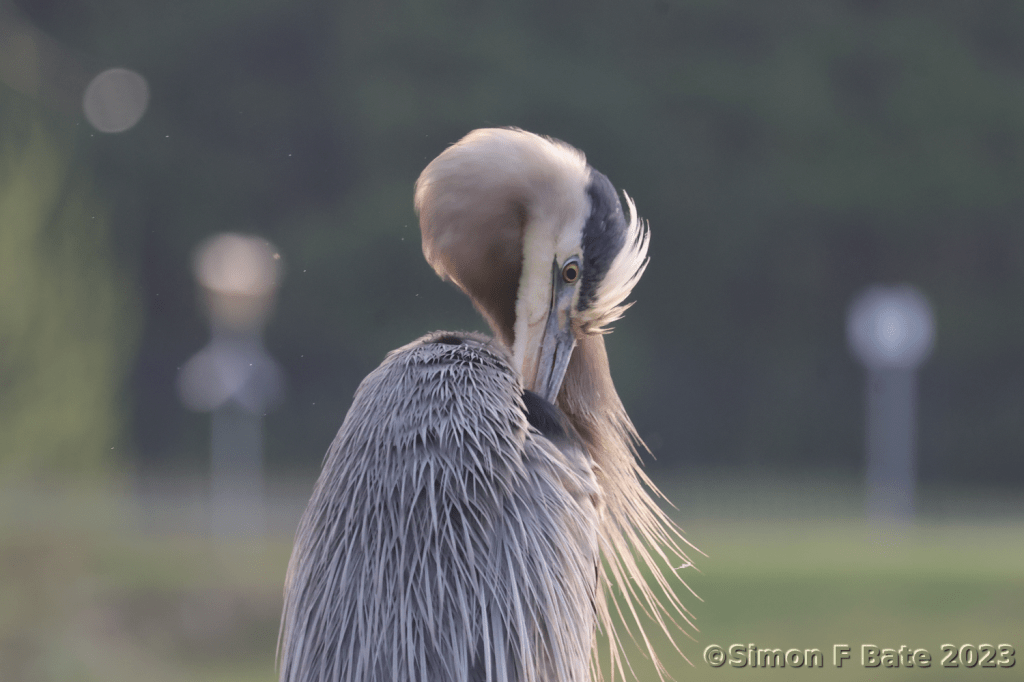
Today’s is an artistic picture. It’s not the standard pose I look for in a bird. Certainly not a “reference plate.” In fact, it shows only a portion of the bird. Additionally, the bird is preening. Most preening or grooming pictures show the bird in an awkward pose. But this bird has focus and intent (in my mind).

Some things about this image.

It is the first of many pictures I took of this Great-blue Heron. Unlike a “desperation shot,” I crept down the ramp to the dock just far enough to get clear of branches, took a solid stance, carefully lined the camera up, and took a good number of shots. Of all those images, still think this one, the first, is the best.

Normally I crop my pictures to the Golden Ratio. I think it lends a nice balance to the images, and it ensures that all images in a post have the same dimensions. This makes grouped images in a matrix much more consistent. However, the more I looked at this image and attempted to crop it, the less happy I was. So I left this image uncropped. It is almost exactly what I saw through the viewfinder.

It’s not perfect. I could ask for a different background. I know what the background objects are and I would prefer to show birds in natural surroundings (despite the sign in yesterday’s Tree Swallow picture).

So that’s my very general take on the types of bird pictures I take. I’d love to hear how you think of your images.

Poster Girl, or Boy

Correction from yesterday. I was so energized about having seen a Palm Warbler, I entirely missed that every time I meant to write “Palm Warbler” I wrote “Pine Warbler.” (Pine Warblers are quite common at Seagroves Pond; I see and hear them just about every day.) Thanks to a couple of friends, I have since updated the post to indicate the correct bird. Apologies.

In yesterday’s post I talked about categorizing images into three groups: artistic pictures, reference plates, and desperation shots. Today’s image might be categorized as a “reference plate.”

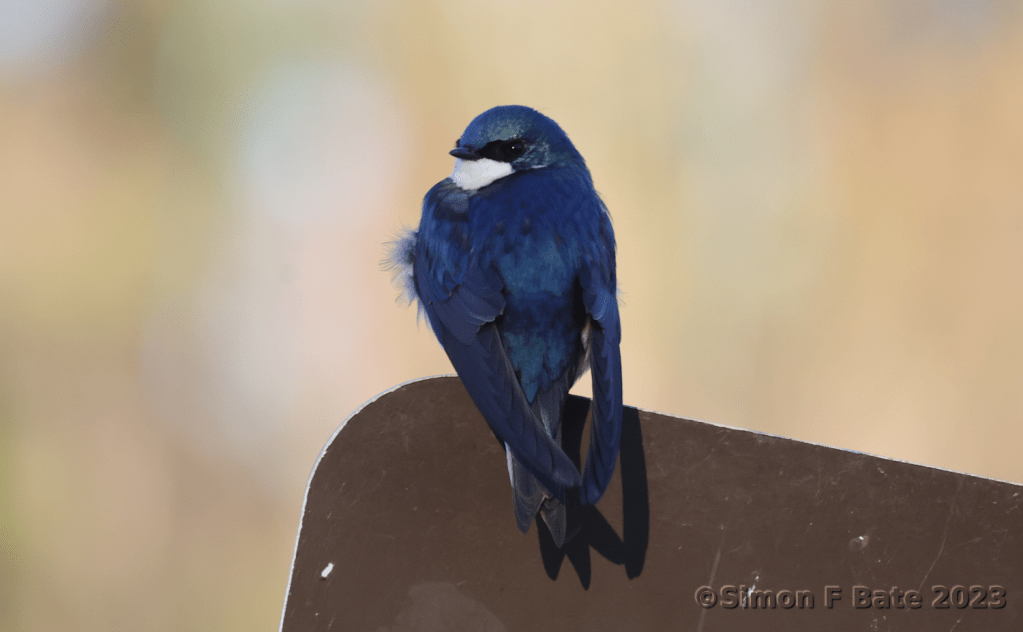
I know I posted a picture of a Tree Swallow not too long ago, but this one really needed its picture taken.

The bird flew onto the sign, just as I walked past it. Even while I futzed with the camera, it remained in place, giving me its best “I’m ready for my close-up, Mr. DeMille.”

I like this one because you can see much more of the bird’s variation in color. And I like the detail of the minute feathers on its mantle and coverts (essentially its back).

Tomorrow: artistic pictures.

Life-Lister

In general, there are three types of photos I take: artistic pictures, reference plates, and desperation shots.

The artistic pictures are those that are composed (mostly) in the viewfinder. They bring together the bird—or birds—and the other elements surrounding the bird in a well-balanced whole.

The “reference plates” are those that focus on the bird itself, in hopes of crisply capturing all the elements that distinguish it from others of its kind. Possible candidates for a bird book.

Finally, the desperation shots are those I fire off as quickly as possible, in hopes of identifying a bird I don’t recognize. (Usually with the desperation shots, my pulse quickens and my adrenaline shoots up, so I’m doing whatever I can just to make sure the bird is in the frame.)

Today I took all three types of pictures. I’ll share the other two in the next couple of posts, but today I want to show a couple of desperation shots that turned out fairly well.

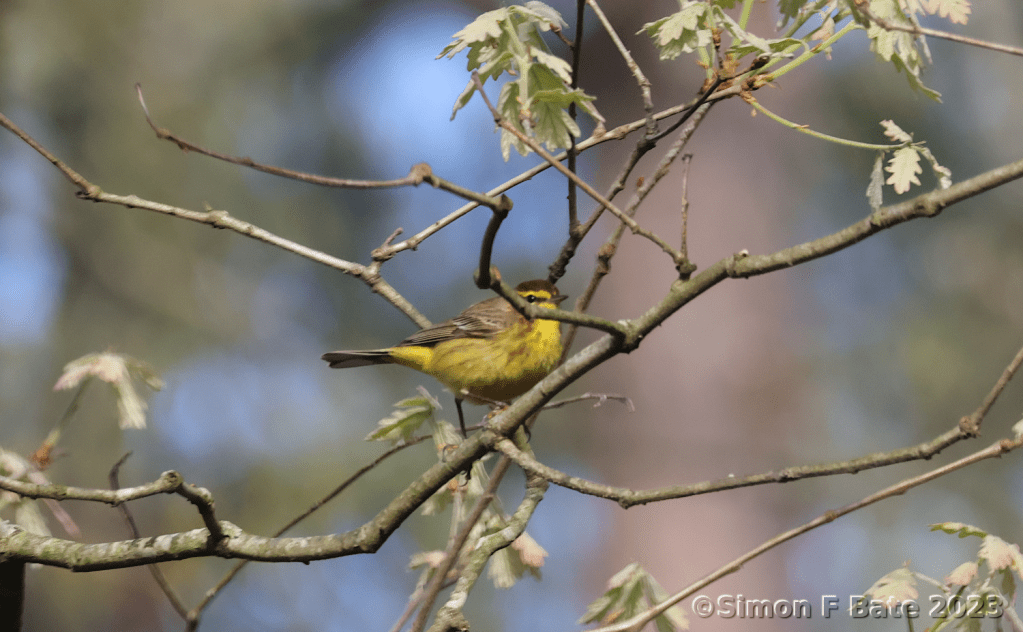
At this time of year I’m on the lookout for migrating warblers, and other birds. Today, while talking with one of my “pond buddies” I saw a yellow flash in a near-by oak. (Sorry, R., I got absorbed.) A quick check with my binoculars showed me this was something I had not seen before. I fired off a number of shots, following the bird as best as I could.

When I got home and downloaded the pictures, it truly was something I’d never seen before; it took a while to identify it: a Palm Warbler. A new bird for my life list.

Often desperation shots are something I reference, just to make an ID, but never plan on posting. But I thought these two were worthy of a post.

As I say, not quite the quality I usually post (not happy about the twig in front of the bird in the second picture), but I’m pleased enough to share these two.

I’m adding Palm Warbler to my list of birds seen around Seagroves Pond. If you have a few minutes, take a look at all the birds you can see in our corner of the world!

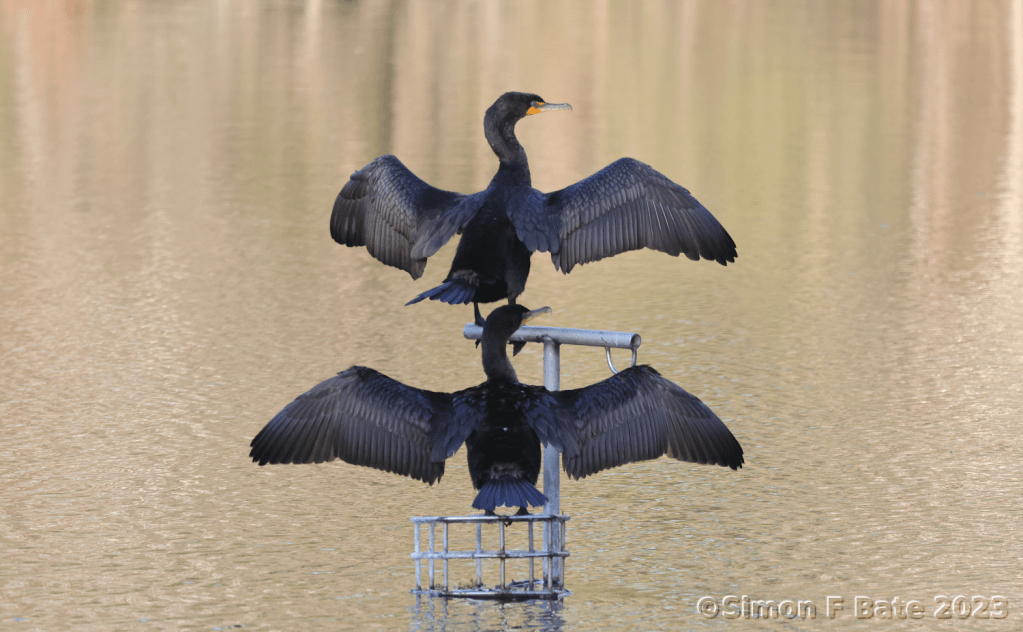
Pair Dryer

(or “Double Double-crested”)

I took this picture of two Double-crested Cormorants drying their wings just a few days ago. If you go to the pond today, it’ll look a bit different.

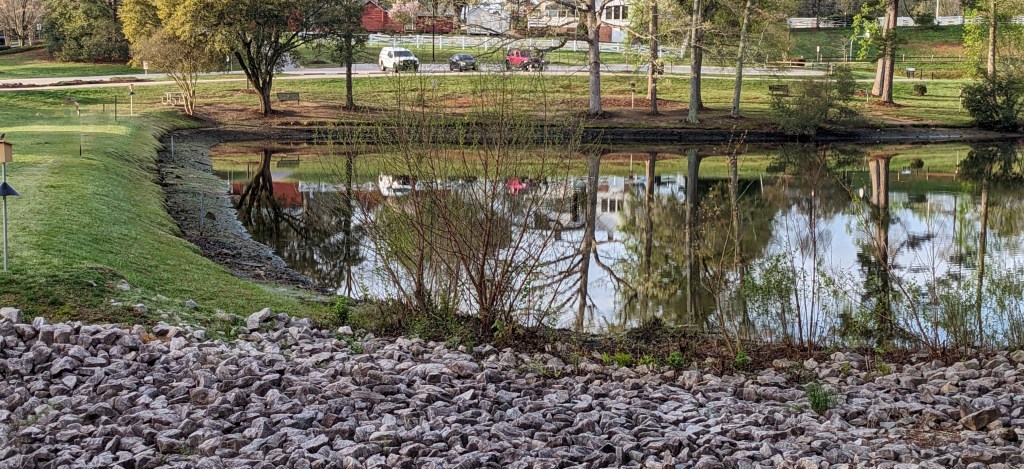
On Monday workers from the town started lowering the level of the pond so that they could repair damage to the dam caused by muskrats. I’ve been watching the number of holes grow for a while now. When chunks of the bank started to subside because of the extent of the holes, I knew it wouldn’t be long before something had to be done.

This is a picture of the pond as of this morning, taken with my phone. At this moment, the level is down by about 2 feet .

It’s a shame. I do like muskrats, but I’m also aware of the serious consequences they can cause by digging in dams.

Spring Green

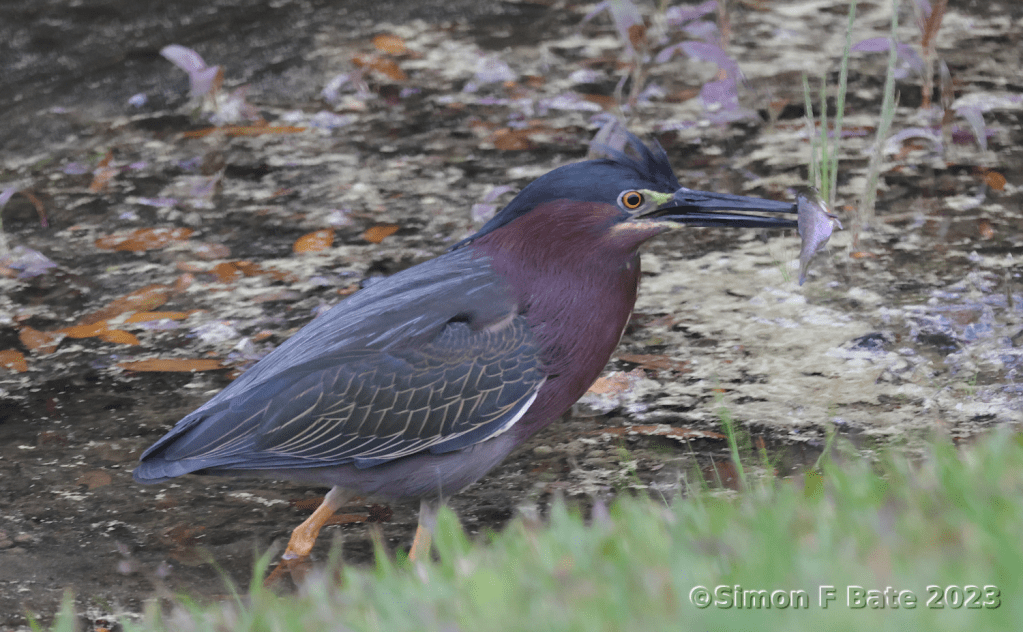
On Saturday I wrote in my post that I expected to hear Green Herons anytime in the next few days. The very next day, as I approached the pond, I heard “Skeeawwww.” A few minutes later, I actually saw the heron, but the light wasn’t great for photography. Nor was it in a photogenic spot.

This morning, I heard the Green Herons again, then found one on the shore of the pond. It put on quite a show.

Just as I started shooting, it darted its head into the water and came up with a small fish.

I like that its crest is slightly raised.

After swallowing the fish, it turned around and gave me a nice, coy posterior view.

Then, as it turned around a bit more, it stretched out its neck and raised its crest more fully.

A couple of minutes later, it flew over to a wooded portion of the pond.

Overall, a nice first encounter of the season with the Green Herons.

FOY* White-eyed Vireo

As spring unfolds the warm-weather birds start to appear, such as the Tree Swallows and Bank Swallows I mentioned a few days ago. Yet, some winter birds are still around. I’m still seeing Slate-colored Juncos (a.k.a. “Snow Birds”), Yellow-bellied Sapsuckers, and on today’s walk, I saw four Ring-billed Gulls.

To counterbalance the presence of those winter species, this morning I saw my (*) first-of-the-year White-eyed Vireo. It was encouraging to see the Vireo because it means that the spring migration is ratcheting up.

I’m still waiting to hear the skeeaw and gulp of the Green Herons. Should be any day now (although our colder than average March weather might be holding them back).

Swallow Two

Yesterday I posted a picture of a Tree Swallow, along with a picture of an Eastern Bluebird.

The Tree Swallows first appears (to my knowledge) about two years ago. They probably visited the pond before, but they never stayed. It occurs to me, as I write, that their nesting at the pond is related to the erection of the bluebird nesting boxes. The swallows and bluebirds compete for the boxes across the dam, with Brown-headed Nuthatches taking the box across the spillway, and Chickadees in the box further up the path from there.

However, for several years before the Tree Swallows stayed to nest, the only swallows I saw at Seagroves were Bank Swallows. They don’t appear regularly, but they are occasional visitors in the summer months, showing up for a few days at a time, then disappearing again. It’s possibly a migratory pattern.

There have been a pair of Bank Swallows around the pond for the past few days. I’ve found they don’t startle easily, so it is possible to get quite close for a photograph.

While not as brilliantly colored as the Tree Swallows, the Bank Swallows make up for it in almost teddy-bear softness.

One other difference you might notice between the two birds is that the Tree Swallows tend to fly high above the pond, staying fairly close to the eastern (dam) side of the pond. Whereas the Bank Swallows fly much closer to the water and prefer the western (dock) side of the pond.

Blue bird? or Bluebird?

If you see a blue bird, does that make it a Bluebird? Not necessarily.

If you see a bird that isn’t all blue, can it be a Bluebird? Perhaps.

This first image is a Tree Swallow. It’s probably one of the prettiest blue birds we see around the pond (and it’s almost entirely blue). I am asked from time to time if a Tree Swallow is a Bluebird. I’ll reply that its a pretty color, but it’s not an Eastern Bluebird.

To see an Eastern Bluebird, you have to look for orange.

Admittedly, this is a carefully chosen view of an Eastern Bluebird. The back of the Eastern Bluebird is blue, particularly on the males. Nevertheless, I find it amusing that from some perspectives, the Eastern Bluebird doesn’t appear to be blue at all.

On the west coast of North America, there are Western Bluebirds, but they have more orange than Eastern Bluebirds. However, if you go to the Rocky Mountains, you’ll find Mountain Bluebirds, which are completely blue. And they’re Bluebirds.

Great, Blue Heron

There have been at least two Great-blue Herons around the pond over the past few weeks. I’ve seen and heard them confronting(?) each other several times. A few days ago I heard a strange “Awwk” above my head and looked up to see the two of them concluding a brief, in-flight battle.

Or at least I think they were battles. Another time I thought I saw one pursuing another off into the woods to the east of the park. A few minutes later one of them returned alone.

At this time of year, they could be territorial battles for food or nesting, or they could be some kind of pre-courtship “getting to know you” rituals between a male and female.

Because the sexes are very hard to tell apart, I’ll never really know…unless we’re lucky enough to see some “little” Great-blue Herons.

Either way, as they fly around, they make interesting targets for photographs.

Just Ducky

Up in the trees we’re watching Red-shouldered Hawks build nests. But much lower down, there’s some subtle nest building occurring on the forest floor. Or perhaps I should say “location scouting.”

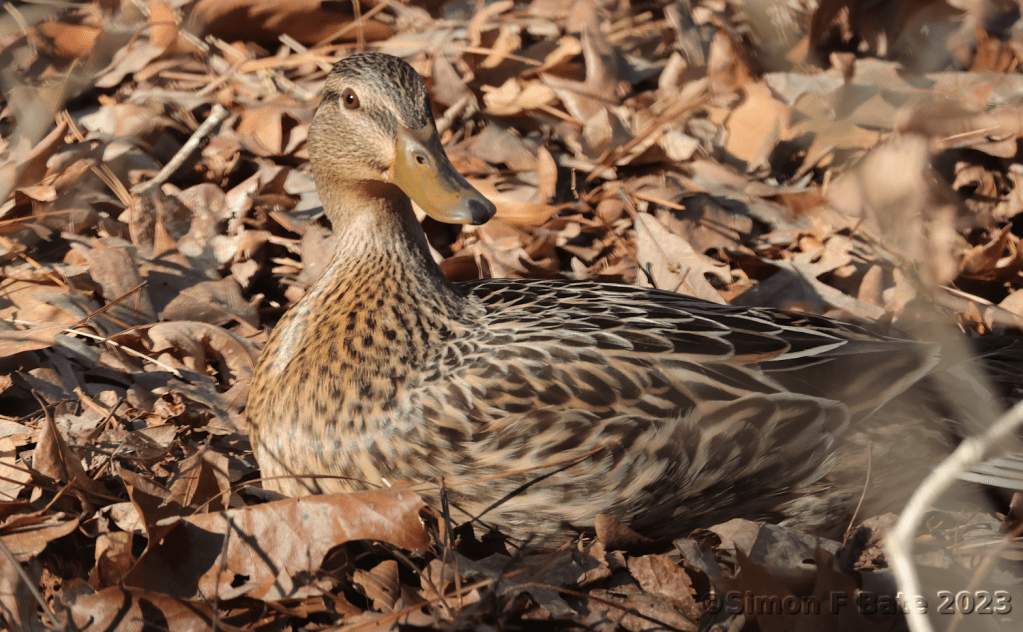
Several pairs of ducks have been noticed in the area between the bridges, some quite close to the path. This Mallard hen was just a bit off the paved path, very close to one of the “free-form” dirt paths. She blended into the dead leaves remarkably well.

Perhaps she was a bit too close to the path. As I watched, after taking this shot, a man and his young son came right along the dirt path. The Mallard wasn’t happy about that and waddled off to the water.

I inspected the site and was actually glad she hadn’t started lining the spot with downy feathers.

But somewhere around us, there’s a duck that knows what it’s doing. She’ll have a nest much like this one, perhaps almost in plain sight. But you will probably never know it’s there, until you see the little ones on the pond.

To Capture a Kinglet

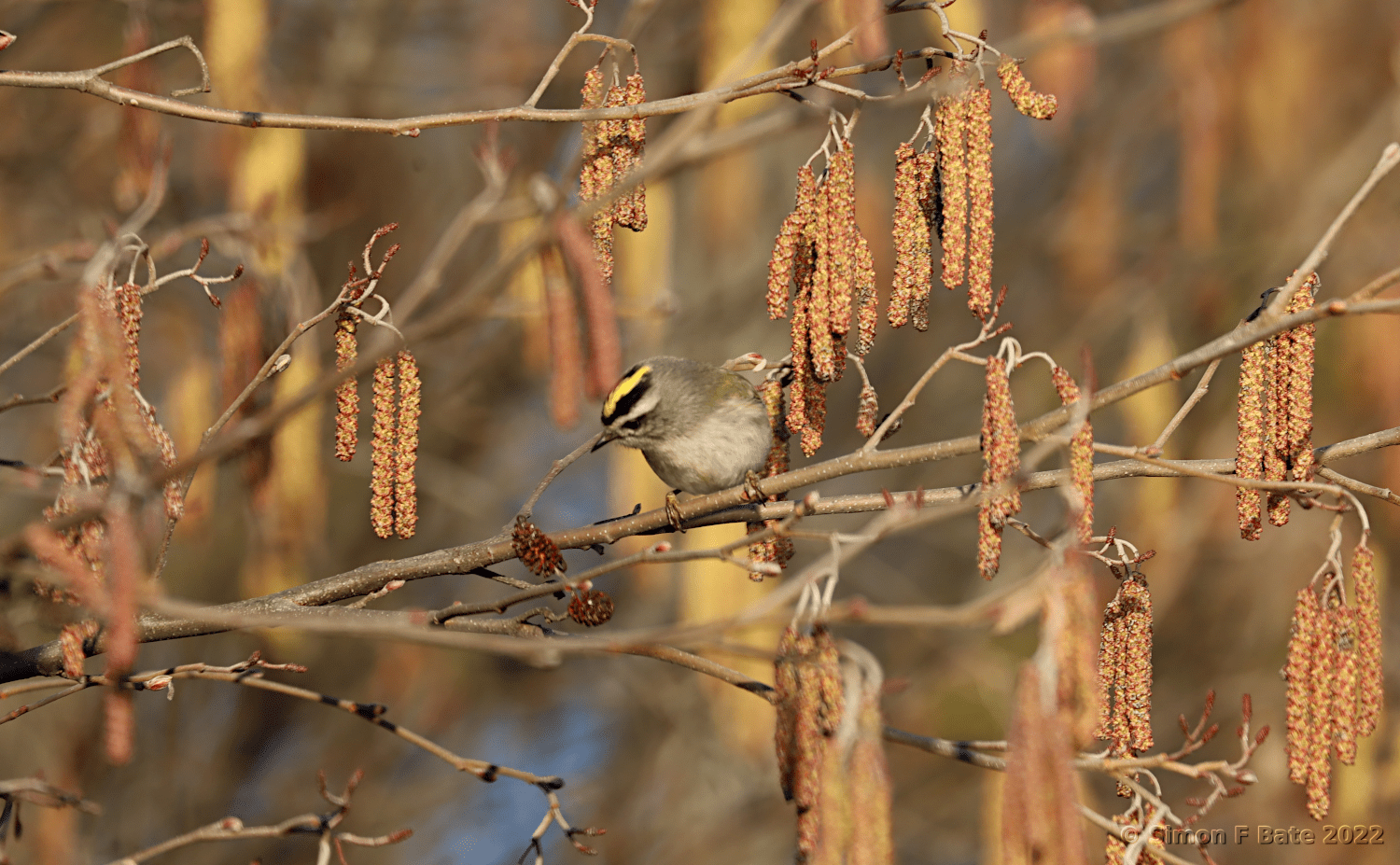
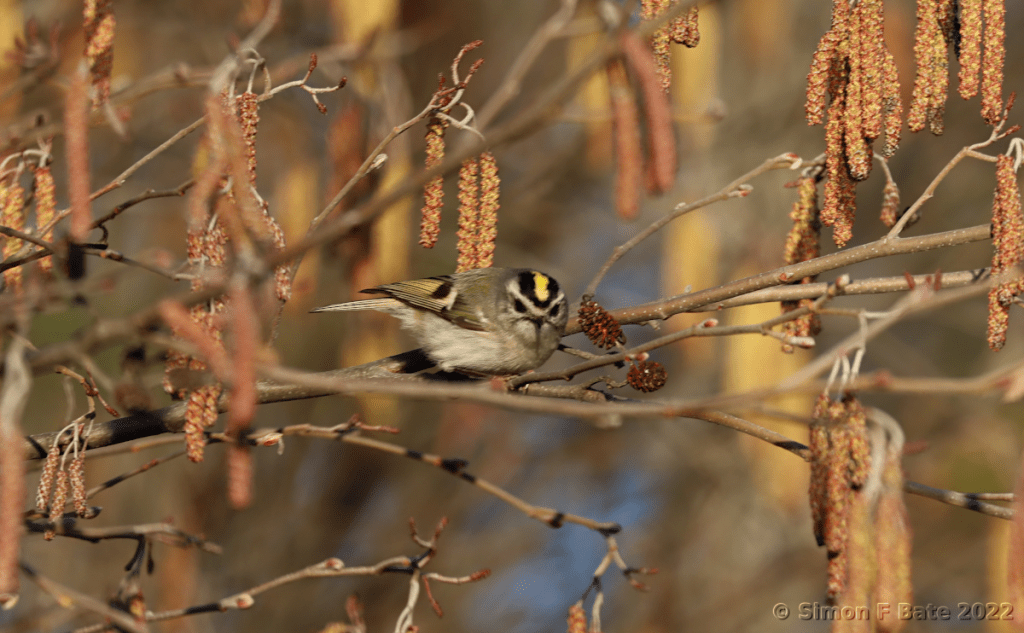
The only bird that’s smaller than a Kinglet is a Hummingbird. We have two species of Kinglets at Seagroves Pond: Ruby-crowned and Golden-crowned. Both species are busy birds. They move from branch to branch and twig to twig in small hops, usually not more than 8-12 inches at a time. They’re constantly looking for insects and other food.

But the constant motion presents a problem in trying to photograph them. No sooner do I press the shutter than the bird decides to move on to the next spot. Although it can be frustrating, it often amuses me when I’m looking through shots to see the Kinglet first in a nice pose on a branch, then in the next shot to see a blur headed somewhere out of the frame.

Even so, it’s rewarding when a shot pays off. This picture of a female Ruby-crowned Kinglet was part of the second pair of images, above.

The Kinglets will be around for another few weeks, then they’ll migrate north for the summer. The Golden-crowned will go about as far a Quebec; The Ruby-Crowned Kinglets can migrate as far as Labrador. They’ll come back to us in October or November.

Nesting is work!

I’ve seen at least four Red-shouldered Hawk nests under construction this week. Most will probably be false starts, abandoned for one reason or another. Some not well supported by the tree, some too public, some, well, who knows? Certainly the hawks do.

This morning I saw two hawks building a nest in some pines, just off the path. I think it’s a very public spot, so I don’t have much hope they’ll stay. But they are certainly busy gathering twigs and sticks. They’re opportunists and will often take useful-looking branches from squirrels nests. Other times they’ll hang and swing acrobatically while trying to pull a twig off of a tree.

I like these images because they show the birds in action, with the raw materials right in front of them.

Phoebe in Pink

Walking by the dock today, I heard some Brown-headed Nuthatches making their squeaky toy sounds. Then I heard another sound down by the water, almost like the Nuthatches, but a bit more pronounced. Then I heard it more distinctly: “fee-beee, fee-beeeee.”

I’ve seen an Eastern Phoebe around the pond for the past few days. When this one took its pose in a blooming tree, with reddish sweetgum buds behind it, I couldn’t resist. I fairly well knew how the picture would look before I pushed the shutter.

Then it said “fee-beeee,” just as the camera clicked.

Appropriate day for couples

Here’s a pair of (quite literally) “love birds,” spotted just today.

I saw one carrying nesting materials and tracked it as it flew to its nest. While it was working on the nest, a second, the female, alighted on the branch pictured here. The male joined it a few minutes later.

The male is on the left, the female on the right. Among raptors and owls, the female is often noticeably larger than the male.

We had a pair of Red-shouldered Hawks attempt to build a nest in Seagroves Park two years ago. Perhaps it was the same couple. I documented some of their nesting in one of my earlier posts. For whatever reason, they decided not to use the nest; perhaps this pair will succeed!

Sing a song of sixpence

An isolated shot of just one Red-wing Blackbird. There were others around. In fact, you will rarely see these blackbirds as singletons; there are always others around. Sometimes those others may include Grackles or Brown-headed Cowbirds. It’s always a party with Red-wing Blackbirds.

You might see them flying in flocks of 10 to 100 individuals. (Did anyone say “four and twenty”?) The entire flock will land together in the top of a group of trees. I’ve noticed they’re particularly fond of pine trees. In pines, they become invisible, save for the movement of a few birds, but the noise they make with their “skrr” call is unmistakable.

Hooded Merganser

I must have hundreds of pictures of Hooded Mergansers at Seagroves pond, but I just can’t help myself. The males are so dramatically colored and the females have a quiet beauty all of their own.

The one visual feature both sexes have in common are the secondary feathers on their wings. When their wings are folded, the secondaries appear as the stripes on their “sterns.”

Quick Post: Yellow-bellied Sapsucker

I get the feeling that many people think “Yellow-bellied Sapsucker” is a made up name, used in comedy sketches and in the funny papers.

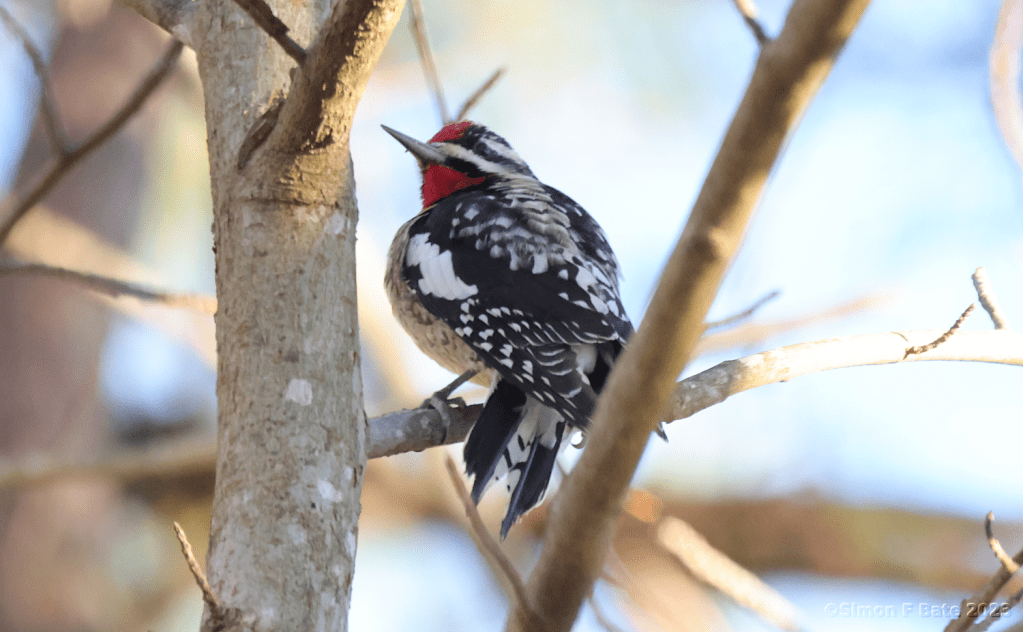
There are actually four different sapsuckers in North America: Williamson’s, Red-breasted, Red-naped, and Yellow-bellied. The others are found in the mountain west. The Yellow-bellied variety visits us in the winter months.

These are pictures of the same bird. It left its perch, flew over my shoulder, and landed on the branch right behind me.

A nice (aquatic) end to the year

The past few days have been been profitable birding and photography-wise. I don’t have pictures of the 4th- or 5th-year Bald Eagle I saw the other day, but do I have a number of images I’m happy with, for one reason or another.

First off, I’ve been wanting to get a picture of a Belted Kingfisher for a couple of years. I’ve taken to calling it my nemesis. As soon as I’ve gotten anywhere close to a Kingfisher, it has flown off, chattering as it goes. Sometimes one comes close, looks like it’s about to land, then flies off again, taunting me. (I know. Not really. But it feels like it, at times.)

At last, for the past couple of days, I’ve been able to get some almost descent shots of the Kingfisher. Yesterday, I managed to remain hidden behind some bushes. Today, I found that walking directly toward the bird (slowly), didn’t phase it as much as side-to-side motion. Yesterday’s shots were almost good; today’s shots are better (but I always want more).

Yesterday, as I waited for the Kingfisher to return to its favorite spot, I watched some Hooded Mergansers, looking for a good shot. As I peered through the viewfinder, a Great Blue Heron flew past. I was able to track it and caught a nice (but never perfect) shot as it flapped around the pond.

It might be the light, but I’m struck by the blue-ness of the image.

I mentioned Hooded Mergansers. I’ve probably mentioned this before, but they always show up when the weather turns bitterly cold. With recent morning temperatures as low as 8 or 9 degrees F, I was sure they’d show up. I wasn’t disappointed. In between today’s Kingfisher shots, a male Hooded Merganser came close enough that I could get a reasonable shot.

Finally, I got a reminder today to look closely at the birds I see, and to not make assumptions about what I’m seeing. As I stood near the picnic shelter, I saw a couple of Mergansers in the south “inlet.” I watched the birds and got a few shots. Later, as I sat on the planter looking at other Mergansers, I thought it was odd that one of the birds I saw in the inlet had very white sides, whereas the Hooded Merganser males have brown sides (see above). It wasn’t until I got home and was reviewing my pictures that I noticed an iridescence in the bird’s head, and then noticed that the white went all the way around the back of the head. I then realized I had seen (and photographed) a Bufflehead. This turns out to be my best picture yet of a Bufflehead.

One last comment: I’ve noticed in looking at my posts on my phone, that the cover (or “feature”) image at the top of the post doesn’t appear when viewed on a phone. I recommend, for the best experience, that you view this site on a device with a larger screen.

Like what you see? Leave me a comment.

Follow me to get updates.

Giving thanks for birds

Colder temperatures and beautiful, changing leaves around the pond. With the cold, more winter birds are arriving. Among the more common winter birds are Slate-colored Juncos, White-throated Sparrows, and flocks of Myrtle (Yellow-rumped) Warblers.

The Yellow-rumped Warbler is a good example of the ever-changing nature (ha ha) of bird taxonomy. As a teen, I spent ages pouring over my Golden “Birds of North America,” looking at the Warblers and wondering when I would get to see just one. At the time, I noted two similar Warblers: the Myrtle Warbler (Dendroica coronata) and the Audubon’s Warbler (Denroica auduboni). Even then it was acknowledged that the Audubon’s was a western counterpart of the Myrtle, that the two did hybridize, and the species were hard to differentiate in the fall.

Fast forward to the present day. Now the two are lumped together as the Yellow-rumped Warbler (Setophaga coronata—note the change of the genus name) with two separate “populations” (Myrtle and Audubon’s). But I still call them “Myrtle Warblers.”

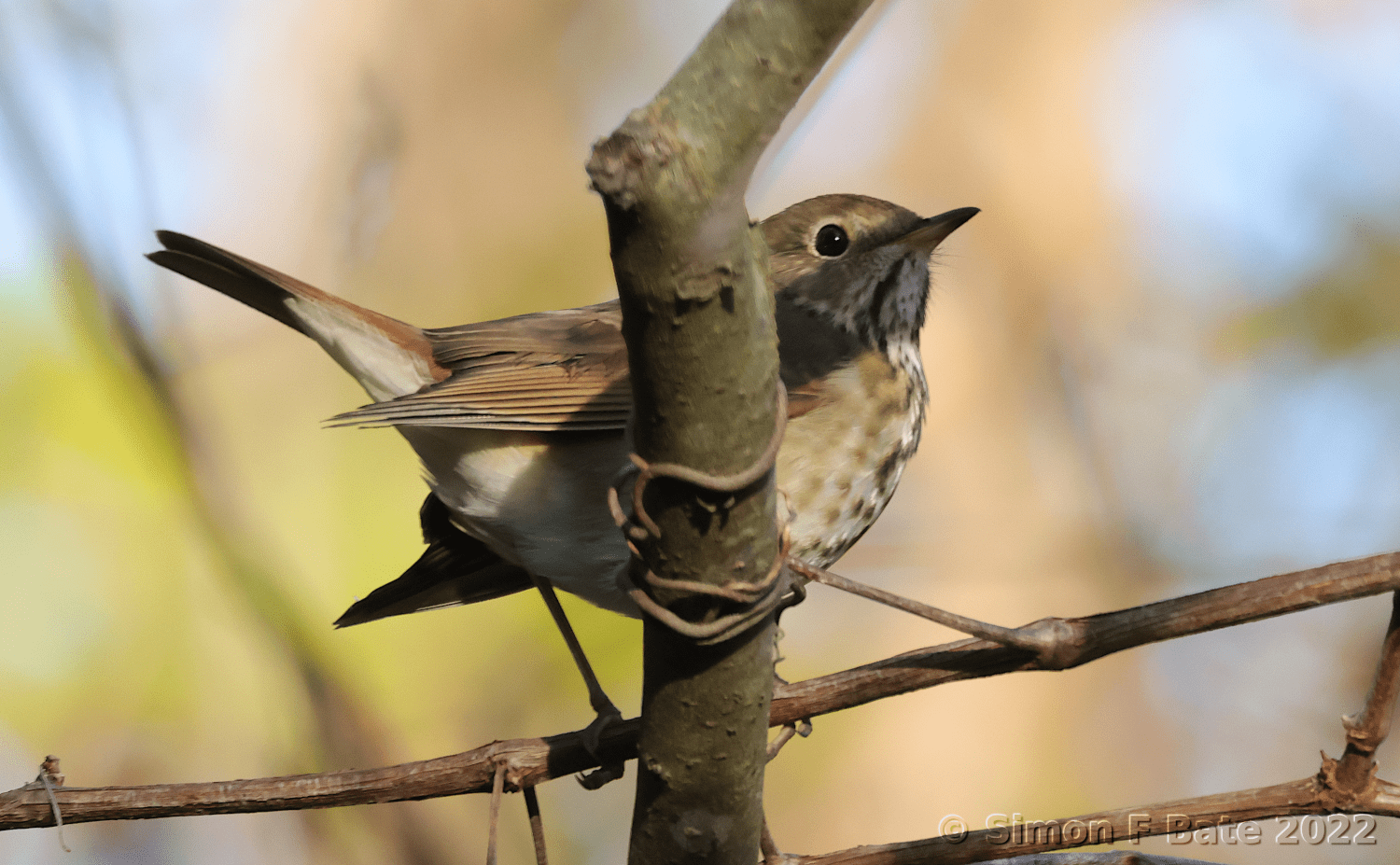
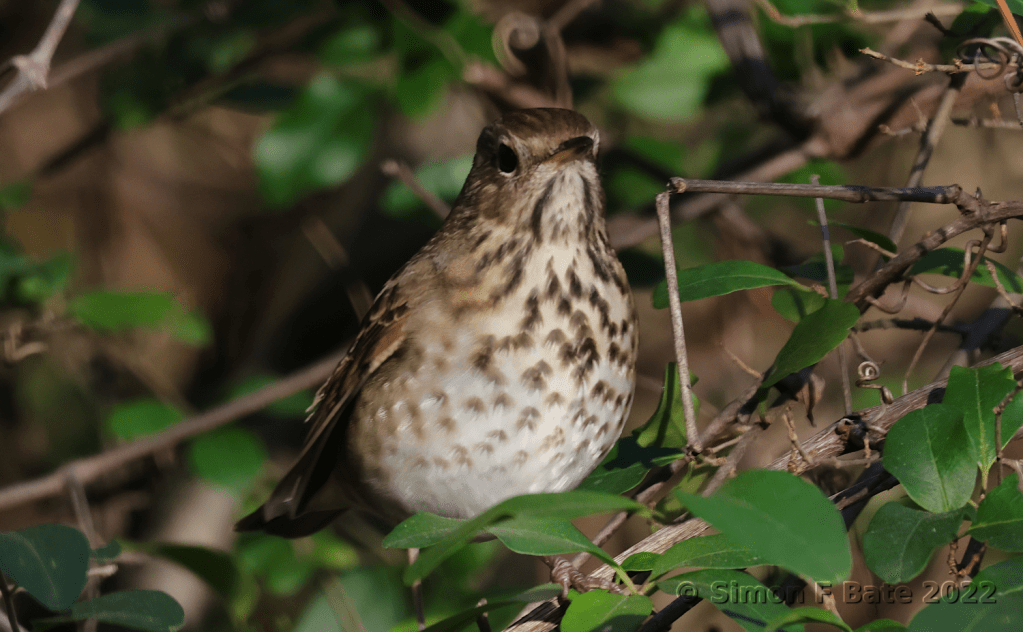
Now, back to the birds. I’ve been looking for Hermit Thrushes for the past couple of weeks. About a week ago, I saw my “first of the season.” Since then, I’ve found them just about every day. I enjoy seeing these birds so much, I though they deserved two spots in this post: the featured (or cover) image and this frontal view.

I’m fascinated by the markings on its breast. I’d like to see the design and arrangement of feathers that produce the effect.

The woodpeckers are much more visible, now that the leaves are falling. The Yellow-bellied Sapsuckers have returned for the winter, but I haven’t yet been able to get a good shot of one. It’s a rare day that I don’t encounter a Red-bellied Woodpecker, and Downy Woodpeckers are just about as common.

This Red-bellied just about rivals an owl in being able to twist its head around.

Finally, we had a Red-shouldered Hawk visit our neighborhood last weekend. I suspect it was resting while digesting a rather large dinner. It stayed in the same location for at least an hour, despite some youngsters quite actively watching the spectacle. I did see the Hawk glide down to the ground and the return to the branch. Probably to pick up a morsel it had missed earlier.

Like what you see? Leave me a like. Follow me for updates!

Movin’ in or movin’ on

The fall migration is in high gear now. For the past month, I’ve seen a number of species that are traveling through our area to find warmer digs for the winter. I’ve also spied a few species that are looking to make Seagroves Park (and its environs) a home for the season.

I’ve seen both Red-eyed and White-eyed Vireos recently. The Red-eyed Vireos are moving through on their way to the tropics. The White-eyed Vireos might stop at our southern coast, or they might continue to the Bahamas and the Caribbean.

Red-eyed-Vireo
Whtie-eyed Vireo

American Redstarts can be found around us most of the summer. I might be seeing one of our summer residents, or I might be seeing birds that have been further north for the summer now heading down to their winter homes in southern Florida.

Yesterday I saw my first Ruby-crowned Kinglet of the season, they and their cousins, the Golden-crowned Kinglets will be here all winter long.

Most of my bird guides indicate that the The Common Yellowthroat (also the featured image for this post) lives in our area all year long. But I seem to see them most in the spring and the fall.

I’ve mentioned the birds that held still long enough to get their pictures taken. Other migratory birds that I’ve seen this fall include Black-throated Blue Warblers, a Prothonotary Warbler, and a Summer Tanager. Two weeks ago I saw one more lone Green Heron. I expect that’s the last one I’ll see this year.

This morning I saw (but couldn’t photograph) the first Yellow-rumped (Myrtle) Warbler of the season. You can expect to see more pictures of them through the next several months.

Follow my blog to receive notifications of new posts!

Late(r) Summer Birds

This is the quiet time of year. The birds are done establishing territory, meeting each other, and mating. Now some are looking after young. Other youngsters are off on their own. All are generally staying quiet. They’re laying low, but they are still there. This morning I encountered 25 different species (even though that’s rather unusual for this time of year).

Some of the birds of high-summer have moved on. The Green Herons have departed, along with their young. The Great-crested Flycatchers and Eastern Kingbirds are no longer turning high in the tree tops.

It has been a while since I processed pictures and wrote a post, so this will be a look back over the past couple of months.

Let’s start with a young ‘un: a juvenile Red-bellied Woodpecker. The main thing that marks this as a juvenile is the lack of red on the back of its head.

Next up is a young Cooper’s Hawk. I saw this hawk and one of its parents chasing a gang of American Crows. I’ve read that Cooper’s Hawks will feed on juvenile crows. The young hawk rested on a chimney while the adult continued the chase. A week or so later I saw the same scenario play out again, closer to the pond: two Cooper’s Hawks chasing crows.

Green Herons raise between two and three clutches of eggs each breeding season. These fledglings were probably from a later clutch. I watched the first one preening, then, when it folded its wings, the second appeared behind it. After taking these pictures, I realized a third one was further up the branch.

A few days later, I saw another young Green Heron (below). I don’t think this one is related to the ones above, it’s much further along in gaining its feathers. All that’s left of its fluff is the tuft on top of its head.

While I’m posting pictures of herons on the dock, this Great Blue Heron must have been digesting something. It stayed in place while I took a picture from the parking lot (the new cover picture for this blog) and was still there when I walked around to the dock. I was able to creep down the ramp to take pictures. Another of my walking friends was also able to take pictures. Unflappable. (I think it was still there when I got to the other side of the pond.)

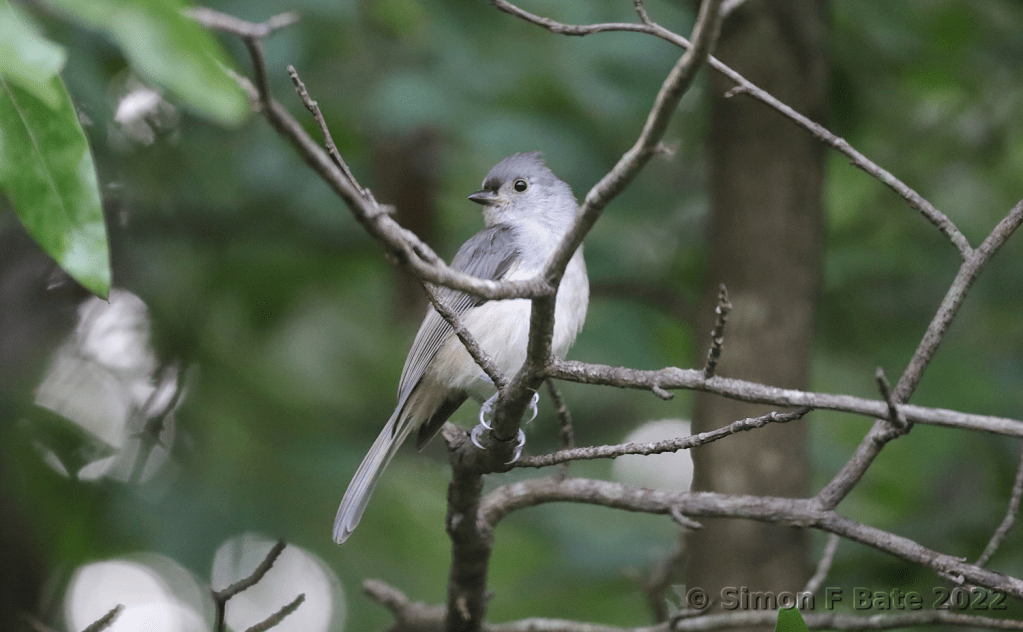
A Tufted Titmouse posed nicely for me. What I find interesting about this picture is that its claws aren’t closed around the branch. In fact they don’t seem to be touching at all. I suppose the fleshy part of its feet provide enough “hold” for it to perch comfortably.

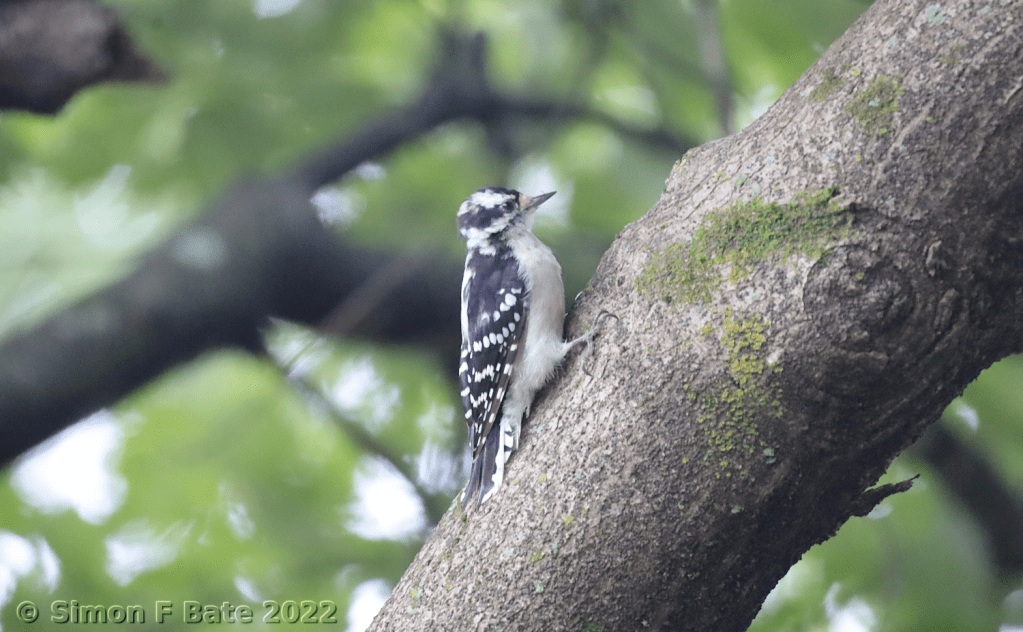
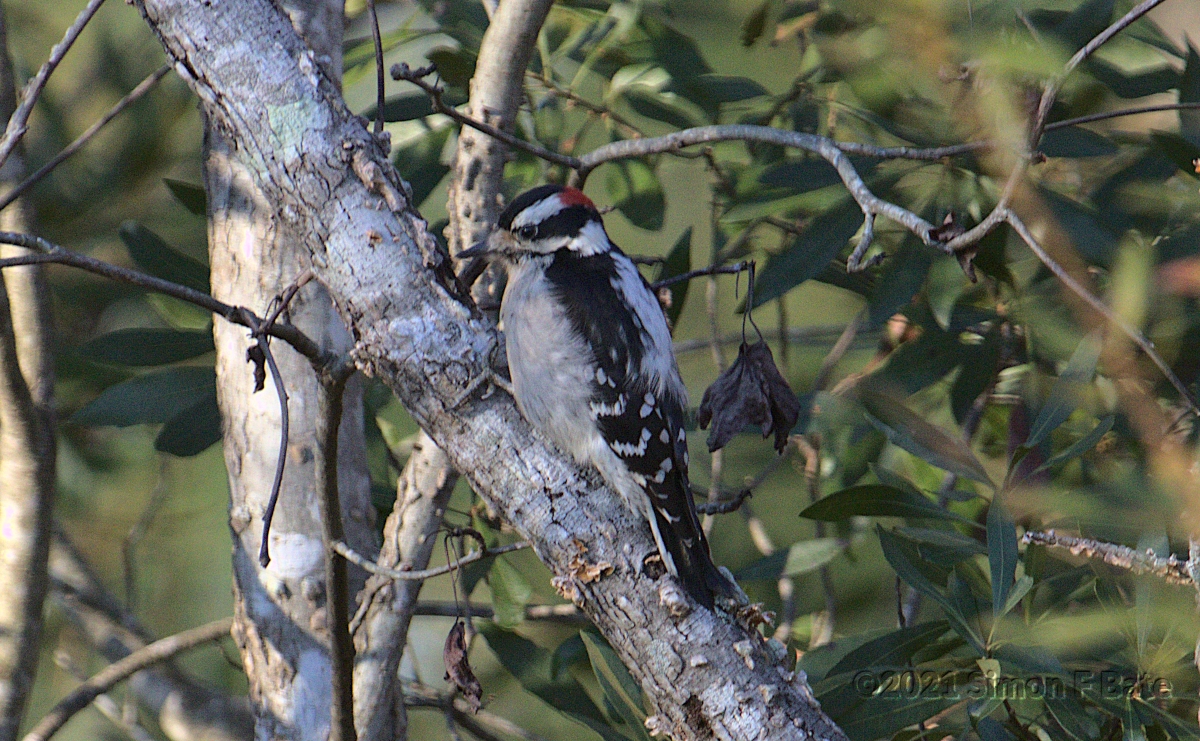
As I’ve written in earlier posts, Hairy Woodpeckers and Downy Woodpeckers can be hard to differentiate. Here are a female Downy on the left and a male Hairy on the right. Note the outer tail feathers and the position of the eye, relative to the length of the head, beak to nape.

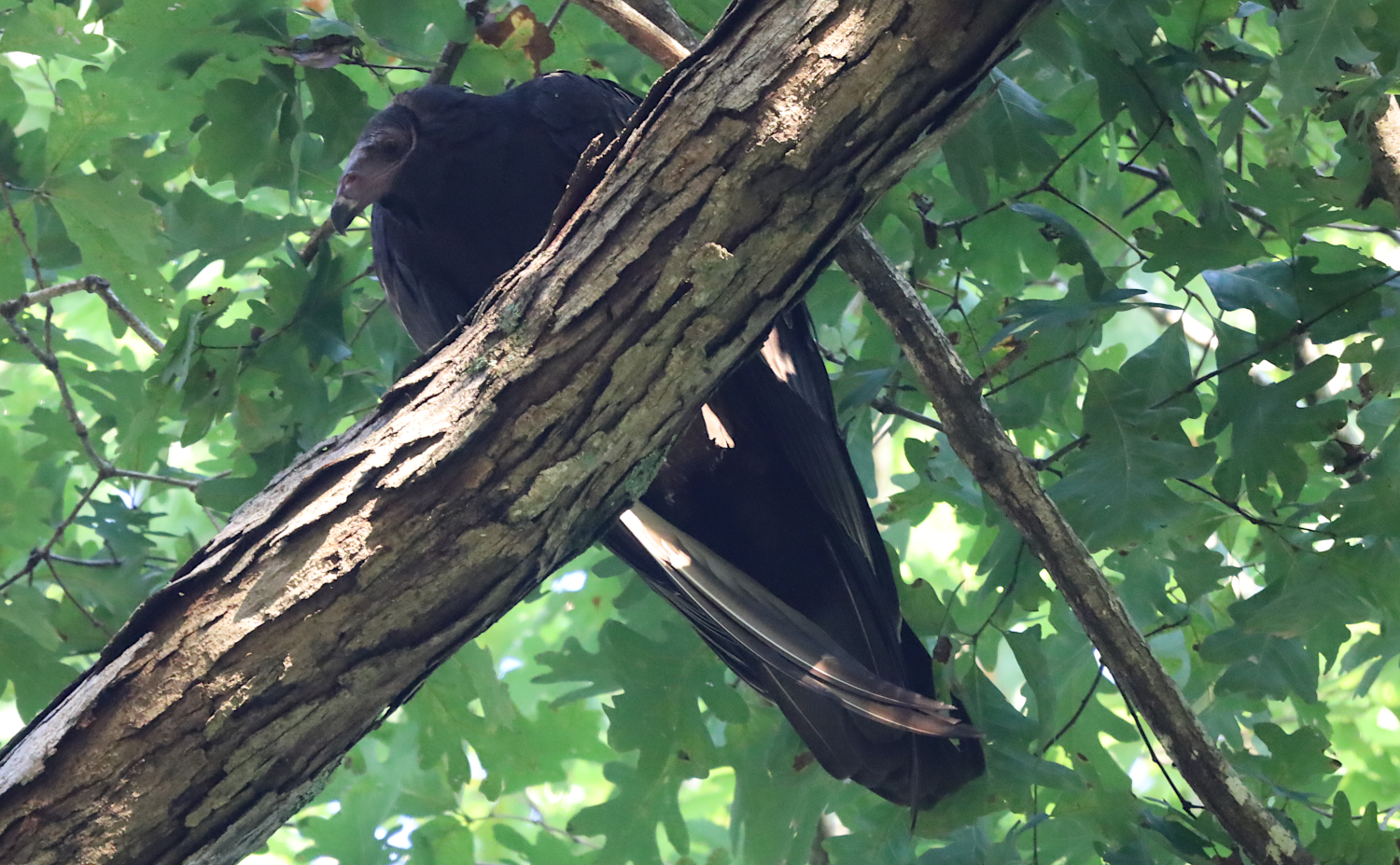
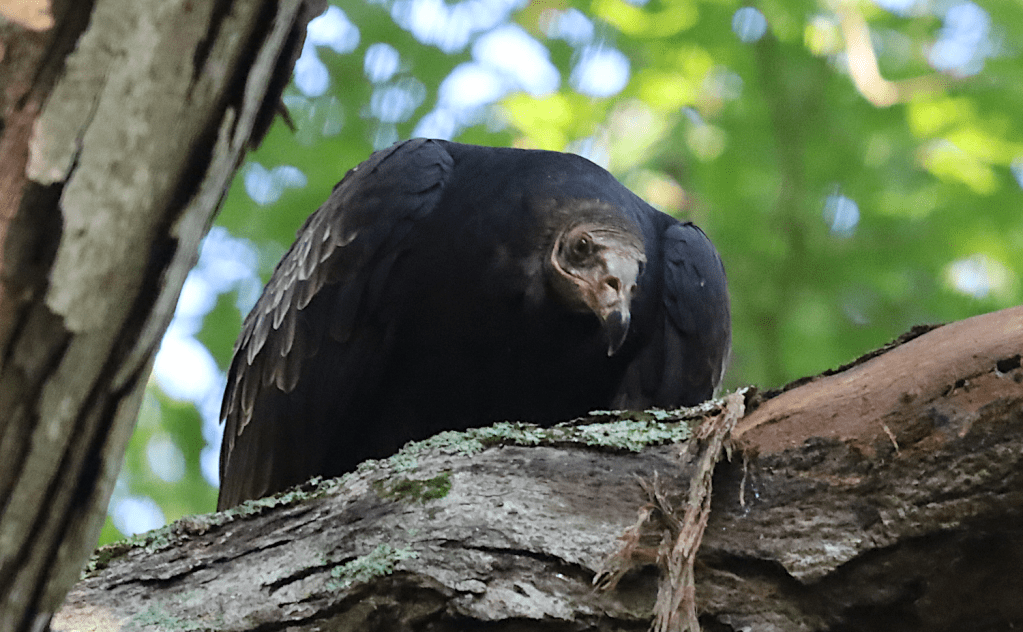
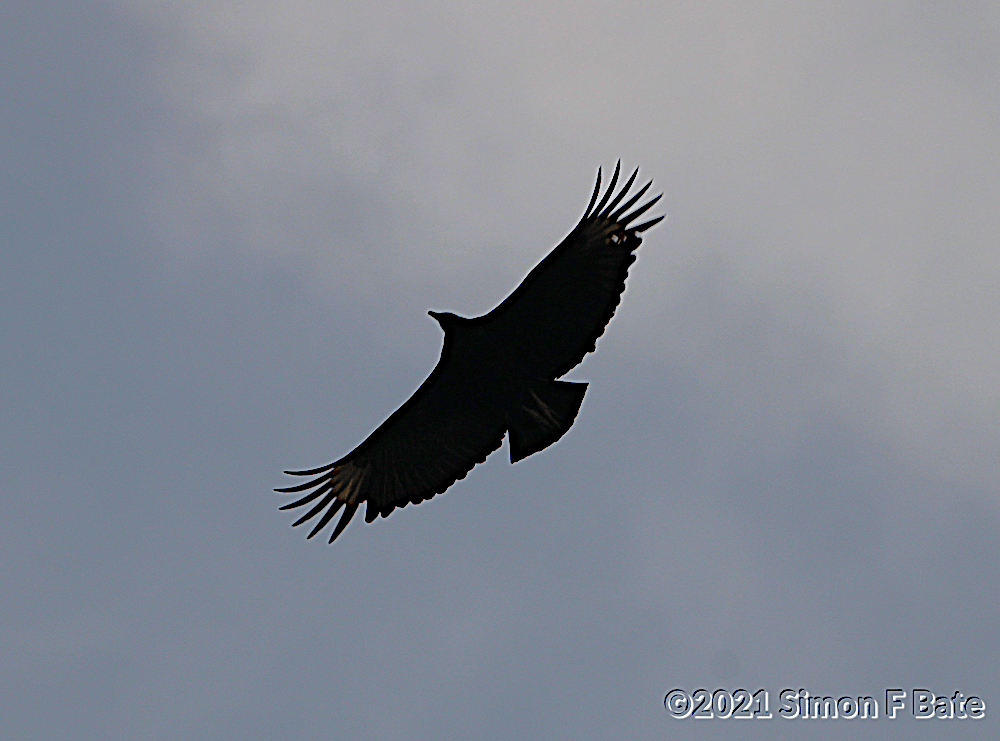
Some may be turned off by this next picture. Yes, the Turkey Vulture’s head is decidedly unattractive. Focus instead on the glorious array of feathers it uses to soar for hours on end.

And to wrap things up, here are a Great-crested Flycatcher, a White-breasted Nuthatch,and an Eastern Kingbird (also seen as the featured image on this post).

Like what you see? Leave a comment.

Follow the blog to receive updates.

Working Title

Looks like it’s been a month since the last time I posted. I’ve accumulated a bunch of (what I think are) really good pictures. So without further ado…

The Green Herons are settling in and nesting. I’ve been watching a pair of young ones flying around the pond for the past couple of days. This one is mature, but a bit vocal.

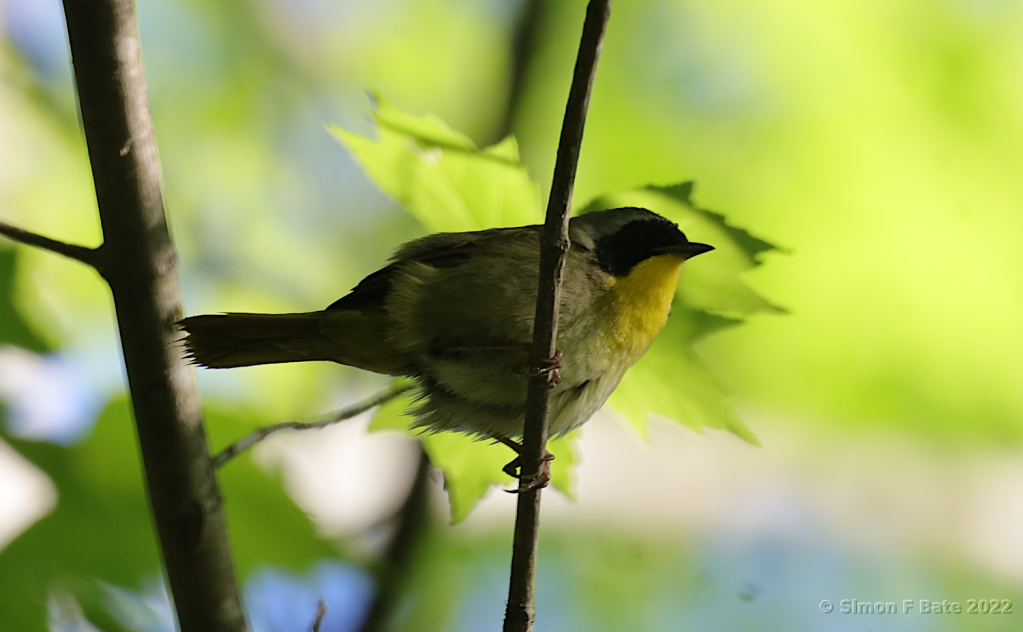
Common Yellowthroats were very, um, common in May.

Brown-headed Nuthatches took over one of the nesting boxes. I think the Eastern Bluebirds have reclaimed it.

Geese were found almost anywhere during the molt. One of the pair on the right seemed to be enjoying sliding down the tin roof.

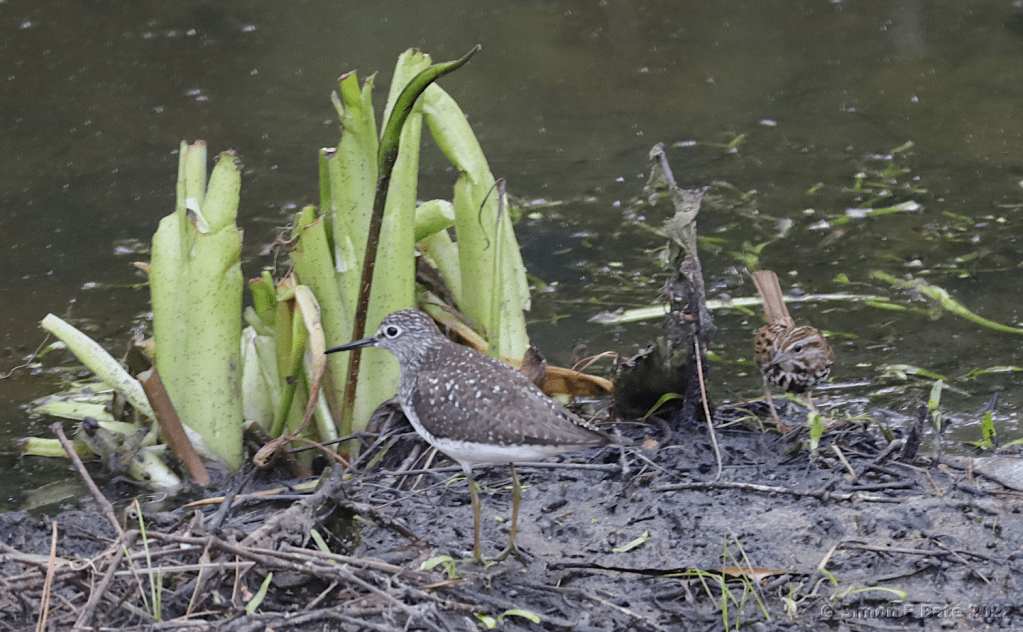
I spied a trio of Spotted Sandpipers while I was gathering pictures for the immature bird post. This one was sharing the settling pond with a Song Sparrow.

We were graced with the beauty of a Great-blue Heron.

This Tree Swallow was very cooperative. It didn’t seem to mind me getting quite close, front and back.

Like something here? Let me know!

Follow my site to receive notifications of new posts.

Annual Fledgling Post

Every year at this time, I’m surprised and heartened by the number of fledgling birds I see. The odds are against the nesting birds and their chicks. Springtime weather can be brutally variable. And the woods are full of birds and other animals that love to feast on eggs and baby birds. Yet, many triumph. Some by luck. Some by extremely protective parents. Some by ruses (I’m looking at you, Cowbirds).

Speaking of predators, here’s a Red-shouldered Hawk I saw gliding through the understory. It was an odd place for a Red-shouldered; more a place for Cooper’s Hawks. When I processed the pictures I realized why; from the white breast and ermine-like spots, this is quite a young bird. It was probably still figuring out this flying thing.

I (and a number of other people I see in the morning) have been watching a Red-bellied Woodpecker hole by the south bridge. There was a lot of coming and going, and calling, but nothing ever seemed to happen (cover picture). However, just off the north bridge, in a tree that I had previously seen a Flicker’s hole (further up), I saw activity from another Red-bellied Woodpecker pair. At this hole, I saw the female lean in, then, when she backed off, a little head darted out. For several days I saw the little one pictured below. Activity has now stopped around the hole, so I believe the little one fledged.

This is one of three fledgling White-breasted Nuthatches I saw a week ago or so. Notice how it’s already quite comfortable facing down the tree and holding on with its feet.

This is one of three Brown Thrasher fledglings I saw the same day as the Nuthatches. Their momma was working hard to get them all fed. You can see her, out of focus, in the foreground.

Finally, earlier this week a number of us saw this Mallard hen with ten(!) ducklings. We haven’t seen her since, but she’s probably in the woods along a creek somewhere close by.

Like what you see? Leave me a like. Subscribe to get updates.

Two Elusive Birds, and One Not

A short post of three pictures I’ve been wanting to post for a week.

The first two birds are rather elusive. Sometimes I see them on my walks, but most of the time I don’t. Perhaps it’s the rarity of seeing them that brings me pleasure.

The first is an old friend that a number of you have seen over the past year or two. Only, the Barred Owl hasn’t been on it’s familiar roost for a few weeks. About a week ago I walked past the spot; no owl (that was expected). Then, a little further on, I looked to my left and there it was, among some Carolina Jasmine. With all the twigs and vines there was no clear shot, but the image gives a sense of how sheltered it was.

The second is a Hermit Thrush. They spend most of their time low down in the undergrowth. However, unlike other ground foragers, such as thrashers and towhees—which are quite noisy in scratching and calling, the Hermit Thrush is quiet and discreet about it. Sometimes I only notice them when I glimpse a fast movement near the ground.

The Hermit Thrushes were quite busy last Sunday. I saw at least two; this one was near the south bridge, the other was around the north bridge. Or maybe it was the same thrush, but moving around and keeping pace with me.

Finally, the not-so-elusive bird: the Green Heron. As I’ve written before, at some point in March, the Green Herons return to the pond. This bird was the year’s first explorer. A few days later, there were three of them. Today, it was hard to keep track, but I believe I saw at least five.

We will see the herons from now until late August flying from here to there around the pond or sitting (surprisingly high up) in the trees. They’ll be busy raising two or perhaps three clutches of young.

We will also be hearing them. The Green Heron has two unusual vocalizations: a strange swallowed “skeeow” or, when nervous, an odd “kuk-kuk-kuk-kuk-kuk” call.

Click on the images to see them at a higher magnification.

If you like this post, give me a like. Follow me to get updates about new posts.

Nests and Interesting Views

The first brushes of spring is starting to show around the pond, both aurally and visually. The Cardinals and Brown Thrashers are singing their songs, and the trees and shrubs are budding (and in some cases, blooming).

The White-throated Sparrows are active, preparing for their soon-to-be migration to the Canadian provinces. This one paused long enough for me to get some good pictures.

Along with spring comes nesting for the birds, which is well in evidence already.

A pair of Red-bellied Woodpeckers have started a hole right next to the south bridge. Whether they choose to nest there remains to be seen. But I can always hope.

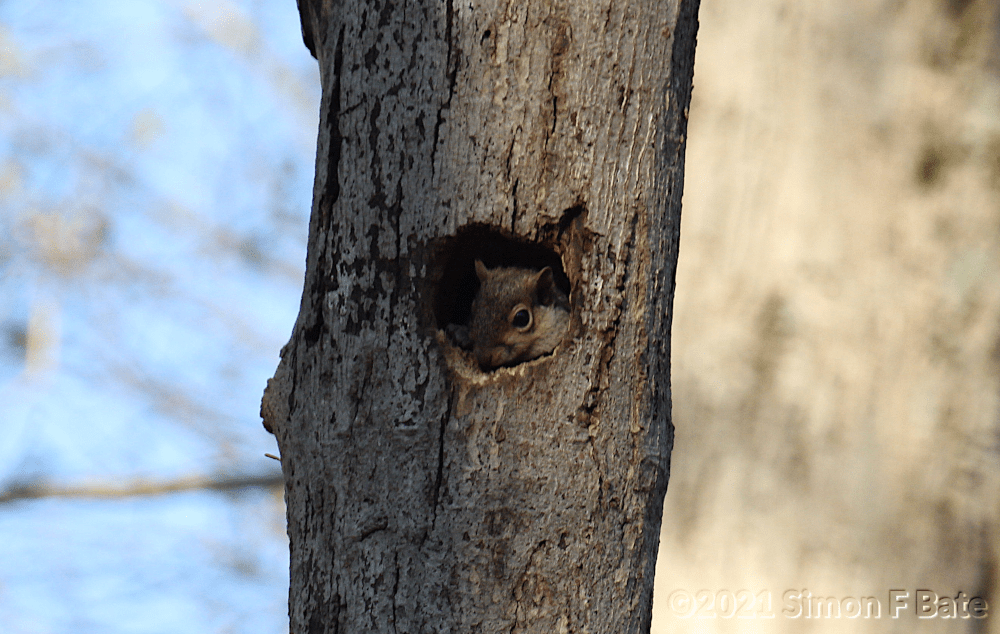
A pair of White-breasted Nuthatches have found a clever way to hide their nest from marauding Blue Jays. Their nest is built in right underneath (or behind) a squirrels’ nest. It’s quite close to the path (but fairly far up), so I hope they can brave all the people passing by.

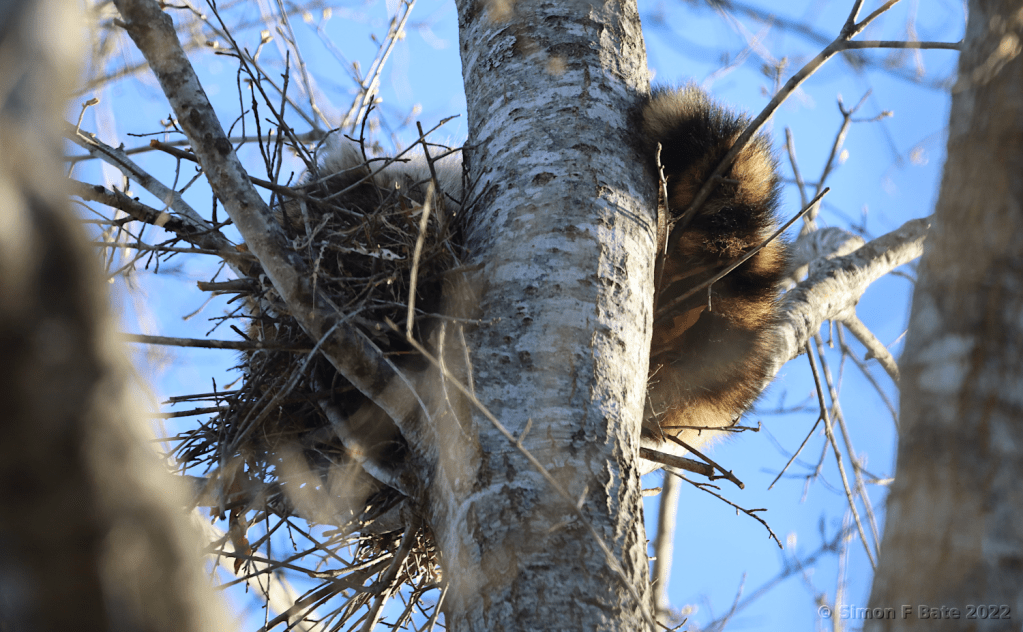
Speaking of mammalian nests… Not quite in the park, but by the Seagroves Farms club house, I found a raccoon sleeping in a rough nest of twigs. I don’t know if it slept through the day there, it was still sleeping there when I drove by a few hours later. I tried a number of different angles, but all I could really catch was its tail and the tufts of its ears.

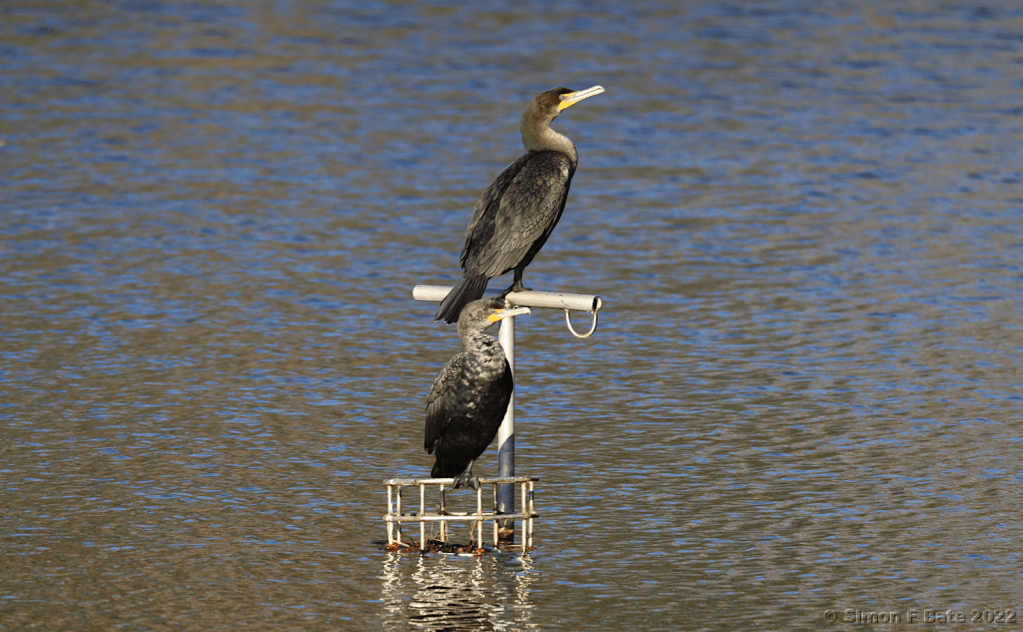
In the past few weeks, a number of Double-crested Cormorants have spent some time fishing in the pond. These two took a break to pose quite nicely. Cormorants are interesting birds. They fish by diving, so their bones are much denser than the bones of most birds. Because of their weight, they have a hard time gaining altitude when flying. You can watch them fly in a circle two or three times around the pond before they can clear the trees. Another curious feature of these birds are their blue eyes.

Sometimes there are things you can see in reflection in the pond that you can’t see directly. I’ve taken pictures of hidden Green Herons in reflection. This is the first time that I’ve caught a Great-blue Heron that way. I thought I was seeing a pair of Mergansers, but when I looked through my binoculars, I saw this Great-blue.

Let me know what you like. Follow me to get updates!

Mixed February

It has been an up-and-down month for photos. I downloaded pictures from an SD card the other day and noticed that at one point I had gone for five days without taking a single picture.

We had a stretch of gray days, but we’ve also had a fair share of birds. My daily species count is often in the high 20’s so that’s always satisfying. And the species I encounter varies greatly from day-to-day. One day I’ll see both Ruby-crowned and Golden-crowned Kinglets; another day and I won’t see any at all.

Northern Cardinal

Another thing that lends to higher counts is that there’s a lot of chatter around in the woods. The Northern Cardinals have picked up their science fiction sounds after a fall-through-winter hiatus. The Brown Thrashers are starting their twice-times imitations of other birds. I saw three different Eastern Phoebes this morning singing fee-bee-fee-bee-fee-bee. And Northern Flickers are calling to one another with their wicka-wicka-wicka cry.

The Barred Owl seems to be a regular visitor right now, as do the Double-crested Cormorants and the Belted Kingfisher. (I still haven’t been able to get close enough to the Kingfisher to get a good picture. I think it’s teasing me.) A Great-blue Heron has dropped in a few times.

Barred Owl

The owl (or owls) has become quite a thing around the pond. The other day I walked down the drive to look for it and there was a crowd gathered. That didn’t seem to disturb the owl as it has been back several times since then.

The owl is big enough that it’s hard not to notice. Here’s a much smaller bird that’s quite easy to miss. The coloration on the Brown Creeper is an excellent disguise. But if you know to look for a moving shape creeping up and around the trunk of larger trees, you’ll see one.

Brown Creeper

Let me know if you like what you see. Follow the site to get updates for new posts.

Glimmers of Spring

We’ve had a few days of warmer temperatures, which have attracted—or perhaps fooled—a few spring-time birds back to Seagroves Pond. One day last week I heard a Fish Crow and then later on I saw a Gray Catbird. The Catbird was puffed up to insulate itself and was clearly out of place.

The Fish Crow was a surprise in what I still consider to be winter. But since then I’ve heard several more with their nasal “haw-haw.” Fish Crows are much more common along the coast and venture inland to the Piedmont in the summer.

I don’t have any pictures of the Fish Crows. But it wouldn’t matter much, because, on sight, they’re indistinguishable from the American Crows that stick around all winter. The only way to distinguish one from the other is by listening to their caws. (I sense a future blog post with audio clips.)

However, we still have plenty of winter birds.

The Hooded Mergansers appear on the pond on colder days. Earlier this week I was able to get some good shots. The males are so flashy, they get a lot (too much?) of my attention. They also contrast with the woods around the pond, so it’s much easier to get a good “stand out” shot. The female has a remarkable appearance, but—by nature—blends in with the background much more. In these shots, the female was closer than normal and didn’t blend into the background as much as usual. (As usual, you can click on any of the images on this page to get a larger view.)

A pair of Golden-crowned Kinglets were browsing the shrubs near the dock this morning. The male kept his distance, but the female came in fairly close, allowing me to get a good look at it. The same one appears as the “featured image” for this post.

Although not a winter bird, I take pictures of Downy Woodpeckers whenever they’re close enough. This one is from just a few days ago.

What winter birds have you encountered around the pond?

Before I forget, next weekend is the Great Backyard Bird Count (February 18-21). This is a fun event that anyone can participate in. You don’t have to go to an assigned location or join a group of birders. You report the species and numbers of the birds you see in your yard (as the name says) or the birds you encounter on your walks (as I do). For more information, please visit their webpage: https://www.birdcount.org/

Let me know if you like what you see here; follow me to get updates about new posts!

Cold-weather Birds

I’ve often said that the best birding days around the pond are also the coldest. That may be related to another phenomenon I’ve noticed: when it gets really cold, the Hooded Mergansers appear on the pond.

Yesterday we had one of those cold mornings that bring out so many birds. With temperatures in the upper teens, it wasn’t surprising to see the Mergansers. But yesterday was so cold we had two pairs of Hooded Mergansers. In addition, a pair of Ring-necked Ducks showed up. To complete the set of birds found near water, I encountered Canada Geese, Mallards, a Kingfisher, and an Eastern Phoebe.

Normally the Mergansers are quite skittish and immediately head for the opposite side of the pond when anyone approaches them. The Ring-necked Ducks, on the other hand, weren’t worried about my presence at all. Somehow the Ring-necks had a calming effect on the Mergansers, so they stayed around, next to the dock.

It was hard to focus on the ducks, because there were a number of Kinglets gleaning insects from the shrubs by the dock. First I saw the Ruby-crowned Kinglet, then I noticed several pairs of Golden-crowned Kinglets. One of the males really put on a show for me, showing not just his golden crest, but the red highlights hiding under the crest.

On my way home, I encountered a Hermit Thrush, another species that always seems to appear when it gets bitingly cold. Unfortunately, it didn’t feel like posing for a picture.

All it all, it was one of my best days. I ended up counting 33 species, which ties my daily record.

Black and White Warbler Takes a Dive

When you first see a Black and White Warbler in action, you might assume it’s a nuthatch or creeper. Unlike other warblers, which tend to dart from one small branch to another, the Black and White Warbler will often land on the trunk of a tree (or a large branch) and search for insects there. Although nuthatches are the only birds that will walk down a tree, the Black and White Warbler comes close. It will turn upside down, but it won’t walk that way.

Here’s a B&W I spied the other day. I got a nice sequence of pictures of it getting inverted.

The same bird is on the cover of this post.

Bird maps are conflicted about the Black and White Warbler in the Piedmont. Some say it summers here; others say it winters here. I’ve seen them in both summer and winter, so perhaps they’re all right.

As usual, you can click on the images to see them larger. Leave me a like, or follow me for updates.

Happy New Year!

Updated Lists!

On the front page of my site, in the upper right-hand corner are two menu items: “Image Gallery” and “Bird Species.” If you click on the menu items (or even the links here), you’ll see, respectively, a gallery of my favorite pictures from previous posts and a list of the birds you might see at Seagroves Farm Park.

For the past few months I’ve been wanting to enhance the “Bird Species” lists; finally I’ve found some time to update them. In the old list, the entry for each family (or order) simply contained a bulleted list naming the birds. The categories have remained the same, but I have replaced the bulleted list with a table that details:

  • The species
  • How common (or uncommon) the bird is
  • How often I expect to see the bird.
  • When can you expect to see the bird
  • A small map showing the places where I most often see the bird

A couple of notes about the maps:

  • The color of my marks on the map indicates the season when the bird is present (Orange for summer, blue for winter, purple for year-round, and yellow for spring or fall migration).
  • Some species, such as vultures or winter ducks cover the entire map—or the entire pond. Others, such as Juncos or White-throated Sparrows, only appear in specific locations.
  • The maps includes portions of the Seagroves Farms townhouses (and the retention pond at the end of Haybarn Court). Although these areas are not a part of Seagroves Park, proper, but my daily walks take me behind the townhouses and past the retention pond. I see and photograph many birds there. Most species I see there are the same as the birds I see around the pond, but because it’s a nice walk, I thought I would include it in the maps.
  • The maps do emphasize the path of my walk. I don’t often walk up the other entrance paths to the park (from Old Grove Lane or Rainesview Lane). If you walk those paths and have further information about what species you see there, I’d love to hear it.

Of course, I couldn’t post a page without some pictures. Here are a Downy Woodpecker and Ruby Crowned Kinglet from Boxing Day. The cover image is a Northern Mockingbird, also from Boxing Day.

Birding: constant learning

One of the great things about science is that it teaches you that, when presented with new evidence, you can change your mind. I was reminded of this the other day, watching what I was sure was a Downy Woodpecker, but I now believe was a Hairy Woodpecker.

The two species look very much alike. Without getting up close and personal, the best ways to distinguish them are:

  • The Hairy is about two inches taller than the Downy (always difficult when you see a bird in isolation)
  • The eye of the Hairy Woodpecker is half-way between the tip of the bill and the back of the head; on the Downy it’s more like one third of they way from the tip of the bill.
  • (Probably the best visual distinction) The Downy has three dark bars on the outside edge of the outer tail feathers; the Hairy has entirely white outer tail feathers.
  • In addition to differences in appearance, the two species have different vocalizations.
Here’s a not-so-great detail of pair of Downy Woodpeckers. Despite image quality issues, the bird on the left shows the position of the eye, relative to the head; the bird on the right clearly shows the bars on the outer tail feathers.

Standing near the parking lot, watching the usual collection of Bluebirds, finches, warblers, and nuthatches, I saw a woodpecker. At first I thought it might be a Yellow-bellied Sapsucker, based on its size and the first markings I saw. However, looking closer, I didn’t see the long, white mark along its folded wing (the coverts) I would expect to see on a Sapsucker. Then I noticed that it looked a lot like a Downy Woodpecker, but the size was wrong.

Looking at it’s tail feathers, there were no dark spots on the outer feathers. It moved rapidly, and wasn’t particularly close, but I was able to get a pair of descent shots.

The thing is, I was convinced we had very few Hairy Woodpeckers around us. When I lived in California, they were quite common. I was quite familiar with many of their calls, many of which sound like the chirping vocalizations of a Carolina Wren. I haven’t heard those Hairy Woodpecker calls here, which led me to my assumption that they weren’t found here in Apex.

However both birds have a whinnying call. The difference is that the Hairy Woodpecker’s call stays at the same pitch, whereas the Downy’s call descends in pitch toward the end, making it sound like a tiny horse. An easy way to remember is “Downy goes down.”

Now, in light of new data, I’m willing to change my mind about Hairy Woodpeckers around Seagroves Pond.

So, now take a look at the cover image on this post. Which Woodpecker do you think it is?

Owl, Again

After I see the Barred Owl on its roost, I always wonder when (or if) I’ll see it again. I suppose I take so many pictures of it, because I’m never sure how long my luck will continue. The last time I saw it was a couple of months ago (I believe).

It was back again yesterday.

I say “it” but I have no way of knowing if it’s actually the same owl returning to the same spot, or one of a number of Barred Owls that all enjoy the roost from time to time. I haven’t been able to see any difference in appearance. However, with birds, all members of the same species will share some common traits, including markings.

Anyway, it put on a nice show for me, looking one way, then another.

I’ve encountered a number of other birds in the past couple of weeks. These few held still long enough for portraits. (I’ve captured countless blurry pictures of Ruby-crowned and Golden-crowned Kinglets. When I find a Kinglet that stays in my viewfinder for more than a nanosecond, I’ll put it in a post.)

Here are an Eastern Towhee, White-breasted Nuthatch, Pine Warbler, and a pair of Red-winged Blackbirds. I like that the Pine Warbler appeared in a spot of sunlight. The red wing isn’t often visible when Red-winged Blackbirds are roosting. I’m particularly pleased that the one on the left showed not just a patch of red, but an additional bar of yellow.

For all images on this page, you can click on the image to view it at a larger size.

Leave a comment letting me know what you like, and why. Follow me to get notifications of new pages.

Winter Birds Return

Two weeks ago I had a frustrating leg injury, so I had to take a few days off from walking. When I returned, I noticed a number of winter residents have arrived from their migration.

New are Myrtle (or Yellow-rumped) Warblers (the cover image for this post), flocks of Robins and Chipping Sparrows, Golden-crowned Kinglets, and today: Ruby-crowned Kinglets and White-throated Sparrows.

Here is a pair of Ruby-crowned Kinglets I saw this morning.

I like the female’s “Girl With a Pearl Earring” look. The male usually keeps his crown secret, noticeable only when looking straight down on the top of his head. However, when the female is around, he likes to keep the crest a bit more visible. As I’ve said before, Kinglets are the smallest birds we have, apart from hummingbirds.

At the other end of the size scale, is today’s Great Blue Heron. This one deserves a picture, because it modeled for me. As I walked around the pond this morning, several people asked me if I had seen the Great Blue Heron. I hadn’t at that point. After doing one circuit of the pond, I decided to take a look along the bank near the shelter, where some had reported seeing it last.

I was about to give up when I noticed a familiar shape through the shrubs. I watched it for a while, looking for a good gap in the vegetation so that I could get a clear shot. It looked like I wouldn’t get that shot, when to my surprise the Heron turned toward me and walked straight up the bank! (It was probably looking for a better way around the shrub. But I can still think it wanted to show off for me.) I used the opportunity and got a few shots, including the one here.

If you’re wondering about the borrowed lens, I decided not to go that direction. Although the 600mm reach was really nice to have, focusing (even with auto-focus) could be a real pain. Also, when looking through a narrow tube at trees, it’s often very hard to figure out exactly where you’re looking. At least with a zoom lens, it’s possible to zoom out a bit, establish your location and zoom back in again.

Verdict: fun and powerful lens, but not for me right now. I’ll write about the choice I made in the next post (if I remember).

More winter birds to arrive; I’m keeping my eyes open for the first Yellow-bellied Sapsucker of the season.

Borrowed Lens

Normally I use a 70-300mm zoom lens. It does what I need…most of the time. It’s a reasonable lens. Not too heavy, covers most lighting situations. But sometimes I want to get just a bit closer to the birds. I’ve been eyeing a couple of possibilities (a 600mm telephoto, or a 100-400mm zoom), but haven’t been sure how I want to go.

Rather than just wonder what it might be like to use another lens, I discovered it was possible to rent lenses. So, for the past few days I’ve been walking with a borrowed 600mm lens.

I’ve been quite impressed with what the lens has done. It’s not a perfect solution. The price is about right for me, but the price comes with two trade-offs: first, it’s a fixed focal length (so no zooming) and second it’s a fixed aperture (f/11), which is not common in a lens, but helps to keep the cost and weight down. The issue with such a small aperture is that it makes it harder to shoot in low-light conditions.

So far the weather has offered a mixed bag: some cloudy mornings, some sunny mornings, but the light hasn’t affected my pictures much.

The lens came in quite handy when a friend and I discovered that there were Turkey Vultures roosting in the trees above the north bridge. From the ground, it was hard to tell what we were seeing; just a dark elongated shape against a tree branch. But first through my binoculars, then through the borrowed lens, it was clear what we were seeing. The canopy near the north bridge is fairly high, at least 50ft, but through the long lens, the bird just about filled the image frame. The pictures here and on the cover are not cropped by much.

The lens has done fairly well for other, smaller birds. Here are an Eastern Phoebe, a Brown Thrasher, and a Northern Mockingbird.

The jury isn’t yet in on the lens; it is a little cranky when the light is low. I have another week to go. There’s a great deal of luck in photographing birds, so I’ll have to see what I find in the next few days.

The other lens I’m interested in might be harder to rent; it has only just been released, and is only available in limited numbers. Additionally, the global chip shortage has affected camera lenses as much as it has affected new automobiles.

Fall migration begins

Even before the mornings took a chilly turn, I started seeing a few fall migrants. So far, I’ve seen a Baltimore Oriole, Tennessee Warbler, and an American Redstart. I saw a pair of Common Yellowthroats, but it’s hard to say if they were migrants or they were summer residents who had finally made themselves known.

Here are a couple of views of the Redstart. It’s too far away for a “textbook” portrait, but close enough to be able to see the distinguishing characteristics (particularly the yellow patches at the base of its tail). I enjoy capturing in-flight pictures. Someone I follow on Twitter calls them “blurds.”

This morning brought a Great Blue Heron to the pond. They appear every couple of weeks. It’s hard not to take pictures of such a large, graceful bird, so I have photographs from just about every time one has appeared. This one fished around the south-east corner of the pond, which is where I got the cover image for this post. As I was walking to the dock, I heard the heron croak as it took flight. I thought I might find the heron on the dock, so I crept slowly down the ramp and found that my suspicions were correct. As luck would have it, the sun was almost directly behind it, so I had to play with exposures to capture something decent. But I’m happy with the result.

I also have many pictures of Red-bellied Woodpeckers, but when one lands close to me, it’s hard not to take a shot.

In closing, I witnessed an interesting display this morning. Two Cooper’s Hawks were attacking a small flock of American Crows (four or five individuals). It was hard to tell exactly what was going on. I’m not sure if the hawks were displeased with the crows, if they were trying to single a crow out as a meal, or if the crows were unhappy with the presence of the hawks. One of the hawks was a juvenile, so perhaps the adult was watching over it as it practiced its hunting skills.

More mysterious, neither one wanted to leave. The crows huddled together, but didn’t fly away. The show went on for 10 minutes or so. Eventually the crows flew off, one-by-one. The hawks were still there as I walked away. Unfortunately all the action took place much too far up in the trees (and strongly backlit), so there was no chance to get a good picture. I realized later that perhaps if I had used the video on my camera, I might have been able to capture some of it. C’est la vie. Perhaps next time.

Leave me a comment or a like. Let me know what you think might have been going on between the hawks and the crows.

August Doldrums

Well, it’s August and, as expected, many of the birds have gone into seclusion. They’re still there (in fact this morning, my species count was 20), but they’re not as visible as they are the rest of the year. Because they’re not visible, it’s much harder to take pictures of birds. Thus, this post has more insects and other creatures than my usual posts.

The Green Herons seem to have departed for the season. Last year they hung around until the first week in September. This year, they were gone by the first week in August. Also nowhere in sight are the Tree Swallows and the Kingbirds. (However, there are dozens of Tree Swallows—along with Bank Swallows and Barn Swallows—at Howling Cow Creamery on Lake Wheeler Road).

One bird does make an appearance in August: the Blue-gray Gnatcatcher (cover picture, and another in the gallery below). They’re almost worse to photograph than Kinglets. They’re constantly on the move, and often prefer to be under the cover of shrubs or bushes.

As usual, you can click on an image to see a larger version.

I wonder how much longer the dead pine tree (across Parkfield Drive) will stand. There are just a few stubby branches left at the top, but it seems to be enough for the occasional Turkey Vulture to sun itself. In the lower reaches of the pine are the branches where I saw the Barred Owl for many days running this winter. I’m hoping those branches hold up for a while longer, and I’m hoping the owl returns.

If can tell me what insect laid these eggs, I’d like to know. They’re really quite small, about 2-3mm high.

What can I say? I’m a sucker for taking pictures of butterflies. I probably have as many pictures of Tiger Swallowtails as I do of Red-bellied Woodpeckers.

The Long-jawed Orb Weaver is often seen in the corners of the dock. It took me a while to identify it. Unfortunately, most of the pages on spider identification focus on the poisonous spiders. The more obscure orb weavers need to increase their social media visibility!

Like what you see? Leave me a comment. Please feel free to share this site with others!

Look Left!

Here are a few pictures from last week. As it turned out, in all the images I liked best, the subjects are looking to the left of the frame.

This fledgling Green Heron has just about lost all of it’s fluff, with just a bit remaining on top. I saw it and its siblings perched on the dock for the last week or so.

This site isn’t entirely about the birds around the pond. I was chatting with one of my fellow walkers near the dock, when I noticed a doe and fawn not far from us. They must have been there the entire time we were talking.

This old pine tree, across Parkfield Dr. from Seagroves Park, has been steadily losing its branches. But there’s enough space for a Turkey Vulture. I’ve seen other vultures (such as this Black Vulture) on the tree, when there was more to land on:

Summertime…

I haven’t posted much of late, mostly because I haven’t taken many pictures that I thought were worth sharing.

As I’ve said before, once mating is over and the birds are about the business of feeding the young, their level of visibility decreases sharply. Also, with the thick foliage on the trees, there aren’t as many opportunities to photograph birds.

However, they do emerge from time to time. The young Green Herons like to climb trees. Tree Swallows compete for landing spots. Red-bellied Woodpeckers occasionally drop low enough for pictures. And Kingbirds are attracted to the signs around the pond (I like that the one at the bottom of the gallery looks like it’s trying to read the sign).

Finally, I’d like to thank the Town of Apex for erecting two stations for used fishing line. Since they have appeared, I haven’t seen any line left behind on “the dock.” It doesn’t necessarily solve the problem of casts abandoned in the shrubs surrounding the pond, but it’s a start.

…and one more.

Here’s another bird to add to the list of birds found around Seagroves Pond: a Magnolia Warbler. I loitered under the tree for a good long time trying to see the bird in the open. They’re extremely active, constantly moving. When it did emerge from behind the leaves, it wasn’t ever in a perfect spot, but I’ll take what I can get.

The same goes for this Red-eyed Vireo. Usually you find them just under the canopy of tall trees. I was lucky this one found some lower branches; this is the lowest I’ve ever seen one. Even so, it remained in shade and spotty sunlight, so the image is good, but not great.

Add Another Species

This morning brought another new sighting around the pond: a pair of Tree Swallows. We often get the occasional Bank Swallow in the spring, they’re probably the most common swallows you’ll see in our area. But a Tree Swallow is a new one (for me).

Speaking of “new,” I happened across a family of Eastern Phoebes beside one of the retaining ponds in the Seagroves neighborhood. It’s close enough to the park—and part of my walk—so I count is as part of the park. Momma phoebe was doing all she could to keep all three of the little ones fed.

The other pictures in today’s post? Well, I can’t help myself with Eastern Bluebirds, I loved it that the Red-bellied Woodpecker showed it’s back so beautifully, and the lines of a silhouetted Great Blue Heron are always gorgeous.

I’ll have to count again, but I think the Tree Swallows bring my list of species I’ve encountered around the pond to 86. Or maybe 87. I don’t think I added the White-eyed Vireo I saw the other day at the retaining pond where the phoebes were feeding.

It’s “Real” Spring

There’s a meme going around about the seasons in North Carolina in which Spring makes several deceptive feints to warm temperatures. Then, following “The pollening” or “The yellowing” (depending which version you see) comes “Real” Spring.

Well, “Real Spring” is here. Not just in birds, but flowers and butterflies, too. (Bullfrogs and turtles too, but I don’t have any pictures of them…yet.)

The Eastern Kingbirds have shown up (cover photo, as well as shown in the gallery here), along with Great Crested Flycatchers. The Common Yellowthroats have come out of hiding, and birds all over are hatching their young.

Also seen around the pond, a Red-eyed Vireo (the pictures weren’t worth showing) and a White-eyed Vireo (too shy to be photographed).

Like what you see? Leave a comment!
Want to get notified when I post? Follow me!

“Sitting on the dock of the bay…”

This morning a Great Blue Heron decided to sit on the dock. It stayed there the whole time I was walking around the pond. I saw others—like me—sneak down the ramp and take a quick picture or two, but the Heron was (heh, heh) unflappable.

I have a couple of postscripts to this weekend’s sad story (a Green Heron was killed when it got caught in some abandoned fishing line). I took some pictures of the dead bird but I couldn’t bring myself to process them, or post them.

  • I called the town’s Parks and Rec department. A sympathetic person there said she would have a maintenance crew come out to help clean up the fishing line. I do hope they attend to it soon.
  • This morning, another pair of Green Herons was flying around the pond, perhaps looking for a nesting site. (There was probably a realtor Green Heron somewhere with them.)

Mid-April Mornings

Here are a few images from this last week. I think there are two nesting pairs of Green Herons around the pond. There may be more.

On Thursday I saw the season’s first Great Crested Flycatcher. It took me a while to realize it was the “Real McCoy” because you can hear a Brown Thrasher near the picnic shelter that has a spot-on imitation of a Great Crested Flycatcher’s “que-EEEEP” call. Photographing these flycatchers is challenging, because they spend most of the their time in the tree tops.

The Chipping Sparrows are trying their best to imitate Pine Warblers. And one or two wild Azaleas are blooming in the undergrowth. There’s also a trumpet vine of sorts blooming near the path, but it’s also close to one of the Green Heron nests, so I don’t want to disturb them.

Birds, out and about

Not many words. Just a few birds from around the pond…and one not.

I found the Eastern Meadowlark at Howling Cow Dairy on Lake Wheeler Road. I grew up with Western Meadowlarks on the plains of Colorado. This is the first time on the East Coast that I’ve encountered their eastern cousins.

Like something? Leave a comment! Want to receive updates? Follow me!

Shameless promotion: let your friends know about seagroveswalks.org.

Cooper’s Hawk

To identify a hawk “on the wing,” the first thing to look at is the length of its tail.

We have three common hawk species in our area: Red-shouldered Hawks (as I’ve been photographing for the past few weeks), Red-tailed Hawks, and Cooper’s Hawks. The Red-shouldered and Red-tailed Hawks belong to the genus Buteo. They’re larger, stockier hawks, with shorter tails.

Cooper’s Hawks belong to the genus Accipiter. These hawks are slightly smaller and sleeker, having noticeably longer tails. There is another accipiter found in our area: the Sharp-shinned Hawk; they are almost indistinguishable from Cooper’s Hawk, but they’re much less common. If you see a long-tailed hawk flying low through the shrubs and trees of your neighborhood, chances are it’s a Cooper’s Hawk.

I saw this one this morning. It flew quite close to me as I walked away from my house. It disappeared behind a neighbor’s house and I figured that was the last I would see of it. (I considered myself lucky to catch the glimpse that I did.)

More luckily, two or three houses down the street, the hawk flew out from between two houses and alit in a Crape Myrtle, right on the street. I took a couple of quick pictures, then walked slowly down the street to get a clear shot. The male Cooper’s Hawk stayed in the shrub long enough for me to get a couple of good pictures, then took off between the houses across the street. I can tell it’s a male from the color of the back of its head and nape of its neck.

OK. Technically, this isn’t from “around the pond” (and neither is the Barred Owl I see from time-to-time), but it’s close enough.

A New Visitor

One of the real joys of walking around Seagroves Pond every day is in seeing something new.

Today’s “new” sighting was a Killdeer that flitted around the parking lot and across the grassy strip over the dam. I don’t think it has a nest quite yet. In fact, I think I only saw one. Who knows what tomorrow may bring.

The Killdeer is a member of the Plover family and is well-known for feigning injury to draw possible predators (you and me) away from its nest. Its odd name comes from its shrill, two-syllable cry.

I can now add the Killdeer to my list of birds sighted around the pond. You can see the list here. Currently it’s just a simple list, but my plan is to expand it and add details about each bird, including where you might see them, how often, in what seasons, and so on.

Another joy is seeing a bird that I haven’t seen in a while. Today I also saw a Hermit Thrush along the northern path. I’ve seen them there before. I’m trying to recall, but I think it has been more than a year since I last saw a Hermit Thrush in the park. Encountering it reminded me of one of the things I tell myself whenever birding: look at every bird. The reason is simple; when you see many birds, there is a tendency to dismiss a bird or gathering of birds as relatively common species. It’s in looking at every bird that helps me see the rarities.

In this case, as I walked along the path, I thought I saw an American Robin. It would make sense, as there are many Robins in the area right now. And Robins are the most common bird I see along the northern path. But I looked again. Something wasn’t quite right. It seemed smaller than most Robins, and a duskier color. Through the binoculars, I instantly recognized what it was (although its turning toward me to show its spotted breast was also a dead giveaway).

For the “aw ain’t it cute” file, I saw this squirrel peeking out of a former woodpecker hole. It’s not the same hole, but just a few feet higher in the same tree I saw a couple of Flickers drill a hole and raise a little one.

I’m not sure what’s going on with the Red-shouldered Hawks’ nest. They haven’t been around for a couple of days, but I hear them from time to time. Perhaps this year isn’t the year for them. We’ll see.

The “Greenies” are Back!

Around the end of March the Green Herons show up around Seagroves Farm Pond.

Last Tuesday, I looked down toward the pond from the North path (I have a few other names for it, mostly due to the fact that I see so few birds along it) and saw a familiar shape walking along the water’s edge.

Wednesday, I didn’t see a Green Heron, but heard a familiar “skeow” call from just south of the dock.

Thursday, a pair was flying around and both alit in a tree close to the picnic shelter.

There I took the picture at the top of this post, and this one—which I had to enhance somewhat—in which the Green Heron look a great deal like a pterodactyl.

While they live around the pond, we can expect the couples to have two to three clutches of nestlings. Look around the bushes edging the pond and you might see something like these characters:

Green Heron nestlings from 2017

The “Greenies” will be with us until late-August or early-September, when they return to the coast or other warmer climates. I’m still not quite sure why they leave so early, as the warm weather continues well into October. Perhaps when they’re done having chicks, it’s time to go.

I’ll have to read more.

Cloudy Sunday; Irresistible Subjects

Some mornings just bring the right set of elements (or birds) together for photographs. The one element I’m always wishing for—the Sun—decided to hide behind the clouds. But there were a number of birds that just had to be photographed.

It has been a few days since I processed pictures, so there are two here that are from a few days ago, but the other five were from today’s walk.

You can click on any of these images to see a larger image. (Comments follow the image gallery.)

The Eastern Towhee was the first one I encountered this morning. He landed and posed so close to me, I had to give him a session.

Soon after, I saw three Black Vultures circling near me. The sky gave strong contrast, but after some adjustment, you can see the white wingtips. I was thinking about how Black Vultures can be mistaken for Bald Eagles and talking to a friend, when she pointed out the Black Vultures again, behind me. I turned to look at them, then noticed a fourth that wasn’t flying like the Vultures: a Bald Eagle! This one seems to be mid-molt, also, the darker tail causes me to wonder if it’s a younger eagle. They take about 4-5 years to come into their full black and white plumage.

The Red-shouldered Hawks continue to add to their nest. The female was pulling twigs off nearby trees and bringing them back to the nest.

The Barred Owl was back in its same old tree. I must have dozens of pictures of it now, all looking about the same. But every time I see it, I can’t resist the urge to take a few more.

The great lighting and corresponding shadow tells you the White-breasted Nuthatch photo wasn’t taken this morning (it was taken last Sunday). Nuthatches are the only birds that walk down trees.

Finally—also taken last Sunday—is a Myrtle Warbler, showing off quite nicely why some birders affectionately call them “Butter Butts.”

[Unusual species from today’s walk: Black Vulture, Bald Eagle, Great Crested Cormorant, Barred Owl]

Hawks’ Nest

Last week a number of us saw a male Red-shouldered Hawk performing courtship displays. It was fantastic to see him tuck his wings in while he dived and swooped.

It looks like he’s settling down with a mate. A couple of days ago I saw a Red-shouldered Hawk swoop up to a tree in the woods. Then I noticed the pile of leaves it alit upon. A minute or so later another hawk flew up and they “conversed.”

One or the other of the hawks seems, ahem, a little under-aged. The stripes on the upper breast of this bird indicate it’s a juvenile. Time to do some reading on Red-shouldered Hawk life histories.

It would be nice to see this pair raise some chicks. But it might not happen this time around.

Better Cedar Waxwing shots, the Owl returns (and again), Kingfisher gets brave

The past few days have turned up some great shots.

The Barred Owl keeps returning to the same branch. Thursday and Friday, it was back again. It must feel comfortable there, despite the nearby traffic.

Belted Kingfishers can be very shy birds (unless they’re laying claim to territory, in which case they can be oblivious to all, but other Kingfishers). This one was flying around the pond, chattering as usual, and alit closer than usual—still a stretch for my 300mm lens.

In my post of Cedar Waxwings in an ice storm, I regretted that the picture quality was rather low. As if to make up for last week’s bad timing, they showed up again on Friday. At first I thought they were only in the front of the house, but when I got inside, I saw that they were in our back yard, too. I took a few pictures through the windows, but not being satisfied with them, I took a chance on opening our back door. Unlike the skittish Kingfisher, the Waxwings really didn’t mind whether I was there or not. I was happy about their position: close by, not silhouetted against the sky, and showing the tips of their tails quite nicely. There’s even a red wing tip in the shot.

Now I want to clean the bird bath, in case we get a repeat.

Click on the images to see them larger. Leave me a comment!

Cedar Waxwings in an ice storm

We had an ice storm (of sorts) this morning. The ice only gathered on trees, but it was rainy, miserable, and cold. I didn’t even go for my walk, because it was so awful.

Later on, as I was working, I looked out the window and saw that all the trees I could see were filled with Cedar Waxwings. I saw a large-ish flock a couple of days ago, while walking, but that was nothing compared to this onslaught. I’m estimating somewhere around 250 individuals, but perhaps more. I couldn’t see all our trees; now I wonder if there were even more birds than I thought.

The usual apologies about the images. The light was poor, and I took these through a window that (admittedly) needs cleaning. Click on an image to see a larger version. Like something? leave me a comment (below).

Golden-crowned Kinglets

There’s another, serious, post in the works, but I want to add this “informal” page.

I took a number of good pictures of several different species on today’s walk. As a rule, I try to limit myself to one, or sometimes two pictures of a bird. However, when I got to processing the pictures of these Kinglets, I just couldn’t decide which one to post. Instead you’re seeing many of the good images.

I’ve been trying to capture the male’s flaming head for a while; these are the best I’ve taken to date.

Kinglets are the smallest birds we have in NC, apart from Ruby-throated Hummingbirds. The Golden-crowned Kinglet is just a bit smaller than the Ruby-crowned.

Click on an image to see it larger. Want to make a comment? Leave me a note (scroll to the bottom of this page).

A 30-Bird Day

Today was a 30-bird day.

What does that mean?

Each morning I walk, I count bird species (rather than individuals). I count the species that I see and the species I can identify by their sounds (more on that in another blog post). I average 20-species a day; sometimes more, sometimes less. But, thus far, 30 species is my maximum. I’ve hit the number several times, but have yet to go over it.

Continue reading “A 30-Bird Day”

Meet the Birder

I’m the guy you see every morning with binoculars and SLR (usually) slung over my shoulder.

I created this blog to share my pictures, thoughts, and experiences in Seagroves Farm Park. The park is a treasure, a jewel. It is host to many plants, birds, mammals, amphibians, and reptiles that are there to be appreciated. Any time of year, there is something to notice in the park, if you’re ready to see it.

How did I get here? I’ve had a life-long interest in the natural world. I grew up in the mountains above Boulder, Colorado, where we had acres and acres of land (very little of it level) to roam around. This and many other factors lead me to a degree in Geology from the University of Colorado. The science was cool (always an important factor), but what was almost more important to me was being able to be outside. Sure, we looked at formations, deposits, intrusions, deformations, contact zones, and many other delights of field geology, but also I could look around me and take in the trees, the birds, the skies, and all of nature.

Sad to say, once I graduated, I never did a day’s work in geology. But I retained my interest in flora and fauna wherever I lived.

Which brings me to Apex. My wife, son, and I live in Waterford Green, fairly close to the southern park entrance on Parkfield Drive. My morning walk from door to door, around the pond is almost exactly a mile. I try to make the walk every morning, no matter what the weather. There’s always something different awaiting me. And interesting weather often brings out interesting photographs.

That’s all for now. If you see me stop and say “Hi!” (at a safe social distance).